

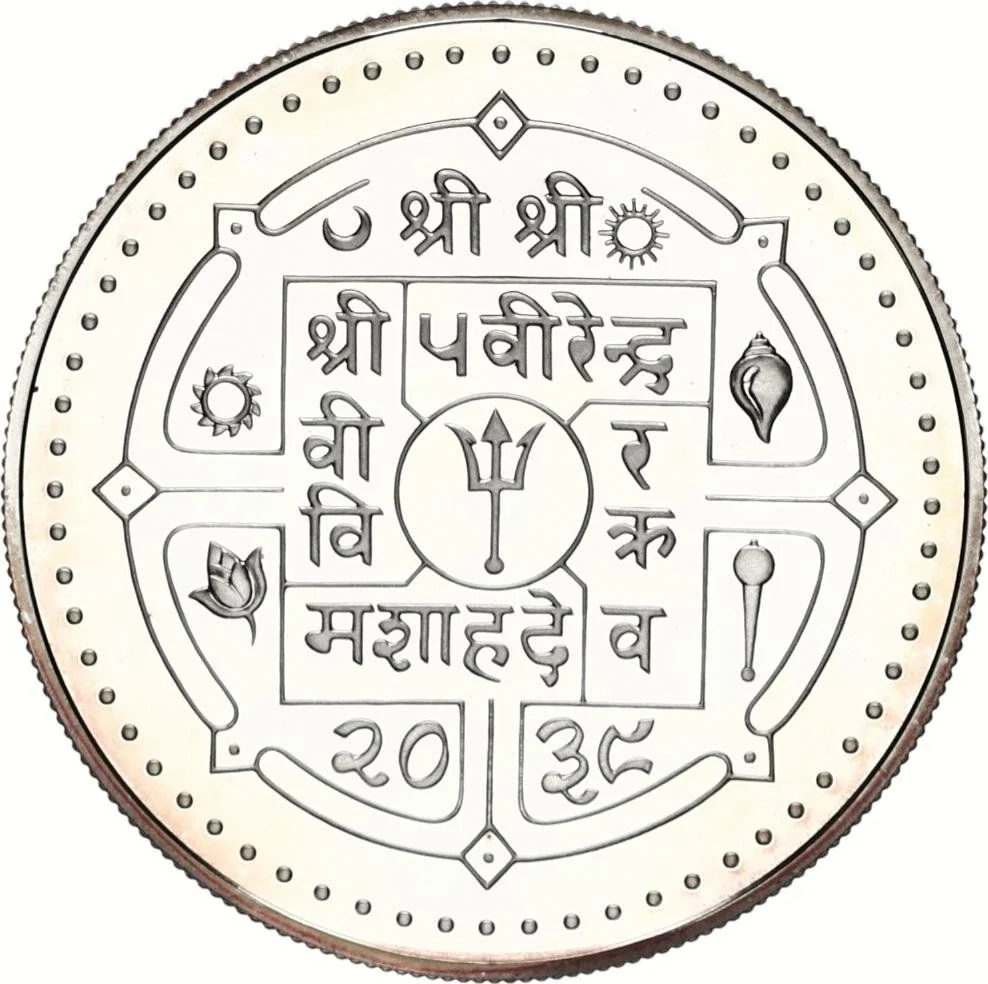
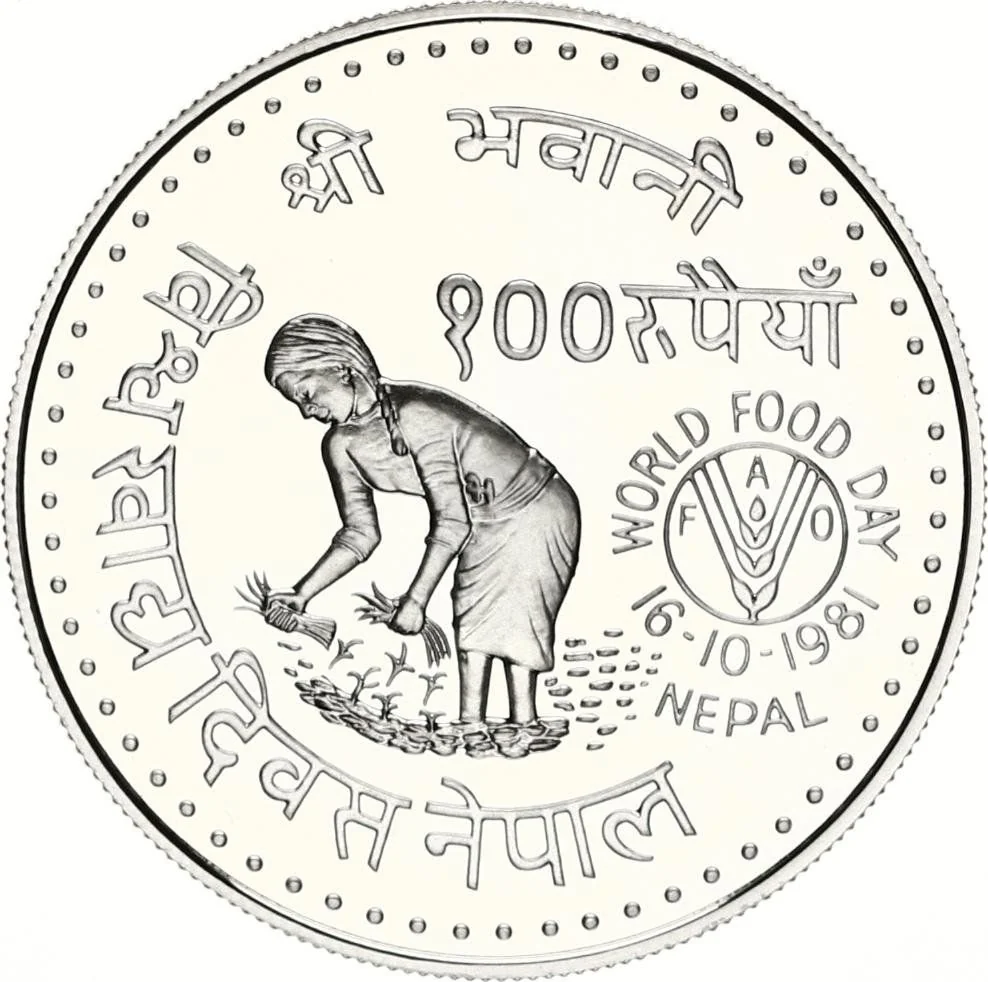
100 Rupees – Nepal
Non-circulating coins
Commemoration: World Food Day - FAO
Nepal
Context
Year: 1982
Vikram Samvat Year: 2038
Issuer: Nepal 
Ruler: Birendra Bir Bikram Shah
Currency:
(since 1932)
Material
References
KM: #Click to copy to clipboard850.2
Numista: #360146
Value
Exchange value: 100 NPR
Bullion value: $68.30
Obverse
Reverse
Edge
Reeded
Categories
| Organization> FAO |
Mints
| Name | Mark |
|---|---|
| Royal Mint | — |
Mintings
| Year | Mint Mark | Mintage | Quality | Collection |
|---|---|---|---|---|
| 1982 | — | — | Proof |
Historical background
In 1982, Nepal's currency situation was characterized by a tightly controlled and fixed exchange rate regime, operating within a broader context of economic isolation and planned development. The Nepalese rupee (NPR) was pegged solely to the Indian rupee (INR) at a fixed rate of 1.45 NPR to 1 INR, a parity established in 1960. This peg was a cornerstone of the 1960 Trade and Transit Treaty with India, reflecting Nepal's deep economic integration with its southern neighbor. The system was highly restrictive; all foreign exchange transactions were monopolized by the Nepal Rastra Bank (the central bank) and a few authorized commercial banks, with severe limitations on convertibility for capital account transactions. This control aimed to conserve scarce foreign reserves and direct resources toward state priorities.
Economically, the early 1980s were a period of stagnation for Nepal, following the completion of its Fifth Five-Year Plan (1975-1980). The country remained one of the world's poorest, with an economy heavily reliant on agriculture and remittances from Gurkha soldiers serving abroad. The fixed peg to the Indian rupee, while providing stability for bilateral trade, also imported inflation from India and limited Nepal's independent monetary policy. Furthermore, a significant black market for foreign exchange, particularly for hard currencies like US dollars, operated alongside the official channel, indicating a disparity between the official rate and market pressures.
Politically, the currency regime existed under the partyless Panchayat system, which emphasized economic nationalism and self-reliance. The government maintained strict capital controls to prevent outward flows. However, by 1982, pressures for economic liberalization were beginning to build, influenced by global trends and the need for foreign investment. The situation would remain largely unchanged until the mid-1980s, when a major economic reform program, including a shift to a multi-currency basket peg in 1985, began to dismantle this tightly controlled system, setting the stage for future financial sector liberalization.
Economically, the early 1980s were a period of stagnation for Nepal, following the completion of its Fifth Five-Year Plan (1975-1980). The country remained one of the world's poorest, with an economy heavily reliant on agriculture and remittances from Gurkha soldiers serving abroad. The fixed peg to the Indian rupee, while providing stability for bilateral trade, also imported inflation from India and limited Nepal's independent monetary policy. Furthermore, a significant black market for foreign exchange, particularly for hard currencies like US dollars, operated alongside the official channel, indicating a disparity between the official rate and market pressures.
Politically, the currency regime existed under the partyless Panchayat system, which emphasized economic nationalism and self-reliance. The government maintained strict capital controls to prevent outward flows. However, by 1982, pressures for economic liberalization were beginning to build, influenced by global trends and the need for foreign investment. The situation would remain largely unchanged until the mid-1980s, when a major economic reform program, including a shift to a multi-currency basket peg in 1985, began to dismantle this tightly controlled system, setting the stage for future financial sector liberalization.
✨ Legendary