

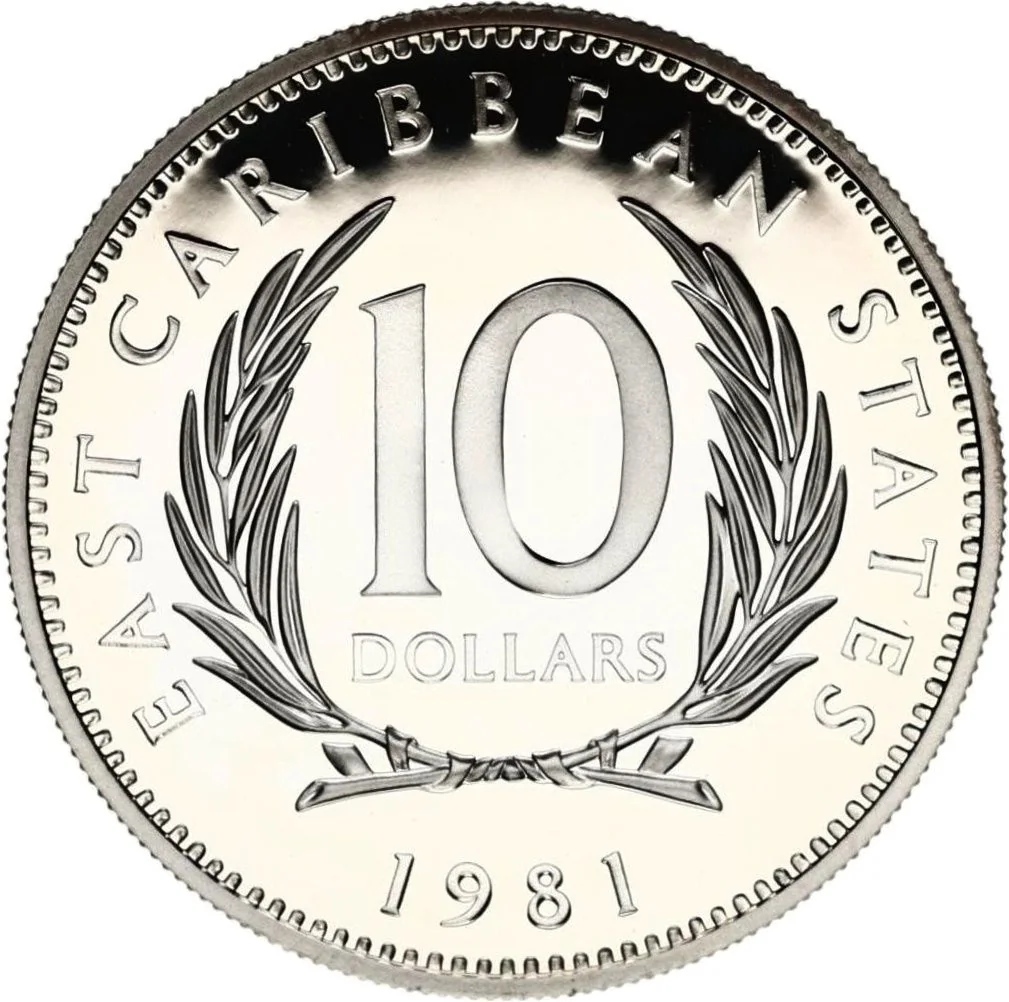
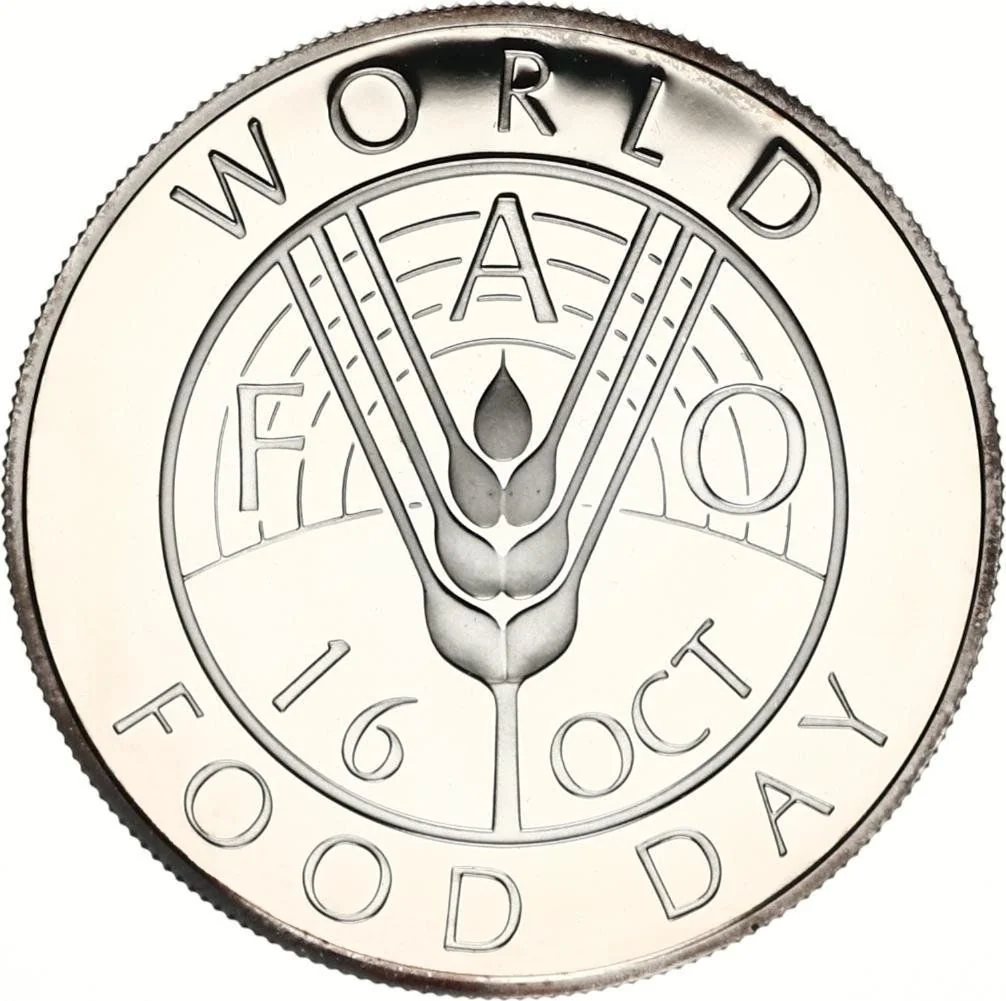
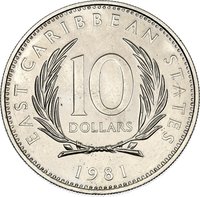
10 Dollars – Eastern Caribbean States
Non-circulating coins
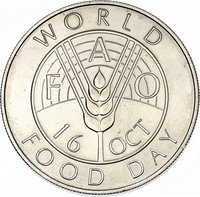
Commemoration: World Food Day
Context
Year: 1981
Issuer: Eastern Caribbean States
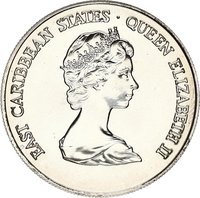
Ruler: Elizabeth II
Currency:
(since 1965)
Total mintage: 15,000
Material
References
KM: #Click to copy to clipboard16a
Numista: #360131
Value
Exchange value: 10 XCD
Bullion value: $40.20
Obverse
Reverse
Edge
Reeded
Categories
| Organization> FAO |
| Symbol> Wreath |
Mints
| Name | Mark |
|---|---|
| Royal Canadian Mint of Ottawa | — |
Mintings
| Year | Mint Mark | Mintage | Quality | Collection |
|---|---|---|---|---|
| 1981 | — | 10,000 | ||
| 1981 | — | 5,000 | Proof |
Historical background
In 1981, the currency situation for the Eastern Caribbean States was defined by a period of transition and institutional consolidation. The region was moving away from the colonial-era British Caribbean Currency Board, which had issued the Eastern Caribbean dollar (EC$) at a fixed parity of EC$4.80 to £1 sterling. This system provided stability but offered little flexibility for independent monetary policy. Following the independence of several member states and the dissolution of the West Indies Associated States, the need for a regional monetary authority managed by the islands themselves became paramount.
This need led to the establishment of the Eastern Caribbean Central Bank (ECCB) in July 1983, a process that was actively being negotiated and prepared for throughout 1981. Therefore, the year can be seen as a final preparatory phase under the old currency board system, with significant work underway to create the new central bank. The core objective of this move was to maintain the cherished fixed exchange rate and currency stability—a critical feature for these small, open, tourism-dependent economies—while gaining a mechanism for greater regional oversight, liquidity support, and financial development.
Consequently, the monetary landscape in 1981 was one of continuity on the surface, with the EC$ remaining firmly pegged (and soon to be re-pegged to the US Dollar at US$1 = EC$2.70 in 1976), but with foundational changes being set in motion. The key discussions involved transferring currency issuance and regulatory authority from London to the region, headquartered in St. Kitts. Thus, the situation was stable for users of the currency, but institutionally, it was the calm before the formal launch of a new era of centralized monetary cooperation embodied by the ECCB.
This need led to the establishment of the Eastern Caribbean Central Bank (ECCB) in July 1983, a process that was actively being negotiated and prepared for throughout 1981. Therefore, the year can be seen as a final preparatory phase under the old currency board system, with significant work underway to create the new central bank. The core objective of this move was to maintain the cherished fixed exchange rate and currency stability—a critical feature for these small, open, tourism-dependent economies—while gaining a mechanism for greater regional oversight, liquidity support, and financial development.
Consequently, the monetary landscape in 1981 was one of continuity on the surface, with the EC$ remaining firmly pegged (and soon to be re-pegged to the US Dollar at US$1 = EC$2.70 in 1976), but with foundational changes being set in motion. The key discussions involved transferring currency issuance and regulatory authority from London to the region, headquartered in St. Kitts. Thus, the situation was stable for users of the currency, but institutionally, it was the calm before the formal launch of a new era of centralized monetary cooperation embodied by the ECCB.
💎 Extremely Rare