

3000 forint – Hungary
Add to wishlist
Non-circulating coins
Commemoration: Hungarian counties and county seats
Hungary
Context
Year: 2022
Issuer: Hungary
Issuing organization: Magyar Pénzverő
Period:
(since 1989)
Currency:
(since 1946)
Total mintage: 10,000
Material
References
Numista: #359450
Value
Exchange value: 3000 HUF
Inflation-adjusted value: 4298.28 HUF
Obverse
Description:
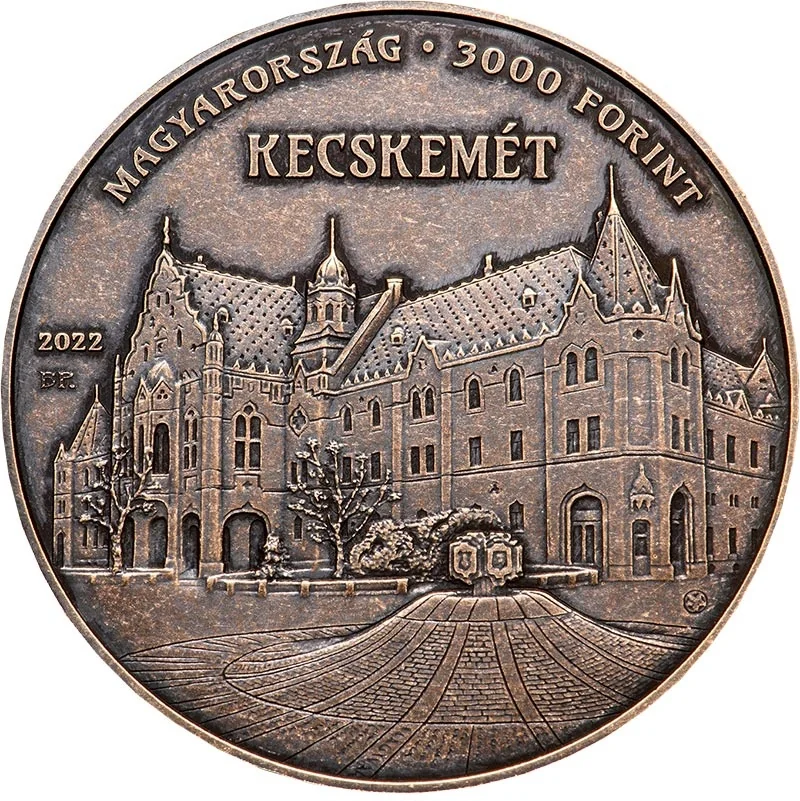
Kecskemét City Hall facing Kossuth Square.
Inscription:
MAGYARORSZÁG - 3000 FORINT
KECSKEMÉT
2022
BP.
KECSKEMÉT
2022
BP.
Translation:
HUNGARY - 3000 FORINT
KECSKEMÉT
2022
BP.
KECSKEMÉT
2022
BP.
Script: Latin
Language: Hungarian
Designer: Gábor Kereszthury
Reverse
Description:
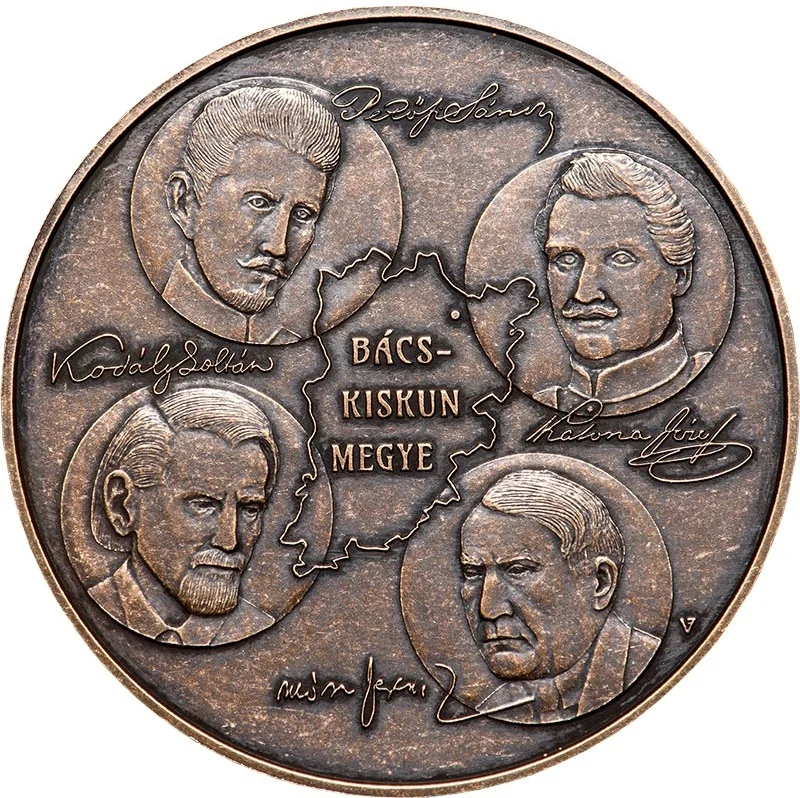
The reverse features portraits of Sándor Petőfi, József Katona, Ferenc Móra, and Zoltán Kodály, each circled and accompanied by their signature. They are arranged clockwise within the county's border, where a dot marks Kecskemét. Designer Fanni Vékony's mark is beside Ferenc Móra.
Inscription:
Petőfi Sándor
Kodály Zoltán - BÁCS-KISKUN MEGYE - Katona József
Móra Ferenc
Kodály Zoltán - BÁCS-KISKUN MEGYE - Katona József
Móra Ferenc
Translation:
Sándor Petőfi
Zoltán Kodály - BÁCS-KISKUN COUNTY - József Katona
Ferenc Móra
Zoltán Kodály - BÁCS-KISKUN COUNTY - József Katona
Ferenc Móra
Scripts: Latin, Latin (cursive)
Language: Hungarian
Designer: Fanni Vékony
Edge
Legend:
MAGYARORSZÁG MEGYÉI, MEGYESZÉKHELYEI
Translation:
COUNTIES OF HUNGARY, COUNTY SEATS
Language: Hungarian
Categories
| Building> Governmental building |
| Map |
Mints
| Name | Mark |
|---|---|
| Hungarian mint | BP |
Mintings
| Year | Mint Mark | Mintage | Quality | Collection |
|---|---|---|---|---|
| 2022 | BP | 10,000 |
Historical background
In 2022, Hungary faced a severe currency crisis, with the Hungarian Forint (HUF) becoming one of the world's worst-performing currencies. The forint plummeted to historic lows against the Euro, repeatedly breaking the 400 HUF/EUR barrier and even approaching 430 at its weakest point in October. This dramatic depreciation was driven by a "perfect storm" of external and internal factors, including the economic fallout from the war in Ukraine, soaring energy prices, and a broader global shift away from risky emerging market assets amid aggressive interest rate hikes by major central banks like the U.S. Federal Reserve.
Domestically, the situation was exacerbated by a protracted dispute with the European Union over the rule of law and the withholding of billions in recovery funds, which undermined investor confidence. Furthermore, the Hungarian National Bank (MNB) faced a complex policy dilemma: while it aggressively raised its base interest rate to a region-high 13% to combat inflation and support the currency, it also introduced a series of unconventional measures. Most notably, it launched a temporary "quick deposit" facility with an even higher rate (up to 18%) to mop up excess liquidity, which was seen as a sign of market stress and created a two-tiered interest rate system.
The currency weakness directly fueled Hungary's skyrocketing inflation, which peaked at over 25% in early 2023, severely eroding household purchasing power. The government responded with price caps on essential foodstuffs and fuel, but these measures further distorted the market. By the end of 2022, intense monetary tightening and a preliminary agreement with the EU on funding conditions helped the forint recover significantly from its lows. However, the year left a legacy of high inflation, slowed economic growth, and increased costs for the state, businesses, and citizens servicing foreign-currency debts.
Domestically, the situation was exacerbated by a protracted dispute with the European Union over the rule of law and the withholding of billions in recovery funds, which undermined investor confidence. Furthermore, the Hungarian National Bank (MNB) faced a complex policy dilemma: while it aggressively raised its base interest rate to a region-high 13% to combat inflation and support the currency, it also introduced a series of unconventional measures. Most notably, it launched a temporary "quick deposit" facility with an even higher rate (up to 18%) to mop up excess liquidity, which was seen as a sign of market stress and created a two-tiered interest rate system.
The currency weakness directly fueled Hungary's skyrocketing inflation, which peaked at over 25% in early 2023, severely eroding household purchasing power. The government responded with price caps on essential foodstuffs and fuel, but these measures further distorted the market. By the end of 2022, intense monetary tightening and a preliminary agreement with the EU on funding conditions helped the forint recover significantly from its lows. However, the year left a legacy of high inflation, slowed economic growth, and increased costs for the state, businesses, and citizens servicing foreign-currency debts.
💎 Very Rare