

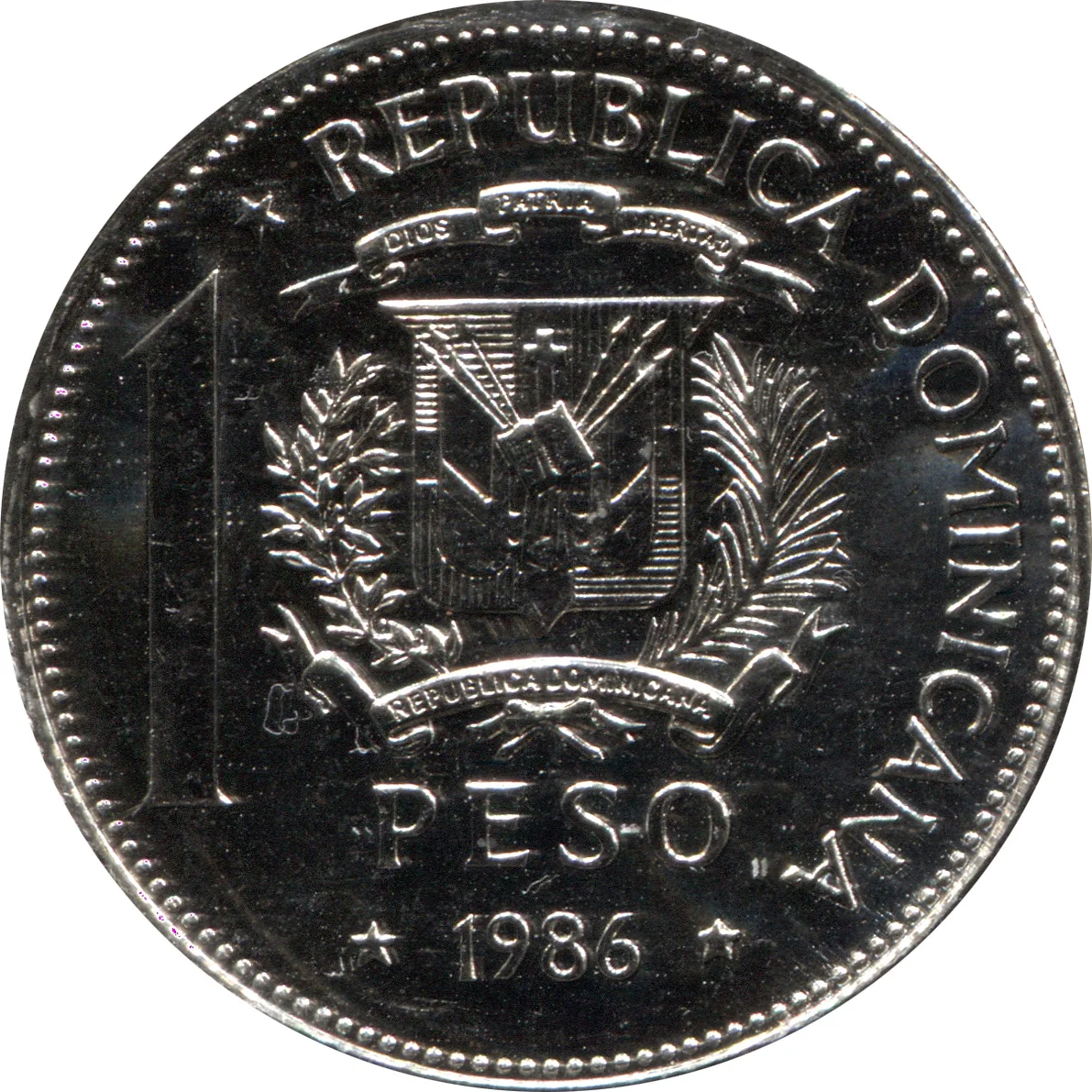
1 Peso – Dominican Republic
Circulating commemorative coins
Commemoration: 15th Central American and Caribbean Games
Dominican Republic
Context
Year: 1986
Issuer: Dominican Republic 
Period:
(since 1966)
Currency:
(since 1937)
Total mintage: 102,000
Material
References
KM: #Click to copy to clipboard65
Numista: #35715
Value
Exchange value: 1 DOP
Obverse
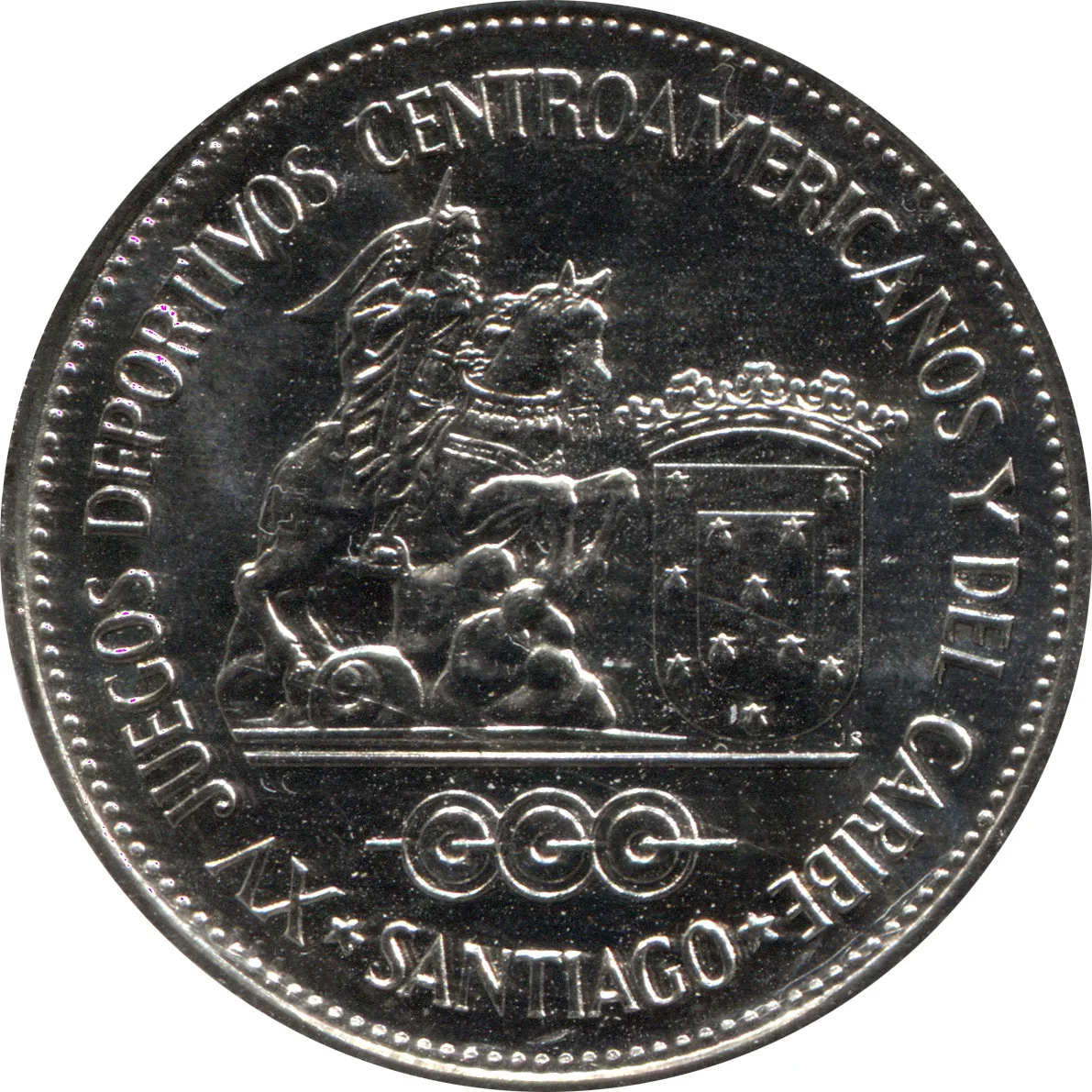
Reverse
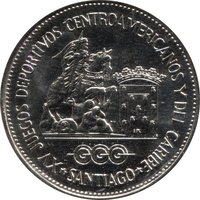
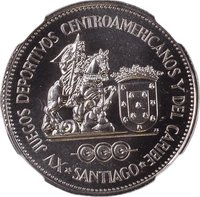
Description:
Horse and rider legend facing left.
Inscription:
XV JUEGOS DEPORTIVOS CENTROAMERICANOS Y DEL CARIBE
SANTIAGO
SANTIAGO
Script: Latin
Edge
Reeded and plain sections
Mintings
| Year | Mint Mark | Mintage | Quality | Collection |
|---|---|---|---|---|
| 1986 | — | 2,000 | Proof | |
| 1986 | — | 100,000 |
Historical background
In 1986, the Dominican Republic was navigating a fragile economic recovery under President Joaquín Balaguer, who had returned to power in a contentious election. The country was still emerging from the severe debt crisis and economic turmoil of the early 1980s, which had necessitated a series of stabilization agreements with the International Monetary Fund (IMF). The national currency, the Dominican Peso (DOP), operated under a heavily managed and multi-tiered exchange rate system. This complex system included an official fixed rate for essential imports and government transactions, alongside a parallel free market rate for most other transactions, which was significantly depreciated. This disparity created distortions, encouraged a black market, and reflected underlying pressures on the currency from fiscal deficits and low foreign reserves.
The government's key monetary challenge was defending the overvalued official exchange rate, which was pegged at 1 DOP to 1 USD for priority sectors. However, widespread scarcity of dollars at this rate meant the free market rate told the true story of economic stress, trading at approximately 3 pesos to the dollar. This gap placed immense strain on the Central Bank's reserves as it attempted to maintain the peg for favored transactions. Inflation remained a persistent problem, eroding purchasing power and undermining the peso's value, while the country's reliance on imports, particularly for food and oil, made it vulnerable to external shocks and currency depreciation.
By the end of 1986, pressures were building towards a major currency reform. The unsustainable dual-rate system, combined with the ongoing burden of external debt servicing, signaled that a significant devaluation and unification of the exchange rates was inevitable. This set the stage for the pivotal economic adjustments that would follow in 1987, including a sharp devaluation of the peso and a shift towards a more unified, market-influenced exchange rate mechanism as part of broader austerity measures to stabilize the macroeconomy.
The government's key monetary challenge was defending the overvalued official exchange rate, which was pegged at 1 DOP to 1 USD for priority sectors. However, widespread scarcity of dollars at this rate meant the free market rate told the true story of economic stress, trading at approximately 3 pesos to the dollar. This gap placed immense strain on the Central Bank's reserves as it attempted to maintain the peg for favored transactions. Inflation remained a persistent problem, eroding purchasing power and undermining the peso's value, while the country's reliance on imports, particularly for food and oil, made it vulnerable to external shocks and currency depreciation.
By the end of 1986, pressures were building towards a major currency reform. The unsustainable dual-rate system, combined with the ongoing burden of external debt servicing, signaled that a significant devaluation and unification of the exchange rates was inevitable. This set the stage for the pivotal economic adjustments that would follow in 1987, including a sharp devaluation of the peso and a shift towards a more unified, market-influenced exchange rate mechanism as part of broader austerity measures to stabilize the macroeconomy.
🌟 Limited