

2.5 escudos – Mozambique
Add to wishlist
Mozambique
Context
Year: 1935
Issuer: Mozambique
Period:
(1910—1951)
Currency:
(1911—1974)
Demonetized: Yes
Total mintage: 1,200,000
Material
References
KM: #
Numista: #14042
Value
Bullion value: $5.58
Obverse
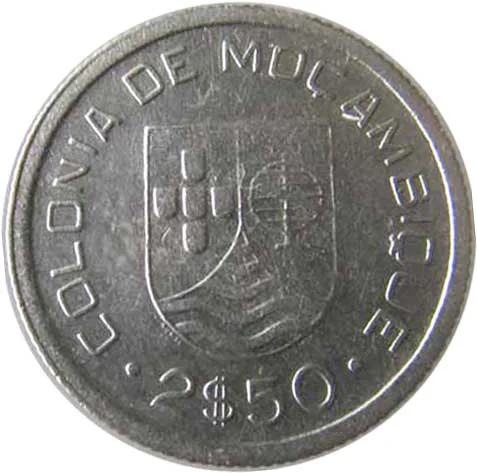
Description:
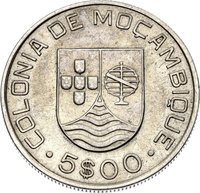
Heraldic emblem
Inscription:
COLONIA DE MOÇAMBIQUE
2$50
2$50
Translation:
Colony of Mozambique
2.50 Escudos
2.50 Escudos
Script: Latin
Language: Portuguese
Reverse
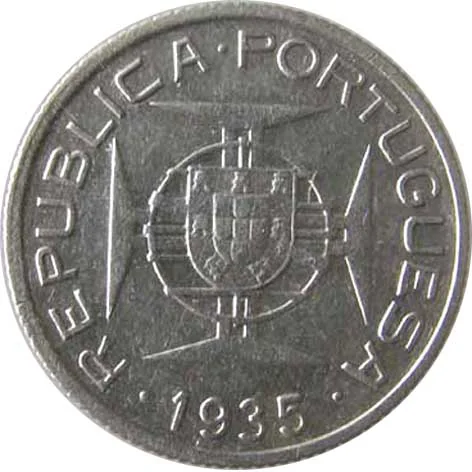
Description:
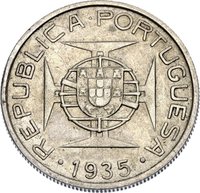
Globe with shield and Maltese cross.
Inscription:
REPUBLICA PORTUGUESA
· 1935 ·
· 1935 ·
Translation:
PORTUGUESE REPUBLIC
· 1935 ·
· 1935 ·
Script: Latin
Language: Portuguese
Edge
Reeded
Mints
| Name | Mark |
|---|---|
| Imprensa Nacional - Casa da Moeda | — |
Mintings
| Year | Mint Mark | Mintage | Quality | Collection |
|---|---|---|---|---|
| 1935 | — | 1,200,000 |
Historical background
In 1935, Mozambique's currency situation was fundamentally shaped by its status as a Portuguese colony, integrated into the wider Portuguese imperial monetary system. The official currency was the Portuguese escudo, which had replaced the real in 1914. However, the colony did not issue its own distinct banknotes or coins; instead, it used the same metropolitan currency issued by the Bank of Portugal, occasionally with stamps or overprints denoting "Moçambique" for regional identification. This arrangement tightly bound Mozambique's economy and monetary policy to Lisbon, ensuring that the colony's financial stability was directly dependent on Portugal's often-fragile economic conditions.
Alongside the official escudo, the practical reality in Mozambique's commercial hubs, particularly in the south, involved significant circulation of British sterling and South African pounds. This was due to the territory's economic integration with its British-dominated neighbours, a consequence of the recruitment of Mozambican labour to South African mines and the use of the port of Lourenço Marques (Maputo) as a key transit point for the Transvaal. The Mozambique Company, a chartered entity administering central regions until 1942, also had considerable financial autonomy and engaged in transactions using these stronger, gold-backed currencies, creating a de facto multi-currency environment.
The year 1935 fell within a period of relative monetary stability under the Salazar regime's Estado Novo, which had consolidated control over Portugal's finances. A key colonial monetary law in 1930 had reinforced the escudo's exclusive legal tender status across the empire, aiming to curb the influence of foreign currency. Nevertheless, the persistent use of sterling in key sectors highlighted the limits of Lisbon's control and reflected Mozambique's dual economic alignment: officially tied to a relatively weak European power, but practically and commercially pulled into the orbit of the more dynamic British sterling area in Southern Africa.
Alongside the official escudo, the practical reality in Mozambique's commercial hubs, particularly in the south, involved significant circulation of British sterling and South African pounds. This was due to the territory's economic integration with its British-dominated neighbours, a consequence of the recruitment of Mozambican labour to South African mines and the use of the port of Lourenço Marques (Maputo) as a key transit point for the Transvaal. The Mozambique Company, a chartered entity administering central regions until 1942, also had considerable financial autonomy and engaged in transactions using these stronger, gold-backed currencies, creating a de facto multi-currency environment.
The year 1935 fell within a period of relative monetary stability under the Salazar regime's Estado Novo, which had consolidated control over Portugal's finances. A key colonial monetary law in 1930 had reinforced the escudo's exclusive legal tender status across the empire, aiming to curb the influence of foreign currency. Nevertheless, the persistent use of sterling in key sectors highlighted the limits of Lisbon's control and reflected Mozambique's dual economic alignment: officially tied to a relatively weak European power, but practically and commercially pulled into the orbit of the more dynamic British sterling area in Southern Africa.
🌱 Fairly Common