

20 centavos – Mozambique
Add to wishlist
Mozambique
Context
Years: 1949–1950
Issuer: Mozambique
Period:
(1910—1951)
Currency:
(1911—1974)
Demonetized: Yes
Total mintage: 20,500,000
Material
References
KM: #
Numista: #14036
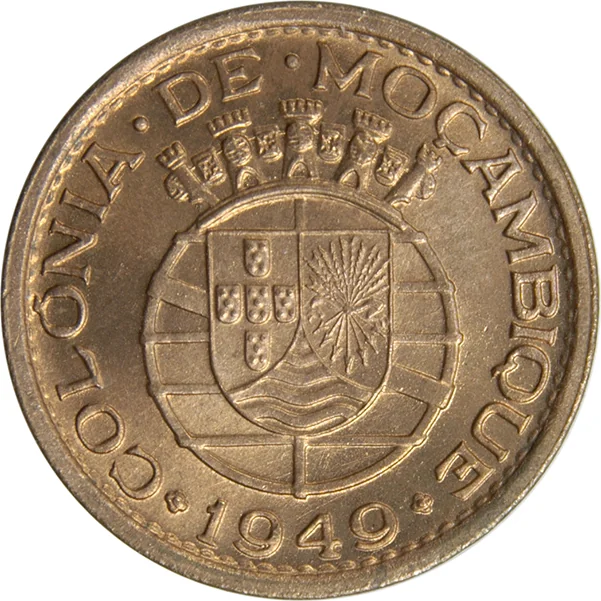
Obverse
Description:
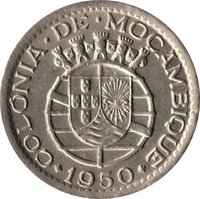
Crowned globe with arms, dated below.
Inscription:
COLONIA·DE·MOÇAMBIQUE
1950
1950
Translation:
Colony of Mozambique
1950
1950
Script: Latin
Language: Portuguese
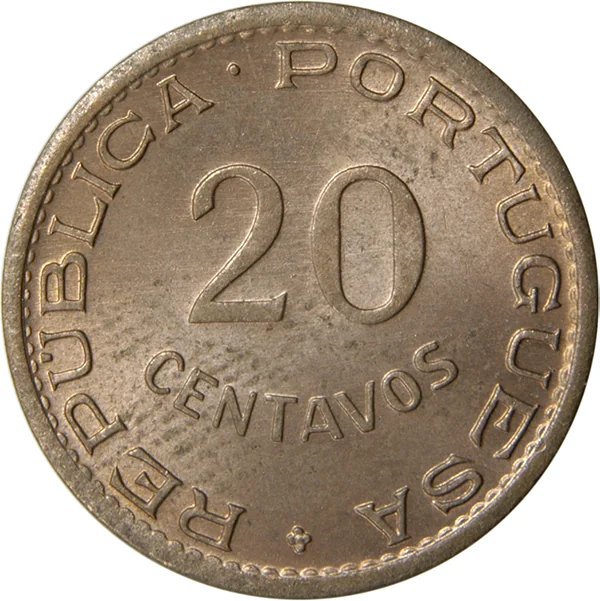
Reverse
Description:
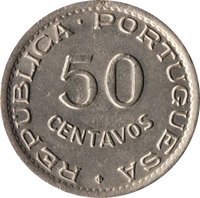
Center value, encircled by legend.
Inscription:
REPÚBLICA PORTUGUESA
20 CENTAVOS
20 CENTAVOS
Translation:
Portuguese Republic
20 Centavos
20 Centavos
Script: Latin
Language: Portuguese
Edge
Plain
Categories
| Symbols> Coat of Arms |
Mintings
| Year | Mint Mark | Mintage | Quality | Collection |
|---|---|---|---|---|
| 1949 | — | 8,000,000 | ||
| 1950 | — | 12,500,000 |
Historical background
In 1949, Mozambique's currency situation was fundamentally defined by its status as a Portuguese colony, integrated into the broader Portuguese Escudo Zone. The official currency was the Portuguese escudo, which had replaced the real in 1914. Monetary policy, issuance, and foreign exchange controls were all dictated by Lisbon through the Banco Nacional Ultramarino (BNU), which acted as the central bank for Portugal's overseas territories. This system ensured that Mozambique's economy was financially tethered to the metropole, with the colony's external trade and capital flows managed to benefit the Portuguese economy.
The colony's monetary landscape was characterized by a dual system. While the escudo was the legal tender for major transactions, trade, and government functions, traditional and informal currencies remained in widespread use, particularly in rural and remote areas. Barter, maize, and cloth sometimes facilitated local exchange, reflecting the limited penetration of the formal monetary economy for a large portion of the indigenous population. Furthermore, the influence of neighboring British territories meant that pounds sterling and South African pounds were also informally present, especially in border regions and for certain cross-border trade.
Economically, the currency regime supported Portugal's colonial objectives. The fixed exchange rate and strict controls facilitated the extraction of agricultural commodities (like cotton, cashews, and sugar) and the channeling of profits to Portuguese companies and settlers. There was little monetary autonomy to address local developmental needs. This structure, which prioritized colonial extraction over internal development, would remain largely intact until the run-up to the Mozambican War of Independence in the 1960s, laying a foundation of economic centralization and external dependency.
The colony's monetary landscape was characterized by a dual system. While the escudo was the legal tender for major transactions, trade, and government functions, traditional and informal currencies remained in widespread use, particularly in rural and remote areas. Barter, maize, and cloth sometimes facilitated local exchange, reflecting the limited penetration of the formal monetary economy for a large portion of the indigenous population. Furthermore, the influence of neighboring British territories meant that pounds sterling and South African pounds were also informally present, especially in border regions and for certain cross-border trade.
Economically, the currency regime supported Portugal's colonial objectives. The fixed exchange rate and strict controls facilitated the extraction of agricultural commodities (like cotton, cashews, and sugar) and the channeling of profits to Portuguese companies and settlers. There was little monetary autonomy to address local developmental needs. This structure, which prioritized colonial extraction over internal development, would remain largely intact until the run-up to the Mozambican War of Independence in the 1960s, laying a foundation of economic centralization and external dependency.
🌱 Common