

10 Cruzados – Brazil
Brazil
Context
Years: 1987–1988
Issuer: Brazil 
Period:
(since 1967)
Currency:
(1986—1989)
Demonetization: 1989
Total mintage: 740,236,000
Material
Diameter: 27 mm
Weight: 6.06 g
Thickness: 1.65 mm
Shape: Round
Composition: Stainless steel
Technique: Milled
Alignment: Coin alignment
flip
References
KM: #Click to copy to clipboard607
Numista: #3538
Value
Exchange value: 10 BRC
Inflation-adjusted value: 27929940777.24 BRC
Obverse
Description:
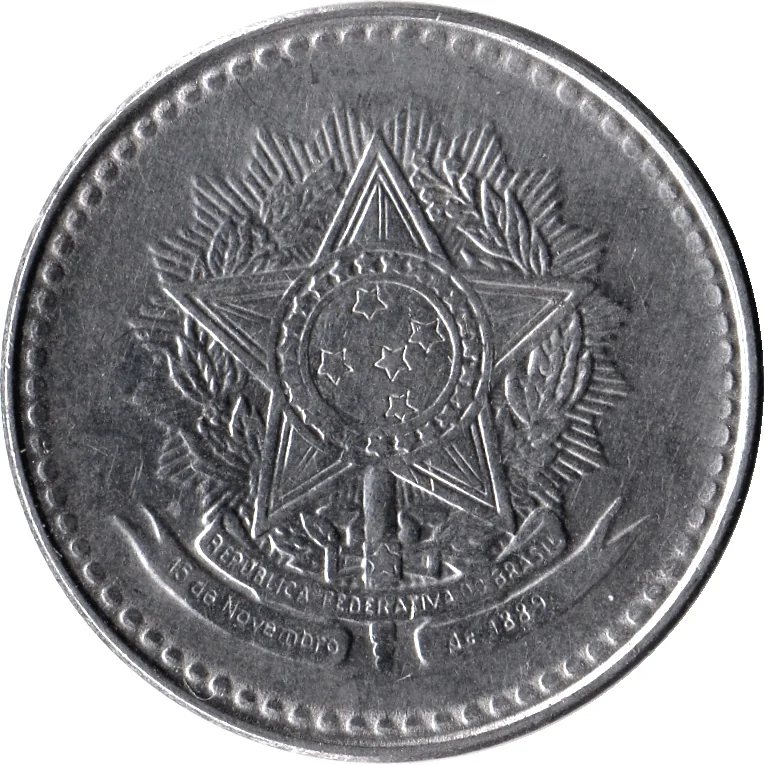
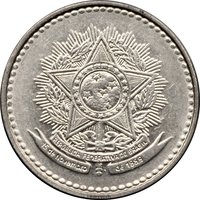
Star encircled by 27 smaller stars, with the Southern Cross inside. Flanked by tobacco and coffee plants.
Inscription:
REPUBLICA FEDERATIVA DO BRASIL
15 de Novembro de 1889
15 de Novembro de 1889
Translation:
Federative Republic of Brazil
15th of November 1889
15th of November 1889
Script: Latin
Language: Portuguese
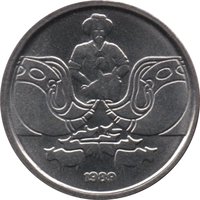
Reverse
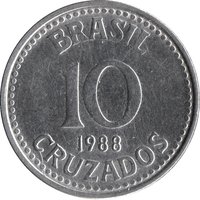
Description:
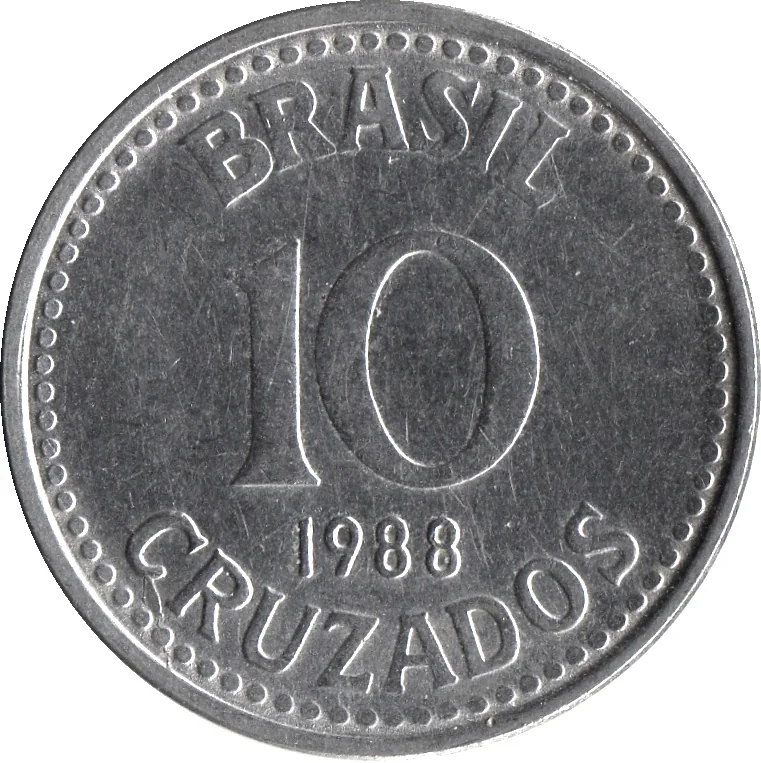
Date/Denomination
Inscription:
BRASIL
10 CRUZADOS
1988
10 CRUZADOS
1988
Translation:
Brazil
10 Cruzados
1988
10 Cruzados
1988
Script: Latin
Language: Portuguese
Edge
Plain
Mints
| Name | Mark |
|---|---|
| Casa da Moeda do Brasil | — |
Mintings
| Year | Mint Mark | Mintage | Quality | Collection |
|---|---|---|---|---|
| 1987 | — | 131,500,000 | ||
| 1988 | — | 608,736,000 |
Historical background
In 1987, Brazil was in the throes of a profound economic crisis, characterized by hyperinflation, a crushing foreign debt burden, and chronic fiscal instability. The currency, the cruzado (Cz$), introduced just a year earlier in the ambitious "Cruzado Plan," was already failing. That plan had instituted a dramatic price and wage freeze and replaced the old cruzeiro, but it failed to address the government's underlying fiscal deficit. By 1987, suppressed inflation erupted anew, and a widespread black market for goods and dollars emerged, undermining the currency's credibility and creating severe distortions in the economy.
The external sector presented a critical challenge. Brazil's massive foreign debt, the largest in the developing world, led to a severe shortage of foreign exchange reserves. In February 1987, President José Sarney's government unilaterally declared a moratorium on interest payments to commercial foreign creditors, a drastic move that isolated the country from international capital markets. This further eroded confidence in the cruzado, as the prospect of obtaining dollars for imports or as a store of value became even more difficult, fueling capital flight and a parallel exchange rate far more depreciated than the official one.
Consequently, 1987 was a year of failed stabilization attempts and monetary confusion. The government launched the short-lived "Cruzado Plan II" in June, which included a price freeze and a new currency, the "cruzado novo," but it was essentially a redenomination that did not alter the economic fundamentals. By year's end, inflation was accelerating toward an annual rate of over 300%, and the currency was in a state of visible decay. The situation set the stage for the even more chaotic years to follow, as Brazil cycled through successive currencies without conquering the root causes of its inflationary spiral.
The external sector presented a critical challenge. Brazil's massive foreign debt, the largest in the developing world, led to a severe shortage of foreign exchange reserves. In February 1987, President José Sarney's government unilaterally declared a moratorium on interest payments to commercial foreign creditors, a drastic move that isolated the country from international capital markets. This further eroded confidence in the cruzado, as the prospect of obtaining dollars for imports or as a store of value became even more difficult, fueling capital flight and a parallel exchange rate far more depreciated than the official one.
Consequently, 1987 was a year of failed stabilization attempts and monetary confusion. The government launched the short-lived "Cruzado Plan II" in June, which included a price freeze and a new currency, the "cruzado novo," but it was essentially a redenomination that did not alter the economic fundamentals. By year's end, inflation was accelerating toward an annual rate of over 300%, and the currency was in a state of visible decay. The situation set the stage for the even more chaotic years to follow, as Brazil cycled through successive currencies without conquering the root causes of its inflationary spiral.
🌱 Very Common