

10000 Dollars (Guyanese Independence) – Guyana
Non-circulating coins
Commemoration: 55 Years of Guyanese Independence
Guyana
Context
Year: 2021
Issuer: Guyana 
Issuing organization: Bank of Guyana
Period:
(since 1970)
Currency:
(since 1965)
Total mintage: 1,500
Material
Diameter: 39 mm
Weight: 31.39 g
Silver weight: 31.36 g
Shape: Round
Composition: 99.9% Silver
Standard: Silver ounce
Magnetic: No
Technique: Milled
References
KM: #Click to copy to clipboard65
Numista: #353218
Value
Exchange value: 10000 GYD
Bullion value: $89.46
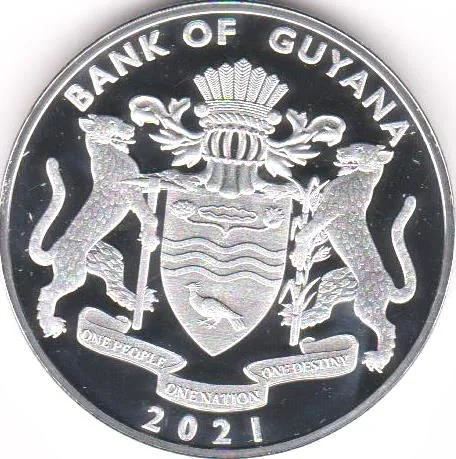
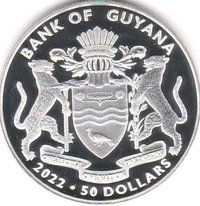
Obverse
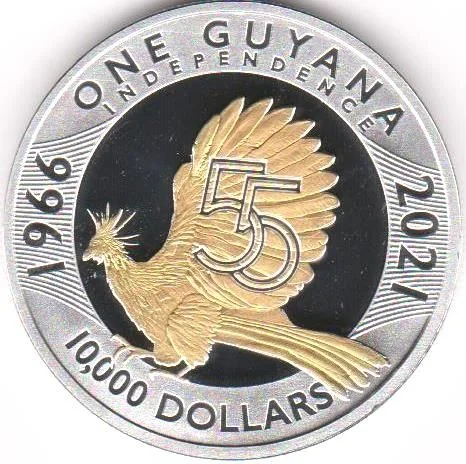
Reverse
Description:
Canje Pheasant premium.
Inscription:
1966 ONE GUYANA 2021
INDEPENDENCE
55
10,000 DOLLARS
INDEPENDENCE
55
10,000 DOLLARS
Script: Latin
Edge
Reeded
Categories
| Animal> Bird |
| Symbols> Coat of Arms |
Mints
| Name | Mark |
|---|---|
| Royal Canadian Mint of Ottawa | — |
Mintings
| Year | Mint Mark | Mintage | Quality | Collection |
|---|---|---|---|---|
| 2021 | — | 1,500 | Proof |
Historical background
In 2021, Guyana's currency situation was characterized by a managed exchange rate regime for the Guyana Dollar (GYD), which was pegged to the US Dollar within a narrow band. The official exchange rate was maintained by the Bank of Guyana at approximately GYD 209 per USD. However, a significant and persistent gap existed between this official rate and the higher rate available on the parallel market, where the dollar traded at roughly GYD 230-235. This disparity highlighted underlying market pressures and a higher demand for foreign currency than was being supplied through official channels, a common challenge for small, import-dependent economies.
The primary economic context for this situation was the nascent oil boom, following major offshore discoveries. While substantial oil revenues began to flow in 2020, their full impact on the macroeconomy and currency stability was still unfolding in 2021. The government was establishing its Natural Resource Fund and navigating how to manage these inflows without causing excessive inflation or Dutch disease—a scenario where the oil sector strengthens the currency and harms other exports. Consequently, the direct effect of oil revenues on the everyday foreign exchange market for businesses and individuals remained limited in the short term.
Key pressures on the currency included a high demand for foreign exchange to pay for imports and facilitate overseas remittances, alongside some domestic uncertainty. The political instability following the contentious 2020 elections, which was only resolved in August 2020, had lingering effects on business confidence in early 2021. Furthermore, the ongoing COVID-19 pandemic continued to disrupt traditional economic sectors like gold mining and sugar, affecting export earnings. Therefore, 2021 was a transitional year where Guyana's currency dynamics reflected its pre-oil economic structure while standing on the brink of a transformative, oil-driven fiscal future.
The primary economic context for this situation was the nascent oil boom, following major offshore discoveries. While substantial oil revenues began to flow in 2020, their full impact on the macroeconomy and currency stability was still unfolding in 2021. The government was establishing its Natural Resource Fund and navigating how to manage these inflows without causing excessive inflation or Dutch disease—a scenario where the oil sector strengthens the currency and harms other exports. Consequently, the direct effect of oil revenues on the everyday foreign exchange market for businesses and individuals remained limited in the short term.
Key pressures on the currency included a high demand for foreign exchange to pay for imports and facilitate overseas remittances, alongside some domestic uncertainty. The political instability following the contentious 2020 elections, which was only resolved in August 2020, had lingering effects on business confidence in early 2021. Furthermore, the ongoing COVID-19 pandemic continued to disrupt traditional economic sectors like gold mining and sugar, affecting export earnings. Therefore, 2021 was a transitional year where Guyana's currency dynamics reflected its pre-oil economic structure while standing on the brink of a transformative, oil-driven fiscal future.

✨ Legendary