

100000 zlotys – Poland
Add to wishlist
Non-circulating coins
Commemoration: Unification of Upper Silesia & Poland
Poland
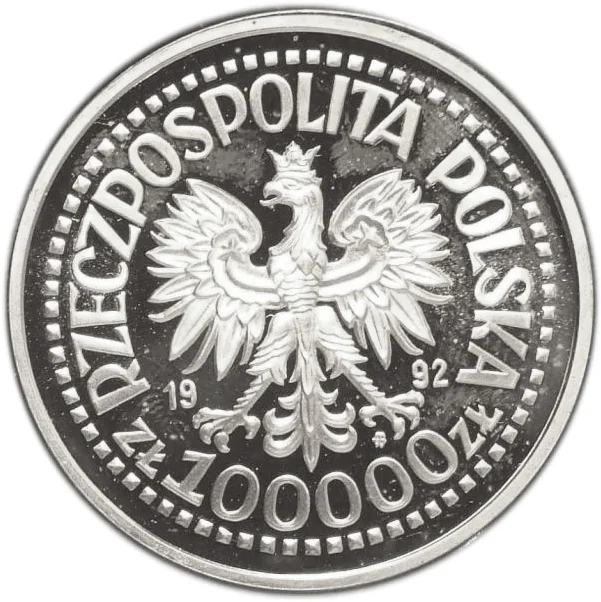
Obverse
Description:
Polish Eagle
Inscription:
RZECZYSPOSPOLITA POLSKA
1992
mw
ZŁ 100000 ZŁ
1992
mw
ZŁ 100000 ZŁ
Translation:
REPUBLIC OF POLAND
1992
mw
ZL 100000 ZL
1992
mw
ZL 100000 ZL
Script: Latin
Language: Polish
Designer: Ewa Tyc-Karpińska
Reverse
Inscription:
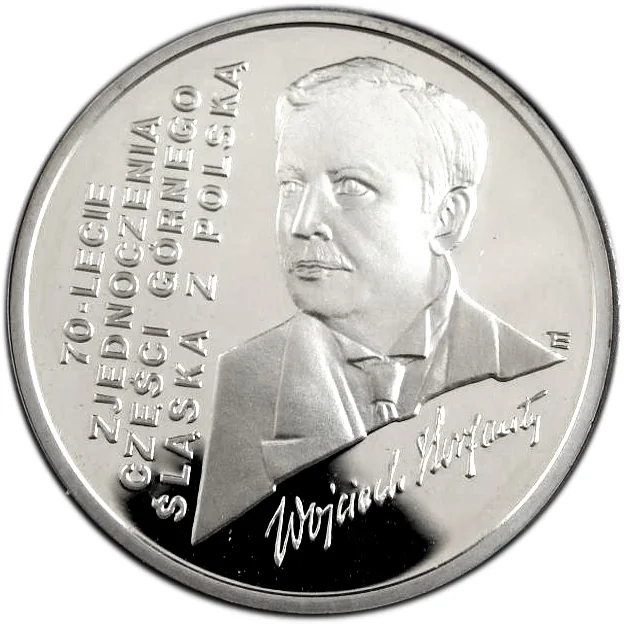
70-LECIE
ZJEDNOCZENIA
CZĘŚCI GÓRNEGO
ŚLĄSKA Z POLSKĄ
E
Wojciech korfanty
ZJEDNOCZENIA
CZĘŚCI GÓRNEGO
ŚLĄSKA Z POLSKĄ
E
Wojciech korfanty
Translation:
70th Anniversary of the Unification of the Upper Silesia Part with Poland
Wojciech Korfanty
Wojciech Korfanty
Script: Latin
Language: Polish
Designer: Ewa Tyc-Karpińska
Edge
Plain
Mints
| Name | Mark |
|---|---|
| Mint of Poland | (MW) |
Mintings
| Year | Mint Mark | Mintage | Quality | Collection |
|---|---|---|---|---|
| 1992 | MW | 30,000 | Proof |
Historical background
In 1992, Poland was in the turbulent early phase of its transition from a centrally planned to a market economy, following the shock therapy reforms of 1990. The cornerstone of its monetary policy was the złoty (PLZ), which had been made internally convertible and pegged to the US dollar as an anti-inflationary anchor. This bold stabilization plan, known as the Balcerowicz Plan, had successfully halted hyperinflation but came at a significant cost: a deep recession and high unemployment. The fixed exchange rate, while providing stability, was increasingly seen as overvalued, hurting export competitiveness and contributing to a growing current account deficit.
The currency situation was characterized by a tense duality. Officially, the National Bank of Poland (NBP) maintained the fixed peg, but pressure was mounting. A parallel black market for foreign exchange persisted, and within financial circles, expectations of an inevitable devaluation were building. The central bank was forced to spend substantial hard currency reserves to defend the złoty's peg, while high real interest rates were used to attract capital and support the currency, further stifling economic recovery. This created a policy dilemma between maintaining the credibility of the stabilization program and addressing the worsening trade imbalance.
By the end of 1992, the system was at a breaking point. The government and the NBP, under President Hanna Gronkiewicz-Waltz, recognized that the rigid peg had outlived its usefulness. Consequently, in a managed move, the złoty was devalued by approximately 12% in February 1993 and the exchange rate mechanism was shifted to a crawling peg. This devaluation marked a critical evolution from a rigid stabilization tool to a more flexible regime aimed at improving external competitiveness, setting the stage for the next phase of Poland's economic adjustment and gradual growth.
The currency situation was characterized by a tense duality. Officially, the National Bank of Poland (NBP) maintained the fixed peg, but pressure was mounting. A parallel black market for foreign exchange persisted, and within financial circles, expectations of an inevitable devaluation were building. The central bank was forced to spend substantial hard currency reserves to defend the złoty's peg, while high real interest rates were used to attract capital and support the currency, further stifling economic recovery. This created a policy dilemma between maintaining the credibility of the stabilization program and addressing the worsening trade imbalance.
By the end of 1992, the system was at a breaking point. The government and the NBP, under President Hanna Gronkiewicz-Waltz, recognized that the rigid peg had outlived its usefulness. Consequently, in a managed move, the złoty was devalued by approximately 12% in February 1993 and the exchange rate mechanism was shifted to a crawling peg. This devaluation marked a critical evolution from a rigid stabilization tool to a more flexible regime aimed at improving external competitiveness, setting the stage for the next phase of Poland's economic adjustment and gradual growth.
💎 Extremely Rare