

5 rand – South Africa
Add to wishlist
Non-circulating coins
Commemoration: Mandela's boyhood in Qunu
South Africa
Context
Material
Diameter: 16.5 mm
Weight: 3.11 g
Gold Weight:: 3.11 g
Shape: Round
Composition: 99.99% Gold
Standard: Gold tenth ounce
Magnetic: No
Technique: Milled
Alignment: Medal alignment
flip
References
Numista: #351617
Value
Exchange value: 5 ZAR
Bullion value: $484.14
Inflation-adjusted value: 9.29 ZAR
Obverse
Description:
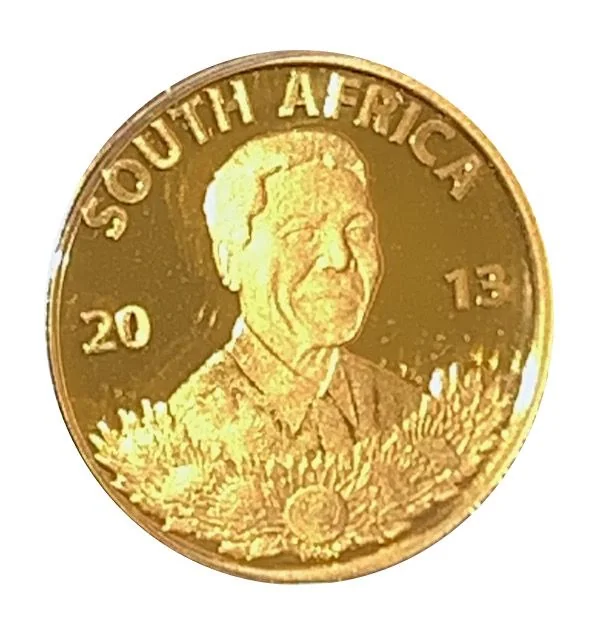
Nelson Mandela's head and shoulders, flanked by the national seal and floral arrangements at the base.
Inscription:
SOUTH AFRICA
2013
2013
Script: Latin
Engraver: Vincent Chipa
Designer: Lilian Guerra
Reverse
Description:
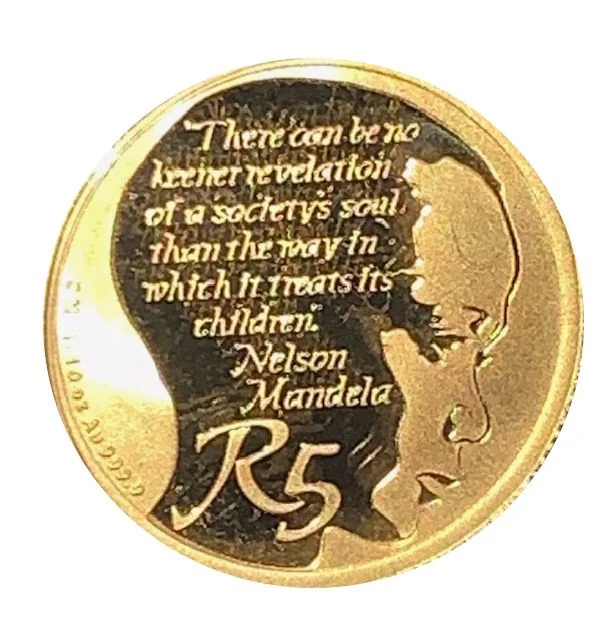
A child's head tilted sideways, with text on the proof finish and the coin's denomination.
Inscription:
There can be no keener revelation of a society’s soul than the way in which it treats its children.
Nelson Mandela
R5
CM 1/10 oz Au 999.9
Nelson Mandela
R5
CM 1/10 oz Au 999.9
Script: Latin
Engraver: Cecil Moses
Designer: Lilian Guerra
Edge
Reeded
Categories
| Person> Politician |
| Plants> Flower |
Mints
| Name | Mark |
|---|---|
| South African Mint | — |
Mintings
| Year | Mint Mark | Mintage | Quality | Collection |
|---|---|---|---|---|
| 2013 | — | 2,596 | Proof | |
| 2013 | NMF | 188 | Proof |
Historical background
In 2013, South Africa's currency, the rand, experienced a period of significant volatility and depreciation, marking one of its most challenging years since the end of apartheid. The primary catalyst was the "taper tantrum" in global markets, triggered by the US Federal Reserve's announcement that it would begin winding down its quantitative easing program. This led to a sharp outflow of capital from emerging markets like South Africa, as investors sought safer, dollar-denominated assets. The rand, which had already been under pressure, plummeted from around R8.50 to the US dollar at the start of the year to briefly breach R11.00 in late December, a loss of nearly 30% of its value.
Domestic economic woes compounded these external shocks. Growth was stagnant, hovering around 2%, while the current account deficit widened to a worrying 5.8% of GDP, making the economy heavily reliant on fickle foreign investment to bridge the gap. Simultaneously, the country faced severe labour unrest, most notably in the mining sector, which disrupted key exports and damaged investor confidence in the government's ability to manage the economy and social tensions. Rising public sector wage bills and concerns over fiscal policy added to the negative sentiment.
The currency's dramatic fall presented a major policy dilemma for the South African Reserve Bank (SARB). While a weaker rand benefited exporters, it sharply increased the cost of imports, fueling inflation and putting pressure on household budgets. The SARB, with its primary mandate to target inflation, was forced into a difficult position, having to consider interest rate hikes in a low-growth environment. Thus, 2013 set the stage for a prolonged period of economic strain, characterized by the conflicting pressures of currency weakness, rising inflation, and subdued growth, challenges that would persist for years to come.
Domestic economic woes compounded these external shocks. Growth was stagnant, hovering around 2%, while the current account deficit widened to a worrying 5.8% of GDP, making the economy heavily reliant on fickle foreign investment to bridge the gap. Simultaneously, the country faced severe labour unrest, most notably in the mining sector, which disrupted key exports and damaged investor confidence in the government's ability to manage the economy and social tensions. Rising public sector wage bills and concerns over fiscal policy added to the negative sentiment.
The currency's dramatic fall presented a major policy dilemma for the South African Reserve Bank (SARB). While a weaker rand benefited exporters, it sharply increased the cost of imports, fueling inflation and putting pressure on household budgets. The SARB, with its primary mandate to target inflation, was forced into a difficult position, having to consider interest rate hikes in a low-growth environment. Thus, 2013 set the stage for a prolonged period of economic strain, characterized by the conflicting pressures of currency weakness, rising inflation, and subdued growth, challenges that would persist for years to come.


✨ Legendary