

30 Pesos (Trujillo regime) – Dominican Republic
Non-circulating coins
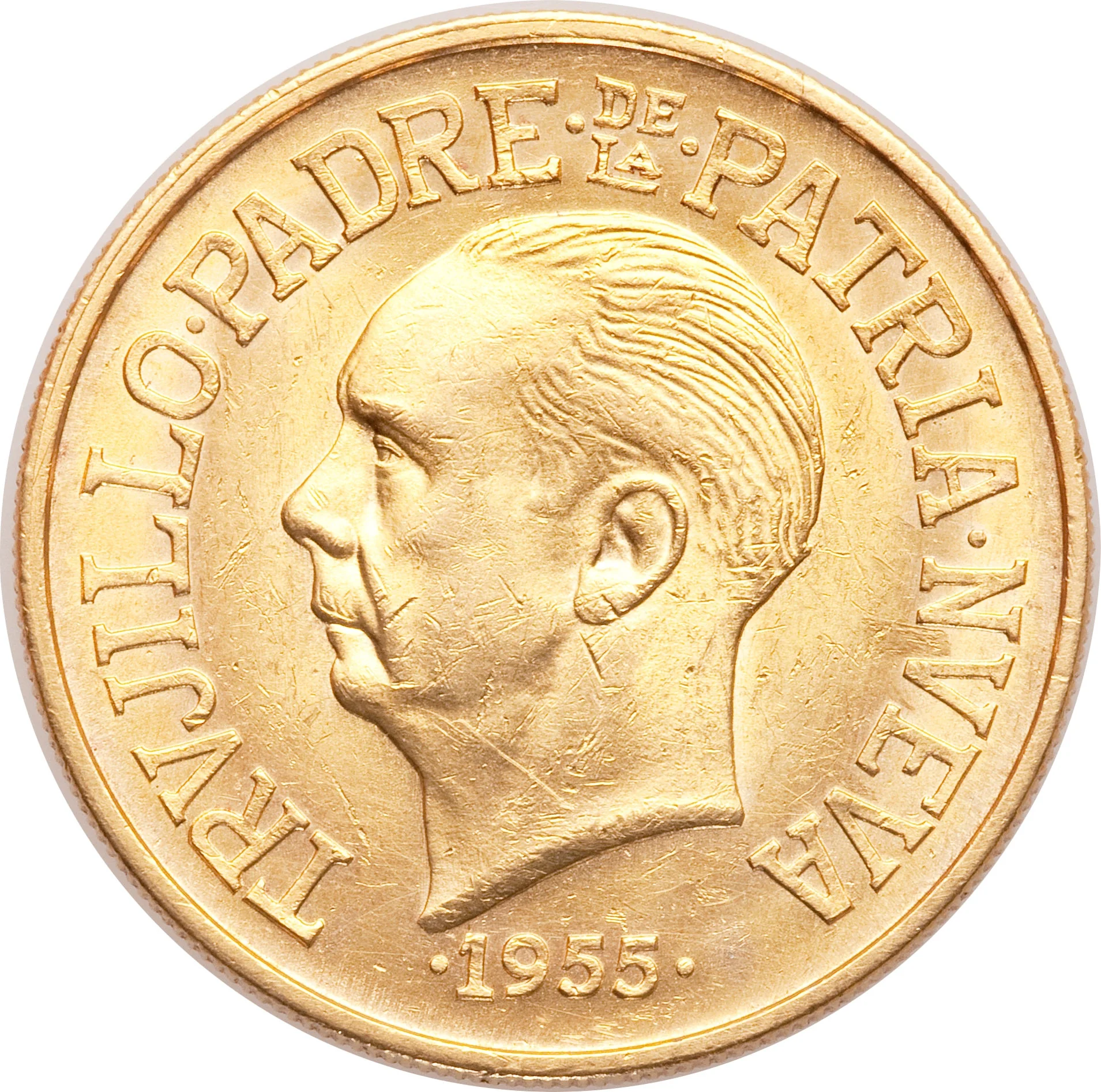
Commemoration: 25th Anniversary of Trujillo regime
Dominican Republic
Context
Year: 1955
Issuer: Dominican Republic 
Period:
(1922—1965)
Currency:
(since 1937)
Demonetized: Yes
Total mintage: 33,000
Material
References
KM: #Click to copy to clipboard24
Numista: #35131
Value
Exchange value: 30 DOP
Bullion value: $4444.70
Obverse
Description:
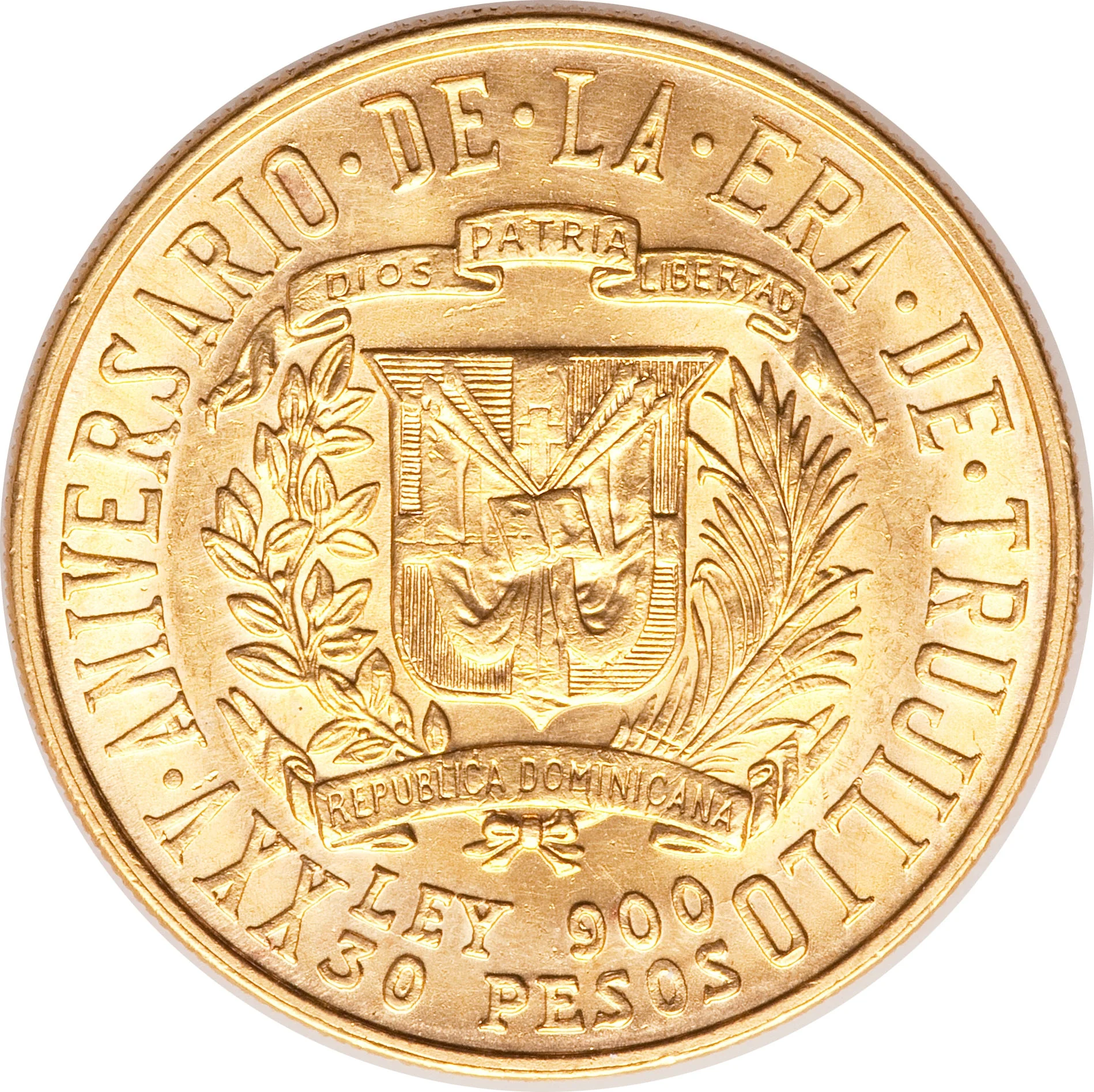
Coat of arms centered, fineness and value below.
Inscription:
XXV · ANIVERSARIO · DE · LA · ERA DE · TRUJILLO
DIOS PATRIA LIBERTAD
REPUBLICA DOMINICANA
LEY 900
30 PESOS
DIOS PATRIA LIBERTAD
REPUBLICA DOMINICANA
LEY 900
30 PESOS
Translation:
TWENTY-FIFTH ANNIVERSARY OF THE ERA OF TRUJILLO
GOD HOMELAND LIBERTY
DOMINICAN REPUBLIC
LAW 900
30 PESOS
GOD HOMELAND LIBERTY
DOMINICAN REPUBLIC
LAW 900
30 PESOS
Script: Latin
Language: Spanish
Reverse
Edge
Reeded
Categories
| Symbols> Coat of Arms |
| Person> Politician |
Mintings
| Year | Mint Mark | Mintage | Quality | Collection |
|---|---|---|---|---|
| 1955 | — | 33,000 |
Historical background
In 1955, the Dominican Republic operated under a managed currency system with the Dominican Peso (DOP) pegged to the US Dollar. This peg, established at a fixed rate of 1 DOP = 1 USD, was a cornerstone of the economic policy under the authoritarian regime of General Rafael Trujillo, who had ruled since 1930. The stability of this exchange rate was artificially maintained by strict government controls, including central bank intervention and restrictions on foreign exchange transactions. This provided a veneer of monetary stability crucial for the regime's legitimacy and for the interests of the sugar-exporting oligarchy and foreign investors.
The country's economy in this period was heavily dependent on agricultural exports, primarily sugar, but also coffee, cocoa, and tobacco. The fixed exchange rate benefited these export sectors by providing predictable revenue conversion. However, it also masked underlying economic vulnerabilities, including a lack of industrial diversification and a growing dependence on the United States, which was the primary market for Dominican goods and the source of much foreign capital. The currency's stability was not a reflection of robust, balanced economic fundamentals but rather a controlled outcome of Trujillo's centralized power and the inflow of dollars from commodity exports.
By the mid-1950s, while the peso appeared stable on the surface, pressures were building. The economy was increasingly directed to serve the interests of the Trujillo family and its associates, who controlled vast portions of the national wealth. This concentration, combined with significant public spending on infrastructure and security to bolster the regime, created long-term fiscal strains. Ultimately, the rigid currency peg and controlled economy of 1955 proved unsustainable after Trujillo's assassination in 1961, leading to subsequent devaluations and monetary instability in the following decade as the country grappled with the legacy of his economic management.
The country's economy in this period was heavily dependent on agricultural exports, primarily sugar, but also coffee, cocoa, and tobacco. The fixed exchange rate benefited these export sectors by providing predictable revenue conversion. However, it also masked underlying economic vulnerabilities, including a lack of industrial diversification and a growing dependence on the United States, which was the primary market for Dominican goods and the source of much foreign capital. The currency's stability was not a reflection of robust, balanced economic fundamentals but rather a controlled outcome of Trujillo's centralized power and the inflow of dollars from commodity exports.
By the mid-1950s, while the peso appeared stable on the surface, pressures were building. The economy was increasingly directed to serve the interests of the Trujillo family and its associates, who controlled vast portions of the national wealth. This concentration, combined with significant public spending on infrastructure and security to bolster the regime, created long-term fiscal strains. Ultimately, the rigid currency peg and controlled economy of 1955 proved unsustainable after Trujillo's assassination in 1961, leading to subsequent devaluations and monetary instability in the following decade as the country grappled with the legacy of his economic management.
💎 Extremely Rare