

1 denar (Christianity) – North Macedonia
Add to wishlist
Non-circulating coins
Commemoration: 2000 Years of Christianity
North Macedonia
Context
Material
References
KM: #
Numista: #100001
Value
Exchange value: 1 MKD
Bullion value: $1124.12
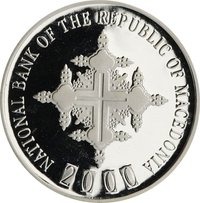
Obverse
Description:
Ornate cross
Inscription:
NATIONAL BANK OF THE REPUBLIC OF MACEDONIA
2000
2000
Translation:
NATIONAL BANK OF THE REPUBLIC OF MACEDONIA
2000
2000
Language: English
Engraver: Biljana Unkovska
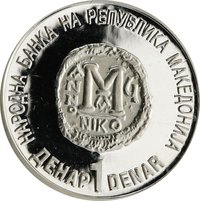
Reverse
Description:
Byzantine copper follis.
Inscription:
НАРОДНА БАНКА НА РЕПУБЛИКА МАКЕДОНИЈА
ДЕНАР 1 DENAR
ДЕНАР 1 DENAR
Translation:
NATIONAL BANK OF THE REPUBLIC OF MACEDONIA
DENAR 1 DENAR
DENAR 1 DENAR
Language: Macedonian
Engraver: Biljana Unkovska
Edge
Categories
| Currency> Coin depiction |
Mintings
| Year | Mint Mark | Mintage | Quality | Collection |
|---|---|---|---|---|
| 2000 | — | 1,000 |
Historical background
In the year 2000, North Macedonia’s currency situation was defined by a period of relative stability following a major crisis. The country’s currency, the denar (MKD), had been introduced in 1992 after independence from Yugoslavia, but it faced severe pressure during the mid-1990s, including a banking crisis and high inflation. A pivotal reform came in 1995 when the National Bank of the Republic of Macedonia (NBRM) abandoned a fixed exchange rate and introduced a managed float, pegging the denar to the German Deutsche Mark. This move, coupled with strict monetary discipline, successfully stabilized the currency and tamed hyperinflation, laying a foundation for the calm witnessed in 2000.
By the turn of the millennium, the denar’s peg had shifted from the Deutsche Mark to the euro, following the euro's introduction in 1999. The NBRM maintained a de facto crawling peg system, allowing the denar to depreciate slowly and predictably against the euro (at an annual rate of about 2-4%) to preserve the competitiveness of exports. This policy provided a crucial anchor for the small, open economy, fostering low inflation and building public confidence in the national currency after the turbulence of the early transition years.
However, the stability in 2000 was set against a challenging economic backdrop. The country was still grappling with the legacy of the 1999 Kosovo War, which had disrupted trade, and faced sluggish growth and high unemployment. While the currency regime was a source of macroeconomic stability, it also limited the central bank's ability to use monetary policy for domestic stimulus. Furthermore, the fixed exchange rate required consistent foreign currency reserves, making the economy vulnerable to external shocks and dependent on steady inflows from remittances and foreign aid. Thus, the currency situation was a carefully managed equilibrium, providing stability but within a context of broader economic fragility.
By the turn of the millennium, the denar’s peg had shifted from the Deutsche Mark to the euro, following the euro's introduction in 1999. The NBRM maintained a de facto crawling peg system, allowing the denar to depreciate slowly and predictably against the euro (at an annual rate of about 2-4%) to preserve the competitiveness of exports. This policy provided a crucial anchor for the small, open economy, fostering low inflation and building public confidence in the national currency after the turbulence of the early transition years.
However, the stability in 2000 was set against a challenging economic backdrop. The country was still grappling with the legacy of the 1999 Kosovo War, which had disrupted trade, and faced sluggish growth and high unemployment. While the currency regime was a source of macroeconomic stability, it also limited the central bank's ability to use monetary policy for domestic stimulus. Furthermore, the fixed exchange rate required consistent foreign currency reserves, making the economy vulnerable to external shocks and dependent on steady inflows from remittances and foreign aid. Thus, the currency situation was a carefully managed equilibrium, providing stability but within a context of broader economic fragility.

✨ Legendary