

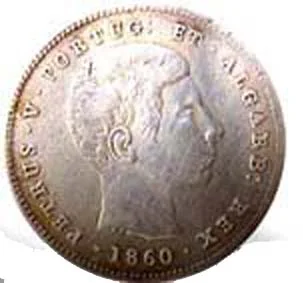
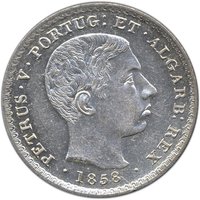
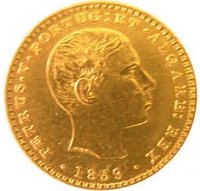
Obverse
Inscription:
PETRUS·V·PORTUG:ET·ALGARB:REX
·1860·
·1860·
Script: Latin
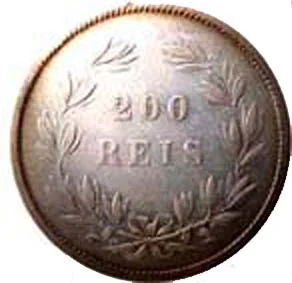
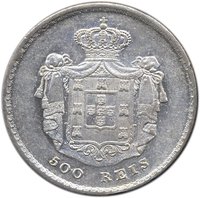
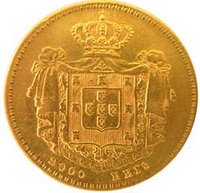
Reverse
Inscription:
200
REIS
REIS
Script: Latin
Edge
Reeded
Mints
| Name | Mark |
|---|---|
| Imprensa Nacional - Casa da Moeda | — |
Mintings
| Year | Mint Mark | Mintage | Quality | Collection |
|---|---|---|---|---|
| 1858 | — | 802,435 | ||
| 1860 | — | 117,165 | ||
| 1861 | — | 201,960 |
Historical background
In 1858, Portugal's currency situation was characterized by a complex and often unstable system, still grappling with the legacy of the Liberal Wars and the country's significant economic challenges. The official unit of account was the real (plural: réis), a currency of very low value that required transactions to be calculated in thousands (mil réis). However, the monetary reality was fragmented. Alongside domestic coinage, foreign gold coins, particularly British sovereigns and French 20-franc pieces, circulated widely and were preferred for major transactions and international trade due to their trusted intrinsic value. This de facto bimetallic system was informal and lacked the firm legal ratios needed for stability.
The period was one of transition following the 1854 law that aimed to adopt a gold standard, but full implementation was slow and incomplete. The state struggled with a chronic shortage of precious metal for coinage, leading to an unreliable supply of official currency. Consequently, private banknotes issued by the Banco de Portugal (founded 1846) and other commercial banks were becoming increasingly crucial for the economy. These notes were theoretically convertible into gold, but public confidence in them fluctuated, and their acceptance outside major urban centers like Lisbon and Porto was limited.
Overall, Portugal's 1858 monetary landscape was a patchwork of metallic and paper money, lacking the uniformity and confidence seen in other European nations. The coexistence of worn domestic coinage, coveted foreign gold, and emerging paper notes reflected a state attempting to modernize its financial system while contending with budget deficits, a large public debt, and an underdeveloped industrial base. This instability would eventually lead to more decisive reforms, culminating in the creation of a new unit, the escudo, in 1911.
The period was one of transition following the 1854 law that aimed to adopt a gold standard, but full implementation was slow and incomplete. The state struggled with a chronic shortage of precious metal for coinage, leading to an unreliable supply of official currency. Consequently, private banknotes issued by the Banco de Portugal (founded 1846) and other commercial banks were becoming increasingly crucial for the economy. These notes were theoretically convertible into gold, but public confidence in them fluctuated, and their acceptance outside major urban centers like Lisbon and Porto was limited.
Overall, Portugal's 1858 monetary landscape was a patchwork of metallic and paper money, lacking the uniformity and confidence seen in other European nations. The coexistence of worn domestic coinage, coveted foreign gold, and emerging paper notes reflected a state attempting to modernize its financial system while contending with budget deficits, a large public debt, and an underdeveloped industrial base. This instability would eventually lead to more decisive reforms, culminating in the creation of a new unit, the escudo, in 1911.
⭐ Rare