

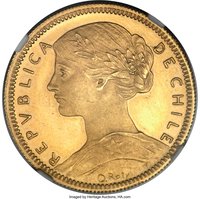
Obverse
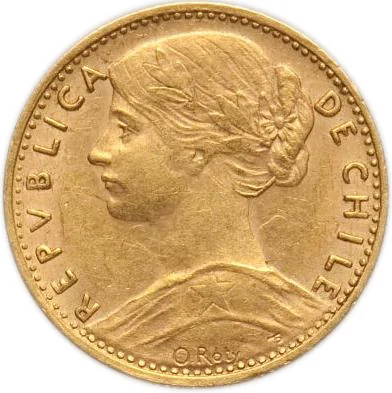
Description:
Turn left at O. Roty.
Inscription:
REPVBLICA DE CHILE
Script: Latin
Engraver: Oscar Roty (1846 -1911)
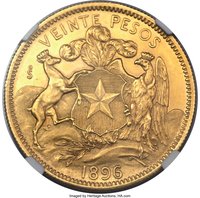
Reverse
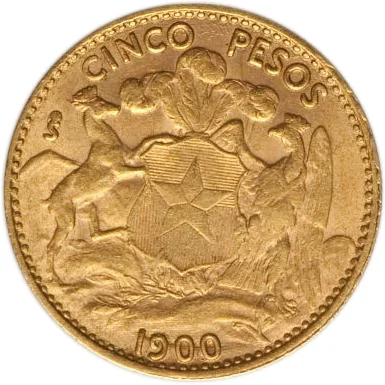
Description:
Arms with supporters, denomination above, date below.
Inscription:
CINCO PESOS
So
1900
So
1900
Script: Latin
Edge
Mints
| Name | Mark |
|---|---|
| Casa de Moneda de Chile | (So) |
Mintings
| Year | Mint Mark | Mintage | Quality | Collection |
|---|---|---|---|---|
| 1897 | So | — | ||
| 1898 | So | 426,000 | ||
| 1900 | So | 1,265,000 | ||
| 1911 | So | 1,399 |
Historical background
In 1897, Chile's currency situation was defined by the peso, which operated under a de facto gold standard following the Currency Law of 1895. This law aimed to stabilize the currency after a period of significant depreciation and inflation, largely caused by the excessive issuance of paper money (banknotes convertible to silver) to finance the War of the Pacific (1879-1883) and subsequent internal conflicts. By 1895, the paper peso had lost nearly 80% of its value against the gold peso. The new law made the gold peso the official monetary unit and mandated the gradual conversion of paper money into gold, seeking to restore fiscal discipline and international confidence.
The economy in 1897 was in a transitional phase, with the government, under President Federico Errázuriz Echaurren, cautiously managing the conversion to gold. The convertibility of paper notes to gold was not yet fully realized, and both forms of money circulated simultaneously. The country's economic health was heavily dependent on nitrate exports, which provided the foreign exchange and gold reserves necessary to back the currency. This dependence created vulnerability, as any shock to the nitrate trade could threaten the gold reserves underpinning the monetary system.
Consequently, the currency situation in 1897 was one of fragile stability. While the legal framework for a strong, gold-backed currency was in place, the practical implementation was ongoing and contingent on sustained nitrate revenue. The system represented a concerted effort by the Chilean state to integrate into the global gold-standard economy, moving away from a chaotic fiduciary system, but it remained exposed to the volatile swings of a single-commodity export economy. This precarious balance would be severely tested in the following decades by political crises and fluctuations in the global nitrate market.
The economy in 1897 was in a transitional phase, with the government, under President Federico Errázuriz Echaurren, cautiously managing the conversion to gold. The convertibility of paper notes to gold was not yet fully realized, and both forms of money circulated simultaneously. The country's economic health was heavily dependent on nitrate exports, which provided the foreign exchange and gold reserves necessary to back the currency. This dependence created vulnerability, as any shock to the nitrate trade could threaten the gold reserves underpinning the monetary system.
Consequently, the currency situation in 1897 was one of fragile stability. While the legal framework for a strong, gold-backed currency was in place, the practical implementation was ongoing and contingent on sustained nitrate revenue. The system represented a concerted effort by the Chilean state to integrate into the global gold-standard economy, moving away from a chaotic fiduciary system, but it remained exposed to the volatile swings of a single-commodity export economy. This precarious balance would be severely tested in the following decades by political crises and fluctuations in the global nitrate market.
💎 Extremely Rare