

10 Fen – Hunan Province
China
Context
Years: 1897–1902
Country: China 
Issuer: Hunan Province
Ruler: Guangxu
Currency:
(1897—1949)
Demonetized: Yes
Material
References
Y: #Click to copy to clipboard115.1
Numista: #34909
Value
Bullion value: $5.95
Obverse
Description:
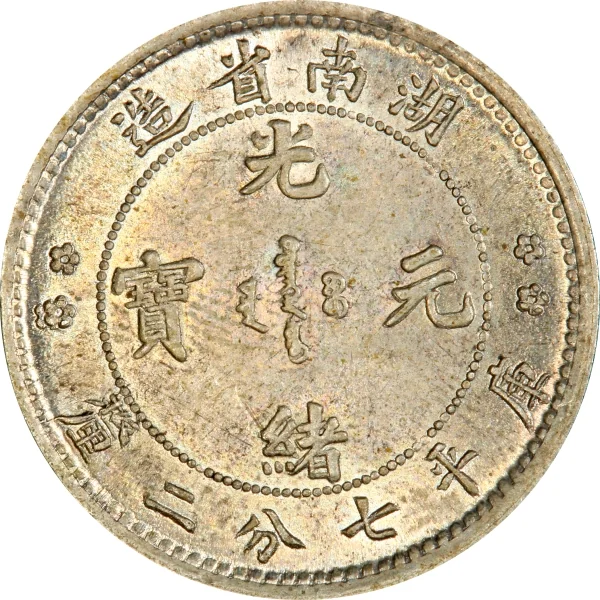
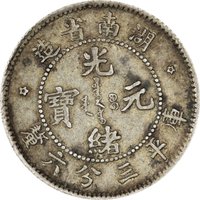
Chinese ideograms read vertically, right to left, with Manchu text in the center, all encircled by more Chinese characters.
Inscription:
造省南湖
光
ᠪᠠᡩᠠᡵᠠᠩᡤᠠ
寶 ᠶᡠᠸᠠᠨ ᠪᠣᠣ 元
ᡩᠣᡵᠣ
緒
釐二分七平庫
光
ᠪᠠᡩᠠᡵᠠᠩᡤᠠ
寶 ᠶᡠᠸᠠᠨ ᠪᠣᠣ 元
ᡩᠣᡵᠣ
緒
釐二分七平庫
Translation:
Made at the Nanhu Mint, Guangdong
Guangxu (reign era)
Ba Da Rang Ga (Manchu: Badarangga, meaning "of the Guangxu era")
Treasure Yuan (Standard coin of the empire)
Do Ro (Manchu: Doro, meaning "principle" or "reign")
1 Mace, 2 Candareens and 7 Cents (Standard Treasury weight)
Guangxu (reign era)
Ba Da Rang Ga (Manchu: Badarangga, meaning "of the Guangxu era")
Treasure Yuan (Standard coin of the empire)
Do Ro (Manchu: Doro, meaning "principle" or "reign")
1 Mace, 2 Candareens and 7 Cents (Standard Treasury weight)
Scripts: Chinese, Mongolian / Manchu
Languages: Manchu, Classical Chinese
Reverse
Description:
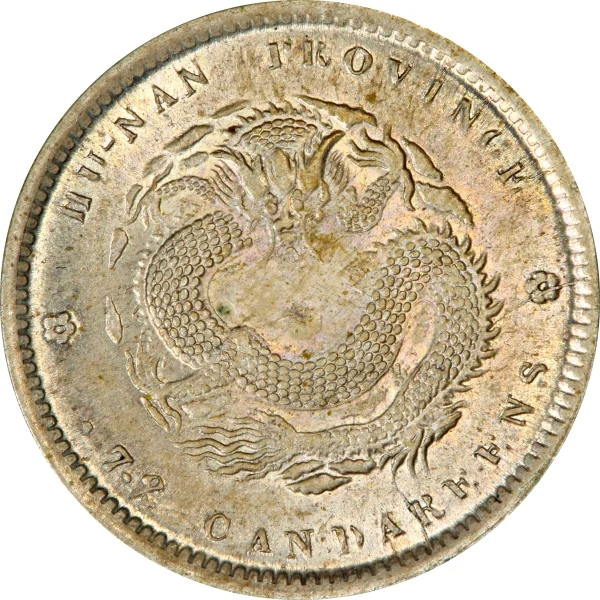
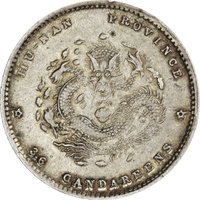
Dragon encircling a pearl, surrounded by English text.
Inscription:
HU-NAN PROVINCE
7.2 CANDAREENS
7.2 CANDAREENS
Script: Latin
Edge
Reeded.
Categories
| Mythology> Fantastic animal |
Mintings
| Year | Mint Mark | Mintage | Quality | Collection |
|---|---|---|---|---|
| 1897 | — | — | ||
| 1902 | — | — |
Historical background
In 1897, the currency situation in Hunan Province was one of profound complexity and instability, characteristic of the late Qing Dynasty's wider monetary crisis. The province operated within a chaotic multi-currency system with no unified standard. The primary mediums included silver, both in sycee (shoe-shaped ingots of highly variable purity and weight), and a dwindling supply of foreign silver dollars, alongside vast quantities of copper cash coins for daily transactions. Critically, the exchange rate between silver and copper cash was not fixed and fluctuated wildly, often to the detriment of peasants who paid taxes in silver but earned income in copper. This instability was exacerbated by a severe nationwide shortage of copper cash, leading to widespread use of privately minted and often debased coins, as well as the circulation of "credit notes" from local merchants and pawnshops.
This monetary disorder was directly tied to both internal decay and external pressure. The Qing central government's inability to enforce a unified currency system allowed provincial authorities and private interests to fill the vacuum. Furthermore, the larger economic context was defined by the massive outflow of silver due to trade imbalances and indemnity payments following the First Sino-Japanese War (1894–1895). The resulting deflationary pressure increased the real burden of debt and taxes, fueling social discontent. In Hunan, a province particularly resistant to foreign influence, the circulation of foreign silver dollars and the growing presence of foreign banks added a dimension of economic nationalism to the currency woes, as locals viewed these instruments as symbols of imperialist encroachment.
Consequently, the currency chaos of 1897 was more than a mere financial inconvenience; it was a significant factor in social unrest and a symptom of the Qing state's faltering sovereignty. The unreliable and predatory monetary environment hindered commerce, strained the agrarian economy, and eroded public trust in both private and official institutions. This financial fragility provided a fertile ground for the revolutionary sentiments that would soon grow more potent in Hunan, making the province's currency crisis a microcosm of the dynastic collapse that would follow in the early 20th century.
This monetary disorder was directly tied to both internal decay and external pressure. The Qing central government's inability to enforce a unified currency system allowed provincial authorities and private interests to fill the vacuum. Furthermore, the larger economic context was defined by the massive outflow of silver due to trade imbalances and indemnity payments following the First Sino-Japanese War (1894–1895). The resulting deflationary pressure increased the real burden of debt and taxes, fueling social discontent. In Hunan, a province particularly resistant to foreign influence, the circulation of foreign silver dollars and the growing presence of foreign banks added a dimension of economic nationalism to the currency woes, as locals viewed these instruments as symbols of imperialist encroachment.
Consequently, the currency chaos of 1897 was more than a mere financial inconvenience; it was a significant factor in social unrest and a symptom of the Qing state's faltering sovereignty. The unreliable and predatory monetary environment hindered commerce, strained the agrarian economy, and eroded public trust in both private and official institutions. This financial fragility provided a fertile ground for the revolutionary sentiments that would soon grow more potent in Hunan, making the province's currency crisis a microcosm of the dynastic collapse that would follow in the early 20th century.
✨ Legendary