



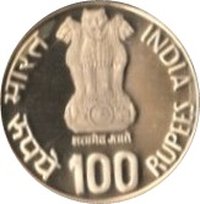
100 Rupees – India
Non-circulating coins
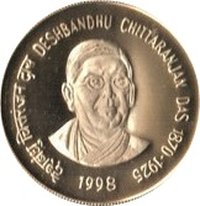
Commemoration: Deshbandhu Chittaranjan
India

Material
References
KM: #Click to copy to clipboard299
Numista: #139405
Value
Exchange value: 100 INR = $1.10
Bullion value: $50.76
Inflation-adjusted value: 540.05 INR
Obverse
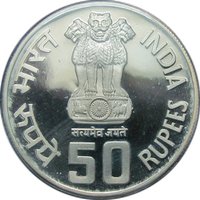
Reverse
Edge
Reeded
Mints
| Name | Mark |
|---|---|
| Kolkata / Calcutta / Murshidabad | — |
Mintings
| Year | Mint Mark | Mintage | Quality | Collection |
|---|---|---|---|---|
| 1998 | — | — | ||
| 1998 | — | — | Proof |
Historical background
In 1998, India's currency situation was defined by a period of cautious stability under the framework of a managed float, but was significantly challenged by external shocks. Following the economic liberalization of 1991, the Indian Rupee (INR) had moved away from a fixed exchange rate to a market-determined system, though the Reserve Bank of India (RBI) actively intervened to curb excessive volatility. The period was initially marked by relative calm, with the RBI building foreign exchange reserves and maintaining a tight monetary policy to control inflation and stabilize the rupee, which traded in a band of approximately ₹39-43 against the US dollar in the years leading up to 1998.
This stability was severely tested by two major events in 1998: the Asian Financial Crisis, which had erupted in mid-1997, and the domestic nuclear tests in May. The regional crisis led to capital flight and speculative pressure on currencies across Asia, indirectly affecting India. More directly, the Pokhran-II nuclear tests triggered immediate international sanctions, notably from the United States and Japan, which hampered capital inflows and increased the risk premium on Indian assets. Consequently, the rupee came under intense downward pressure, depreciating from around ₹39.5 to the dollar in early 1998 to nearly ₹43 by August, as the RBI spent billions from its reserves in a defensive effort to slow the decline.
The government and RBI responded with a multi-pronged strategy to manage the crisis. Capital controls were tightened marginally to deter speculation, and high-interest rates were maintained to attract foreign portfolio investment. A critical move was the launch of the Resurgent India Bonds (RIBs) in August 1998, a diaspora bond scheme that successfully raised over $4.2 billion from Non-Resident Indians (NRIs). This influx provided a crucial cushion for foreign reserves and restored market confidence. By year-end, these measures had stabilized the currency, demonstrating India's resilience but also highlighting its continued vulnerability to geopolitical events and global financial sentiment within the post-liberalization economic framework.
This stability was severely tested by two major events in 1998: the Asian Financial Crisis, which had erupted in mid-1997, and the domestic nuclear tests in May. The regional crisis led to capital flight and speculative pressure on currencies across Asia, indirectly affecting India. More directly, the Pokhran-II nuclear tests triggered immediate international sanctions, notably from the United States and Japan, which hampered capital inflows and increased the risk premium on Indian assets. Consequently, the rupee came under intense downward pressure, depreciating from around ₹39.5 to the dollar in early 1998 to nearly ₹43 by August, as the RBI spent billions from its reserves in a defensive effort to slow the decline.
The government and RBI responded with a multi-pronged strategy to manage the crisis. Capital controls were tightened marginally to deter speculation, and high-interest rates were maintained to attract foreign portfolio investment. A critical move was the launch of the Resurgent India Bonds (RIBs) in August 1998, a diaspora bond scheme that successfully raised over $4.2 billion from Non-Resident Indians (NRIs). This influx provided a crucial cushion for foreign reserves and restored market confidence. By year-end, these measures had stabilized the currency, demonstrating India's resilience but also highlighting its continued vulnerability to geopolitical events and global financial sentiment within the post-liberalization economic framework.

💎 Extremely Rare