

500 Réis – Portugal
Circulating commemorative coins
Commemoration: Peninsular War
Portugal
Context

Material
References
KM: #Click to copy to clipboard556
Numista: #34733
Value
Bullion value: $29.87
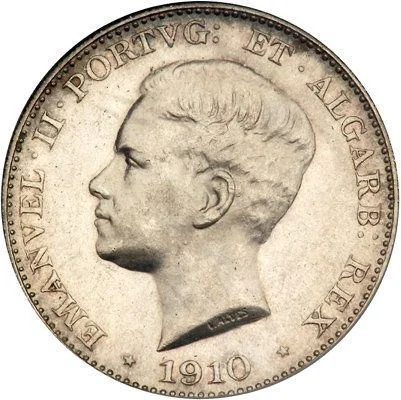
Obverse
Inscription:
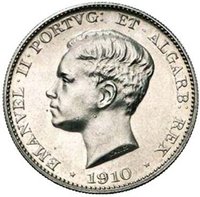
EMMANVEL ·II· PORTVG: ET · ALGARB: REX
V.ALVES
1910
V.ALVES
1910
Translation:
EMMANUEL II KING OF PORTUGAL AND THE ALGARVE
V. ALVES
1910
V. ALVES
1910
Script: Latin
Languages: Portuguese, Latin
Engraver: Venâncio Alves
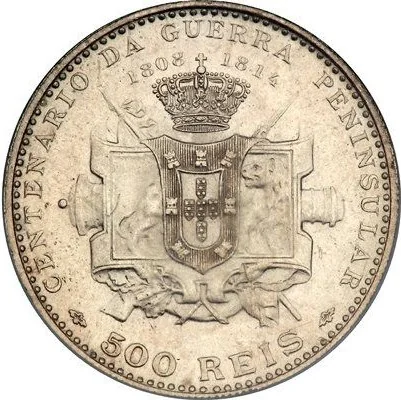
Reverse
Inscription:
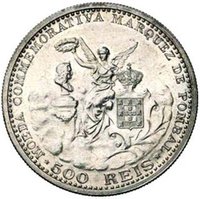
CENTENARIO DA GUERRA PENINSULAR
1808 1814
500 REIS
1808 1814
500 REIS
Script: Latin
Engraver: Venâncio Alves
Edge
Reeded
Mints
| Name | Mark |
|---|---|
| Imprensa Nacional - Casa da Moeda | — |
Mintings
| Year | Mint Mark | Mintage | Quality | Collection |
|---|---|---|---|---|
| 1910 | — | 200,000 | ||
| 1910 | — | — | Proof |
Historical background
In 1910, Portugal's currency situation was intrinsically linked to its profound political and economic instability. The nation operated under the gold standard, with the real (plural: réis) as its official currency, but years of fiscal mismanagement, heavy foreign debt, and stagnant industry had severely undermined confidence. The monarchy, under King Carlos I and later Manuel II, struggled with chronic budget deficits, leading to repeated devaluations and a reliance on inflationary paper money. This financial weakness mirrored the decaying political order, creating a climate ripe for revolutionary change.
The immediate trigger for the monetary crisis was the 1891 bankruptcy, when Portugal famously defaulted on its external debt. This event shattered international credit, forced the abandonment of gold convertibility for banknotes, and led to a period of fiduciary circulation where the value of paper money was not backed by gold reserves. Consequently, the value of the real fluctuated wildly, inflation eroded purchasing power, and gold coins largely disappeared from everyday circulation, hoarded by the public. The currency became a symbol of national decline.
This precarious financial backdrop was a significant factor in the Republican Revolution of October 5, 1910, which overthrew the monarchy. The new First Portuguese Republic inherited a dire monetary system, recognizing that currency reform was essential for modernization and credibility. One of the new government's earliest and most enduring acts was to address this legacy, introducing a new, stronger currency in 1911: the escudo, valued at 1,000 réis, in an attempt to stabilize the economy and signal a break from the monarchical past.
The immediate trigger for the monetary crisis was the 1891 bankruptcy, when Portugal famously defaulted on its external debt. This event shattered international credit, forced the abandonment of gold convertibility for banknotes, and led to a period of fiduciary circulation where the value of paper money was not backed by gold reserves. Consequently, the value of the real fluctuated wildly, inflation eroded purchasing power, and gold coins largely disappeared from everyday circulation, hoarded by the public. The currency became a symbol of national decline.
This precarious financial backdrop was a significant factor in the Republican Revolution of October 5, 1910, which overthrew the monarchy. The new First Portuguese Republic inherited a dire monetary system, recognizing that currency reform was essential for modernization and credibility. One of the new government's earliest and most enduring acts was to address this legacy, introducing a new, stronger currency in 1911: the escudo, valued at 1,000 réis, in an attempt to stabilize the economy and signal a break from the monarchical past.
🌟 Limited