

500 Schilling (St. Severin) – Austria
Non-circulating coins
Commemoration: 1500th Anniversary of Death of St. Severin
Austria

Obverse
Description:
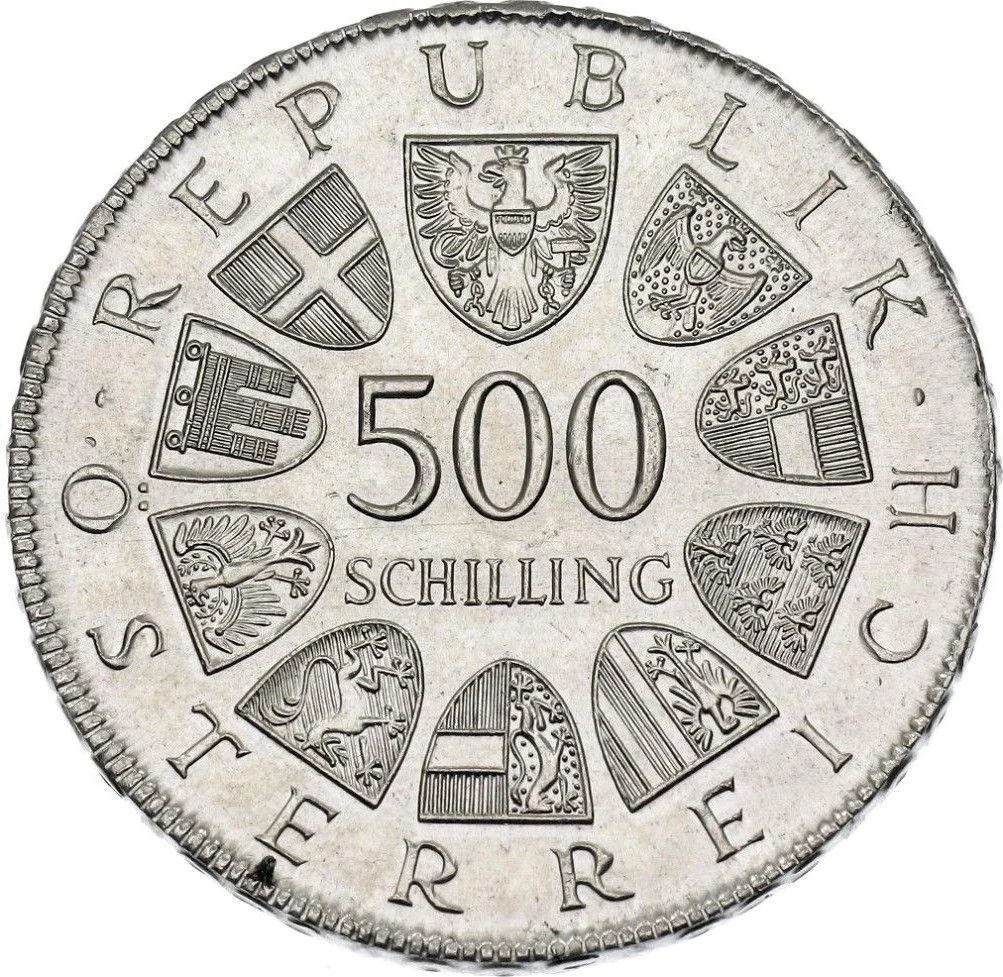
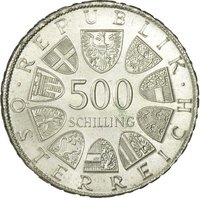
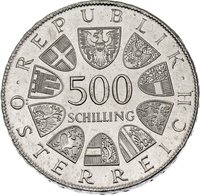
Austrian coat of arms within a ring of shields representing its nine federal states.
Inscription:
REPUBLIK ÖSTERREICH
500 SCHILLING
500 SCHILLING
Translation:
REPUBLIC OF AUSTRIA
500 SCHILLING
500 SCHILLING
Script: Latin
Language: German
Engraver: Edwin Grienauer
Reverse
Description:
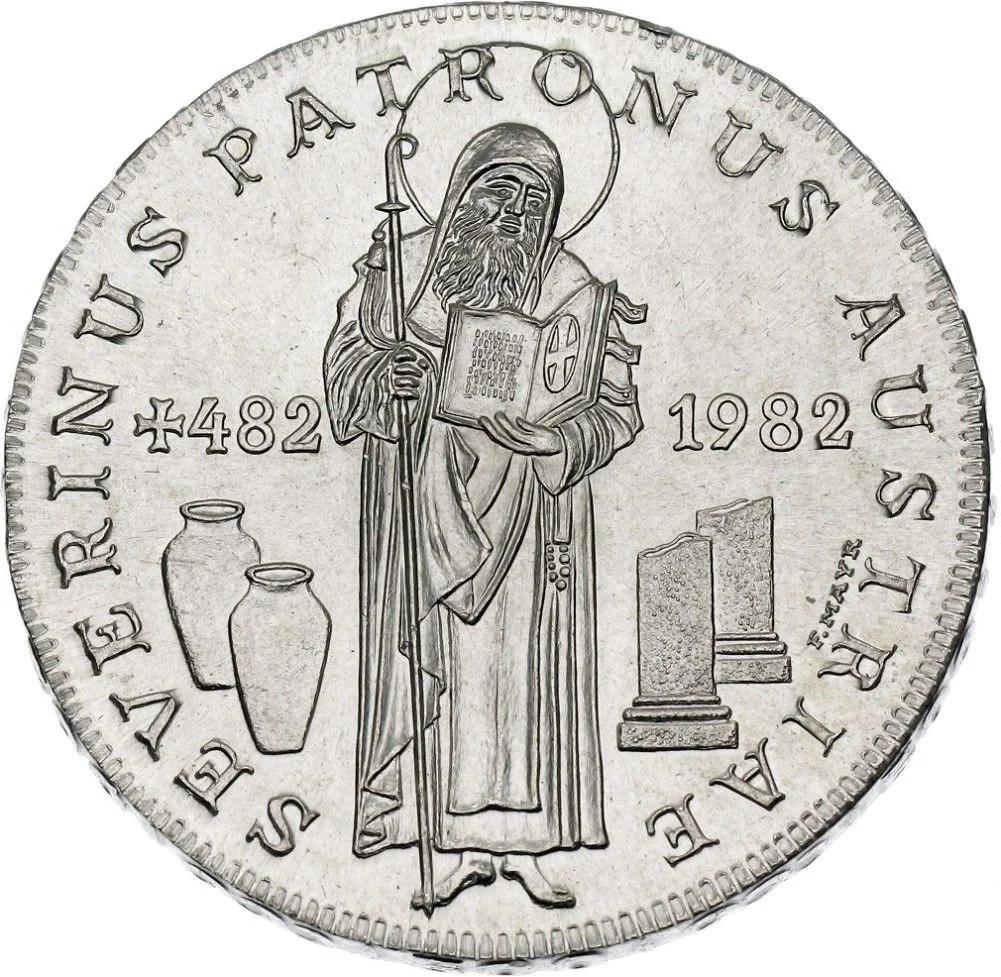
Saint Severin
Inscription:
SEVERINUS PATRONUS AUSTRIAE
482 1982
482 1982
Script: Latin
Engraver: Friedrich Mayr
Edge
Inscripted
Legend:
500
Mints
| Name | Mark |
|---|---|
| Münze Österreich | — |
Mintings
| Year | Mint Mark | Mintage | Quality | Collection |
|---|---|---|---|---|
| 1982 | — | 837,400 | ||
| 1982 | — | 120,000 | Proof |
Historical background
In 1982, Austria's currency situation was defined by its participation in the European Monetary System (EMS), which it had joined in 1979. The primary objective was to maintain exchange rate stability by pegging the Austrian schilling (ATS) to the Deutsche Mark (DEM) within the EMS's exchange rate mechanism (ERM). This policy, often called "hard currency policy" or Hartwährungspolitik, was a deliberate and successful strategy to import the anti-inflationary credibility of the Bundesbank. By closely shadowing the strong German currency, the Austrian National Bank (OeNB) effectively outsourced its monetary discipline, leading to low and stable inflation rates, which stood at around 5.4% in 1982—a significant improvement from the double-digit figures of the mid-1970s.
However, this stability came with trade-offs, particularly during the global economic challenges of the early 1980s. The U.S. Federal Reserve's high-interest-rate policy to combat inflation caused a global recession and a strong U.S. dollar, putting pressure on European currencies. While the schilling's peg provided stability, it also meant Austria had to largely follow German interest rate policies, limiting its own monetary autonomy to address domestic economic concerns. The economy experienced sluggish growth and rising unemployment, but the government and central bank prioritized maintaining the hard currency anchor over stimulating the economy, viewing it as the cornerstone of long-term economic stability.
Consequently, the Austrian schilling in 1982 was considered a stable and strong currency within the European context, but this was a managed stability dependent on German monetary policy. The commitment to the hard currency policy enjoyed broad political and social consensus, seen as a critical factor in Austria's economic resilience. This era solidified a monetary philosophy that would guide Austria for nearly two more decades, ultimately paving the way for its seamless adoption of the euro in 1999.
However, this stability came with trade-offs, particularly during the global economic challenges of the early 1980s. The U.S. Federal Reserve's high-interest-rate policy to combat inflation caused a global recession and a strong U.S. dollar, putting pressure on European currencies. While the schilling's peg provided stability, it also meant Austria had to largely follow German interest rate policies, limiting its own monetary autonomy to address domestic economic concerns. The economy experienced sluggish growth and rising unemployment, but the government and central bank prioritized maintaining the hard currency anchor over stimulating the economy, viewing it as the cornerstone of long-term economic stability.
Consequently, the Austrian schilling in 1982 was considered a stable and strong currency within the European context, but this was a managed stability dependent on German monetary policy. The commitment to the hard currency policy enjoyed broad political and social consensus, seen as a critical factor in Austria's economic resilience. This era solidified a monetary philosophy that would guide Austria for nearly two more decades, ultimately paving the way for its seamless adoption of the euro in 1999.
⭐ Somewhat Rare