

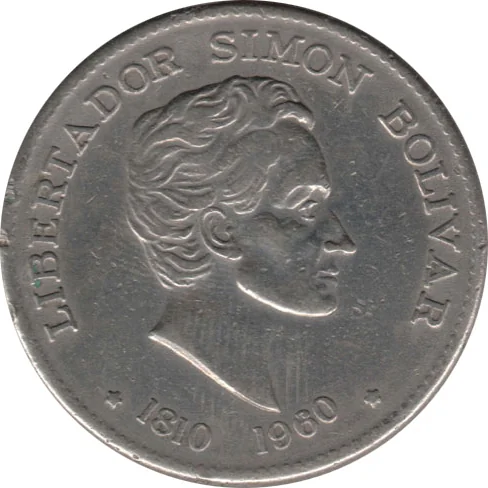
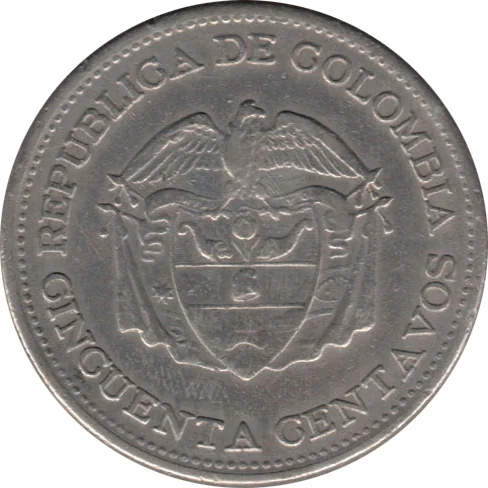
50 Centavos (Proclamation of Independence of Colombia) – Colombia
Circulating commemorative coins
Commemoration: 150th Anniversary of the Proclamation of Independence of Colombia
Colombia
Context

Material
References
KM: #Click to copy to clipboard223
Numista: #34703
Value
Exchange value: 0.50 COP
Inflation-adjusted value: 1868.49 COP
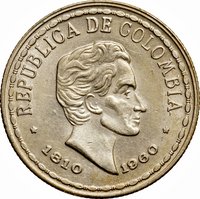
Obverse
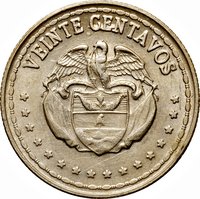
Reverse
Edge
Reeded
Categories
| Event> Independence |
| Person> Politician |
| Symbols> Coat of Arms |
Mints
| Name | Mark |
|---|---|
| Bogota Mint | — |
Mintings
| Year | Mint Mark | Mintage | Quality | Collection |
|---|---|---|---|---|
| 1960 | — | 200,000 |
Historical background
In 1960, Colombia's currency situation was characterized by a managed exchange rate system under the control of the newly established Banco de la República, which had been granted sole authority over currency and credit in 1951. The country operated a multiple exchange rate regime, a complex system where different types of transactions (e.g., exports, imports, financial flows) were subject to different official exchange rates. This mechanism was designed to control capital flows, protect international reserves, and favor specific sectors by making essential imports cheaper and taxing traditional exports like coffee. The peso was not freely convertible, and its value was administratively set rather than determined by the market.
This system existed within the broader context of the National Front political agreement, which aimed to stabilize the country after a period of civil conflict known as La Violencia. Economically, Colombia was in a phase of import-substitution industrialization (ISI), and the multiple exchange rates were a key tool to support this policy by making imported machinery and inputs more affordable for domestic manufacturers while discouraging consumer goods imports. However, the system created distortions, encouraged rent-seeking, and was difficult to administer efficiently. The economy remained heavily dependent on coffee, which accounted for the vast majority of export earnings, making the peso's stability vulnerable to fluctuations in the world coffee price.
By the end of the decade, pressures on this system would intensify, leading to a major devaluation in 1962 and eventual reforms. The 1960 setup, while providing short-term stability and control, embedded imbalances. It reflected a period of transition where Colombia sought to navigate between protecting its nascent industries, managing a primary commodity-dependent economy, and cautiously engaging with the global financial system, all under a fragile political coalition. The complexities of this currency management foreshadowed the persistent challenges of inflation and devaluation that would mark later decades.
This system existed within the broader context of the National Front political agreement, which aimed to stabilize the country after a period of civil conflict known as La Violencia. Economically, Colombia was in a phase of import-substitution industrialization (ISI), and the multiple exchange rates were a key tool to support this policy by making imported machinery and inputs more affordable for domestic manufacturers while discouraging consumer goods imports. However, the system created distortions, encouraged rent-seeking, and was difficult to administer efficiently. The economy remained heavily dependent on coffee, which accounted for the vast majority of export earnings, making the peso's stability vulnerable to fluctuations in the world coffee price.
By the end of the decade, pressures on this system would intensify, leading to a major devaluation in 1962 and eventual reforms. The 1960 setup, while providing short-term stability and control, embedded imbalances. It reflected a period of transition where Colombia sought to navigate between protecting its nascent industries, managing a primary commodity-dependent economy, and cautiously engaging with the global financial system, all under a fragile political coalition. The complexities of this currency management foreshadowed the persistent challenges of inflation and devaluation that would mark later decades.

🌟 Uncommon