

1 crown – New Zealand
Add to wishlist
Circulating commemorative coins
Commemoration: Coronation of Queen Elizabeth II, 1953
New Zealand
Context
Year: 1953
Issuer: New Zealand
Ruler: Elizabeth II
Currency:
(1840—1967)
Demonetized: Yes
Total mintage: 250,000
Material
Diameter: 38.61 mm
Weight: 28.28 g
Thickness: 2.9 mm
Shape: Round
Composition: Copper-nickel
Technique: Milled
Alignment: Medal alignment
flip
References
KM: #
Numista: #13916
Obverse
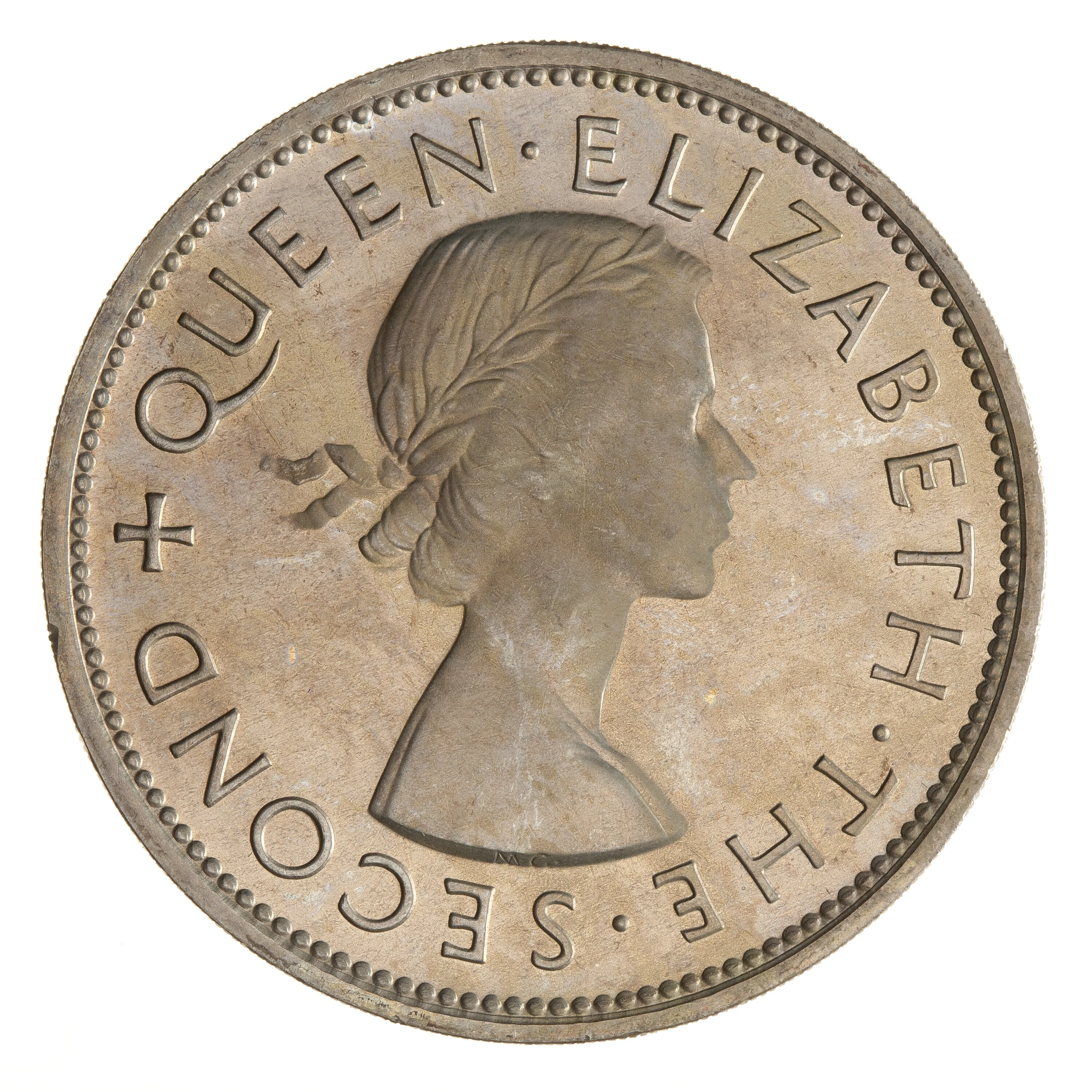
Description:
Young laureate bust of Elizabeth II right, surrounded by legend.
Inscription:
+ QUEEN·ELIZABETH·THE·SECOND
M·G·
M·G·
Script: Latin
Engraver: Mary Gillick
Reverse
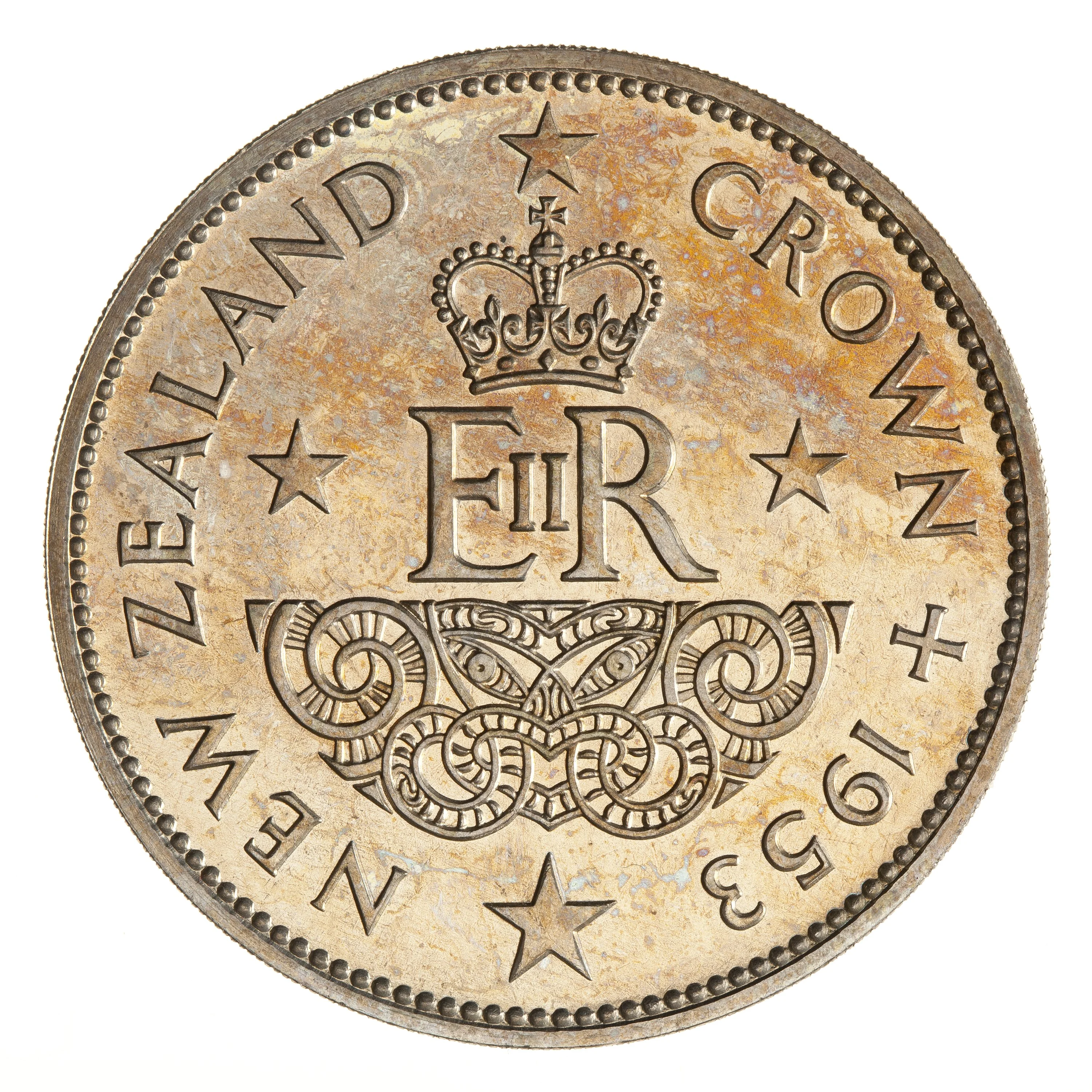
Description:
Royal cypher above Maori carving, flanked by stars, with legend and date.
Inscription:
NEW ZEALAND CROWN + 1953
Script: Latin
Engraver: Robert Maurice Conly
Edge
Reeded
Categories
| Event> Coronation |
| Symbol> Crown |
Mints
| Name | Mark |
|---|---|
| Royal Mint (Tower Hill) | — |
Mintings
| Year | Mint Mark | Mintage | Quality | Collection |
|---|---|---|---|---|
| 1953 | — | — | Matte | |
| 1953 | — | 250,000 | ||
| 1953 | — | — | Proof |
Historical background
In 1953, New Zealand's currency was in a state of transition, firmly embedded within the Sterling Area and operating under a system of exchange controls established during World War II. The New Zealand pound (NZ£) was pegged at parity with the British pound sterling (GBP), meaning the two currencies were officially equal in value. This close linkage meant monetary policy was largely dictated by economic conditions in Britain, and the Reserve Bank of New Zealand managed the exchange to maintain this fixed rate. The country's economic health was heavily dependent on pastoral exports, particularly wool, meat, and dairy, sold overwhelmingly to the United Kingdom, which reinforced the financial ties to Sterling.
The period was characterised by strict capital controls and import licensing, tools used to conserve sterling reserves and manage a persistent balance of payments deficit. These measures were a legacy of the war and post-war reconstruction, designed to prioritise essential imports and protect foreign exchange holdings. While providing stability, this regime also created a complex bureaucratic system for businesses and consumers, limiting access to foreign goods and overseas investment. The economy in the early 1950s was experiencing a boom driven by high commodity prices during the Korean War, but this was beginning to soften by 1953, putting pressure on the managed system.
Significantly, 1953 saw the passage of the Reserve Bank of New Zealand Act, which expanded the central bank's functions beyond merely maintaining currency parity. The new law empowered the Reserve Bank to better regulate credit and currency in pursuit of economic stability, reflecting a growing desire for more independent monetary management. However, the fundamental Sterling link remained unbroken. It would be another decade before decimalisation (shifting to dollars and cents in 1967) and another two decades before the final break with the Sterling peg in the wake of the UK's own decimalisation and the global collapse of the Bretton Woods system.
The period was characterised by strict capital controls and import licensing, tools used to conserve sterling reserves and manage a persistent balance of payments deficit. These measures were a legacy of the war and post-war reconstruction, designed to prioritise essential imports and protect foreign exchange holdings. While providing stability, this regime also created a complex bureaucratic system for businesses and consumers, limiting access to foreign goods and overseas investment. The economy in the early 1950s was experiencing a boom driven by high commodity prices during the Korean War, but this was beginning to soften by 1953, putting pressure on the managed system.
Significantly, 1953 saw the passage of the Reserve Bank of New Zealand Act, which expanded the central bank's functions beyond merely maintaining currency parity. The new law empowered the Reserve Bank to better regulate credit and currency in pursuit of economic stability, reflecting a growing desire for more independent monetary management. However, the fundamental Sterling link remained unbroken. It would be another decade before decimalisation (shifting to dollars and cents in 1967) and another two decades before the final break with the Sterling peg in the wake of the UK's own decimalisation and the global collapse of the Bretton Woods system.
🌱 Common