

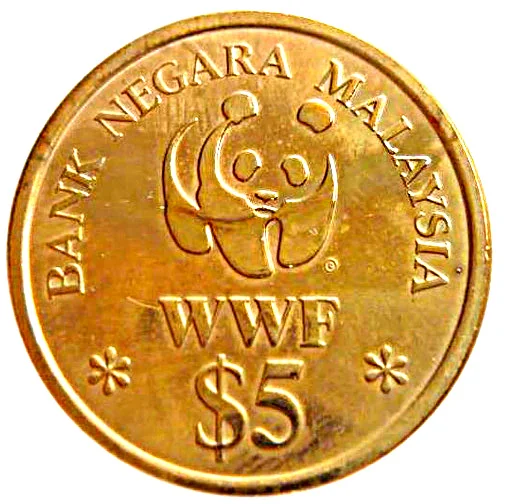
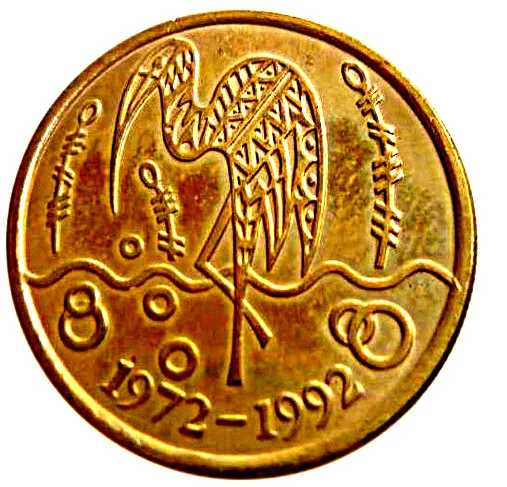
5 ringgit (World Wildlife Fund) – Malaysia
Add to wishlist
Circulating commemorative coins
Commemoration: 20th Anniversary of the World Wildlife Fund
Malaysia
Obverse
Reverse
Edge
Categories
| Animal> Bird |
| Organization> WWF |
Mintings
| Year | Mint Mark | Mintage | Quality | Collection |
|---|---|---|---|---|
| 1992 | — | 100,000 | ||
| 1992 | — | 3,000 | Proof |
Historical background
In 1992, Malaysia's currency, the Ringgit (MYR), was operating under a managed float system, pegged to a undisclosed basket of currencies of its major trading partners. This period was characterized by relative stability, with Bank Negara Malaysia (the central bank) actively intervening in the foreign exchange market to maintain the Ringgit within a targeted band. The primary focus of monetary policy was on ensuring stability to foster economic growth, which was robust during the early 1990s, driven by export-oriented industrialization and significant foreign direct investment. Inflation was moderate, and the currency regime was seen as a cornerstone of the nation's macroeconomic stability.
However, this stability existed against a backdrop of growing global financial market integration and volatility. The early 1990s witnessed significant speculative movements in capital, notably the 1992 European Exchange Rate Mechanism (ERM) crisis, which underscored the vulnerabilities of fixed or heavily managed exchange rate regimes to market sentiment. While Malaysia was not directly caught in that crisis, it served as a cautionary tale. Domestically, there were concerns about the potential for asset bubbles and the challenges of sterilizing large capital inflows to maintain both exchange rate stability and control over domestic money supply.
The situation of 1992 can thus be viewed as the calm before the storm. The managed peg was successful in providing a stable environment for trade and investment in the short term, but it also masked underlying pressures. These included a growing current account deficit and an over-reliance on short-term capital inflows, which would later be brutally exposed during the 1997 Asian Financial Crisis. The crisis would ultimately force Malaysia to abandon its defended peg in favor of a brief period of floating before controversially adopting a hard peg to the US Dollar in 1998, a stark contrast to the more flexible managed basket system of 1992.
However, this stability existed against a backdrop of growing global financial market integration and volatility. The early 1990s witnessed significant speculative movements in capital, notably the 1992 European Exchange Rate Mechanism (ERM) crisis, which underscored the vulnerabilities of fixed or heavily managed exchange rate regimes to market sentiment. While Malaysia was not directly caught in that crisis, it served as a cautionary tale. Domestically, there were concerns about the potential for asset bubbles and the challenges of sterilizing large capital inflows to maintain both exchange rate stability and control over domestic money supply.
The situation of 1992 can thus be viewed as the calm before the storm. The managed peg was successful in providing a stable environment for trade and investment in the short term, but it also masked underlying pressures. These included a growing current account deficit and an over-reliance on short-term capital inflows, which would later be brutally exposed during the 1997 Asian Financial Crisis. The crisis would ultimately force Malaysia to abandon its defended peg in favor of a brief period of floating before controversially adopting a hard peg to the US Dollar in 1998, a stark contrast to the more flexible managed basket system of 1992.
⭐ Rare