

5000 Forint – Hungary
Non-circulating coins
Commemoration: UNESCO World Heritage in Hungary
Hungary
Context

Material
Diameter: 38.61 mm
Weight: 31.46 g
Silver weight: 29.10 g
Shape: Round
Composition: 92.5% Silver
Standard: Silver ounce
Magnetic: No
Technique: Milled
Alignment: Medal alignment
flip
References
KM: #Click to copy to clipboard815
Numista: #34599
Value
Exchange value: 5000 HUF = $15.74
Bullion value: $81.07
Inflation-adjusted value: 10341.45 HUF
Obverse
Description:
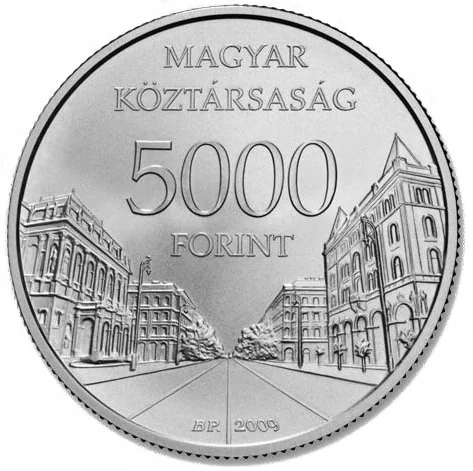
Andrássy Avenue in Budapest, with the Institute of Ballet on the left and the Opera House on the right.
Inscription:
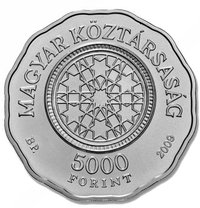
MAGYAR KÖZTÁRSASÁG
5000
FORINT
BP. 2009
5000
FORINT
BP. 2009
Translation:
HUNGARIAN REPUBLIC
5000
FORINT
BP. 2009
5000
FORINT
BP. 2009
Script: Latin
Language: Hungarian
Engraver: Mihály Fritz
Reverse
Description:
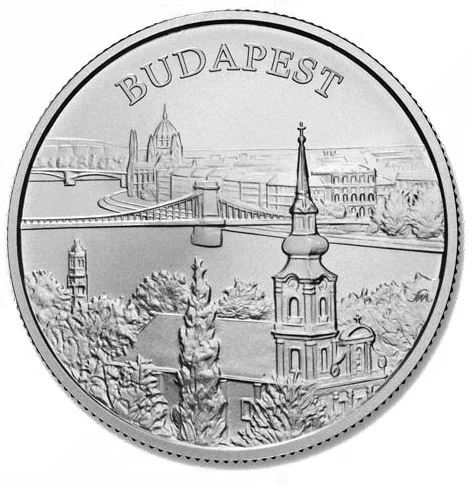
Budapest panorama from Gellért Hill featuring Chain Bridge and Parliament.
Inscription:
BUDAPEST
Script: Latin
Engraver: Mihály Fritz
Edge
Reeded
Categories
| Organization> UNESCO |
Mints
| Name | Mark |
|---|---|
| Hungarian mint | BP. |
Historical background
In 2009, Hungary was grappling with the severe aftermath of the global financial crisis, which had exposed the vulnerabilities of its economy. The country was running high twin deficits (budget and current account) and carried a substantial level of foreign-currency-denominated debt, both at the government and household level. This made the Hungarian forint (HUF) particularly sensitive to shifts in global investor sentiment. As the crisis intensified in late 2008, capital flight from emerging markets led to a sharp depreciation of the forint, losing about 20% of its value against the euro and Swiss franc in a matter of months. This plunge dramatically increased the repayment burden for households with mortgages in foreign currencies, pushing many toward default and creating a major social and banking crisis.
The situation forced the government to seek a stabilization package from the International Monetary Fund (IMF), the European Union, and the World Bank, totaling €20 billion in October 2008. A key condition of this rescue was maintaining a strong forint to curb inflation and stabilize the financial system. Consequently, the Hungarian National Bank (MNB) implemented a policy of high interest rates, with the base rate reaching 9.50% in December 2008 and remaining elevated throughout 2009. This "interest rate defense" aimed to attract capital and support the currency, but it also stifled economic growth, leading to a deep recession with GDP contracting by 6.8% in 2009.
Thus, the currency situation in 2009 was a precarious balancing act. The MNB was forced to prioritize currency stability over economic growth to prevent a full-blown financial collapse, while the government implemented harsh austerity measures to meet IMF targets. The year was defined by the tension between a weakening forint threatening the banking sector and a restrictive monetary policy deepening the recession, leaving Hungary in a fragile state as it slowly began a painful process of adjustment.
The situation forced the government to seek a stabilization package from the International Monetary Fund (IMF), the European Union, and the World Bank, totaling €20 billion in October 2008. A key condition of this rescue was maintaining a strong forint to curb inflation and stabilize the financial system. Consequently, the Hungarian National Bank (MNB) implemented a policy of high interest rates, with the base rate reaching 9.50% in December 2008 and remaining elevated throughout 2009. This "interest rate defense" aimed to attract capital and support the currency, but it also stifled economic growth, leading to a deep recession with GDP contracting by 6.8% in 2009.
Thus, the currency situation in 2009 was a precarious balancing act. The MNB was forced to prioritize currency stability over economic growth to prevent a full-blown financial collapse, while the government implemented harsh austerity measures to meet IMF targets. The year was defined by the tension between a weakening forint threatening the banking sector and a restrictive monetary policy deepening the recession, leaving Hungary in a fragile state as it slowly began a painful process of adjustment.
💎 Extremely Rare