

3000 Forint – Hungary
Non-circulating coins
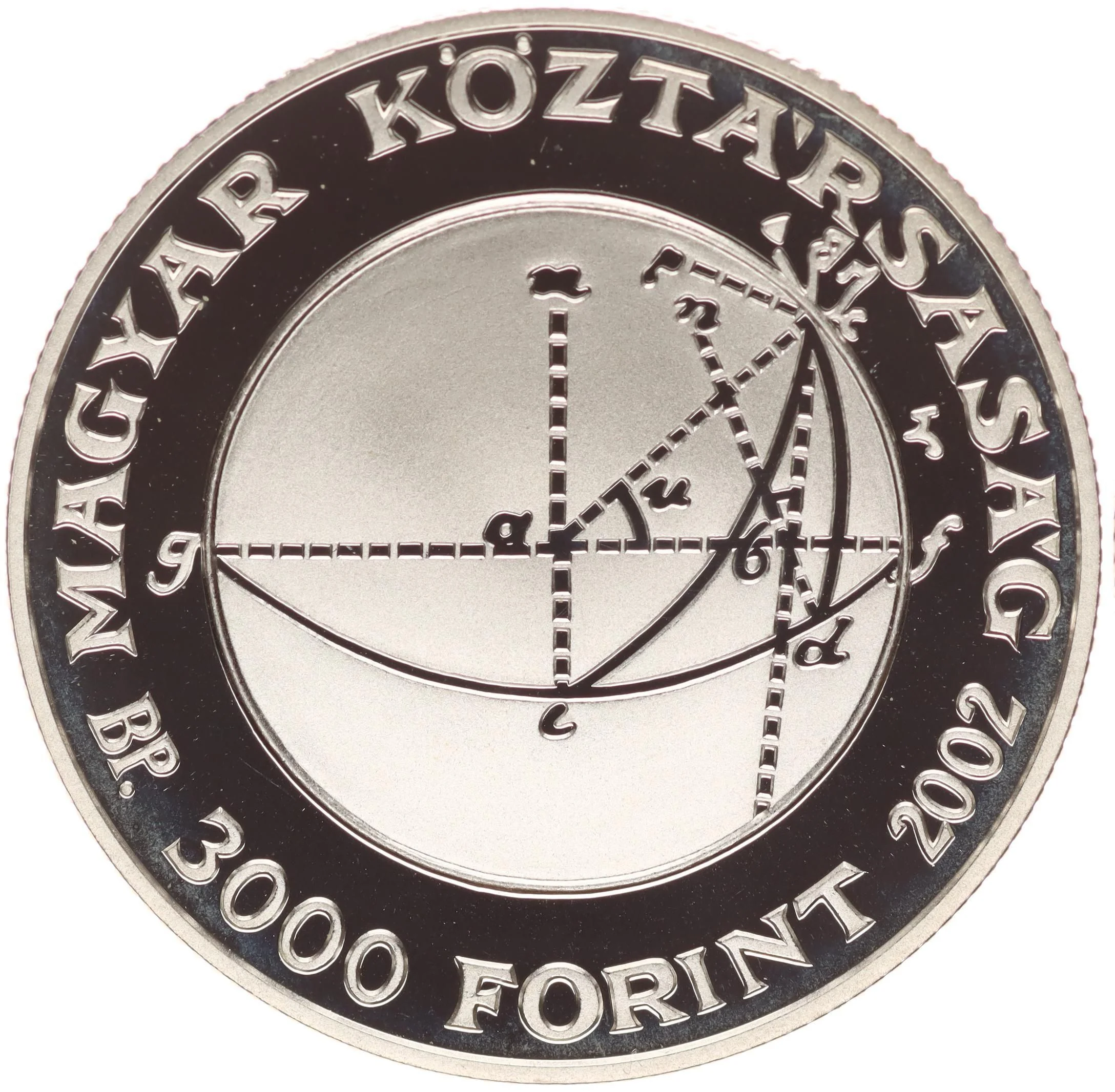
Commemoration: János Bolyai's publication of his "Appendix"
Hungary
Context

Material
Diameter: 38.5 mm
Weight: 31.46 g
Silver weight: 29.10 g
Shape: Round
Composition: 92.5% Silver
Standard: Silver ounce
Magnetic: No
Technique: Milled
References
KM: #Click to copy to clipboard763
Numista: #34572
Value
Exchange value: 3000 HUF = $9.45
Bullion value: $82.72
Inflation-adjusted value: 8991.09 HUF
Obverse
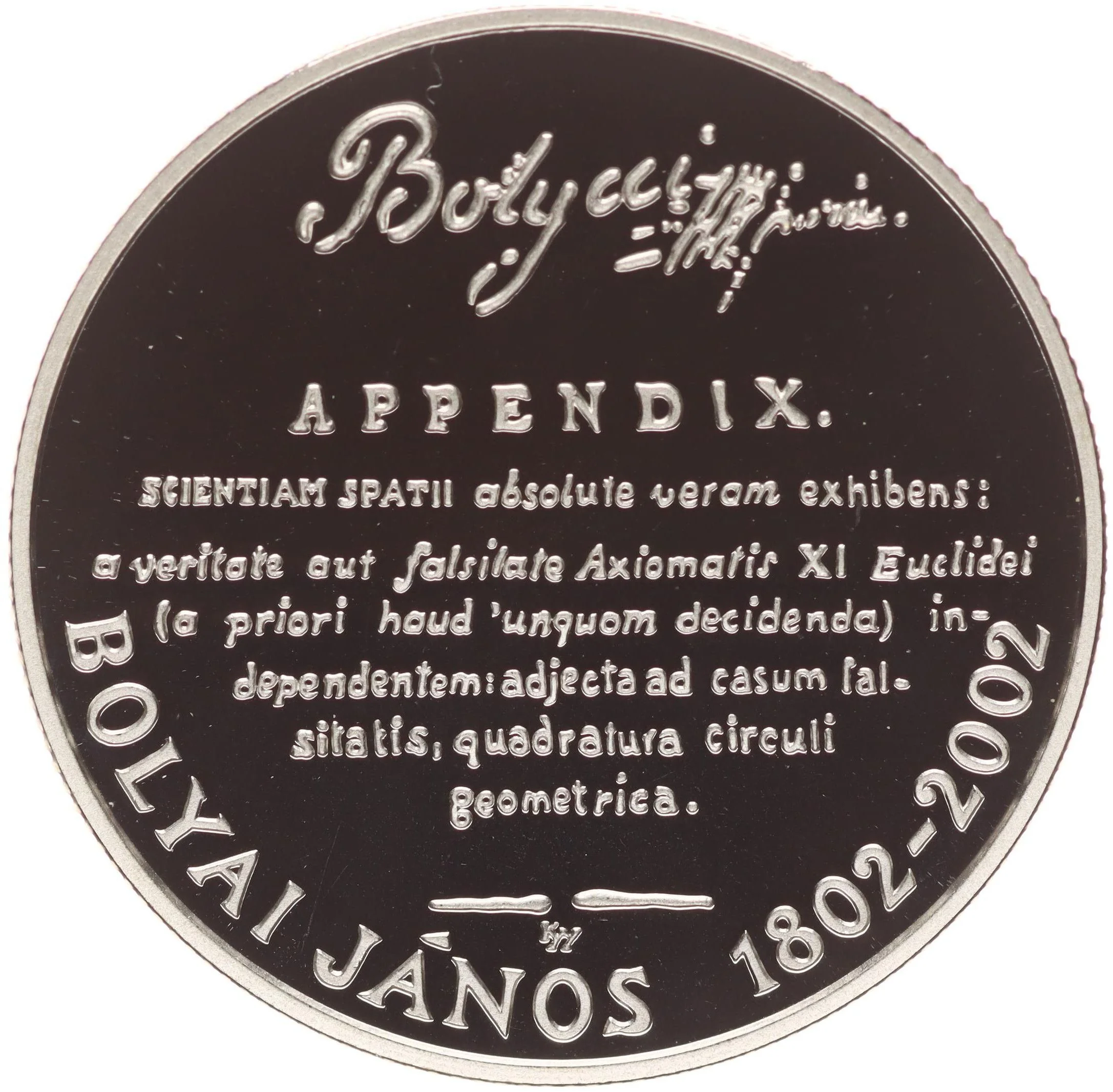
Reverse
Description:
Bolyai János signature, excerpts from his Latin work "Appendix," with inscriptions.
Inscription:
BÓLYAI JÁNOS 1802-2002
Translation:
János Bolyai 1802-2002
Scripts: Latin, Latin (cursive)
Language: Hungarian
Edge
Mints
| Name | Mark |
|---|---|
| Hungarian mint | BP. |
Historical background
In 2002, Hungary's currency situation was defined by a managed floating exchange rate regime for the Hungarian Forint (HUF), operating within a wide ±15% band against the Euro. This system, a remnant of the earlier pre-announced crawling peg used to guide the economy through transition, aimed to balance exchange rate stability with the need for monetary policy flexibility. However, the period was marked by significant pressure on the forint, driven by a large and persistent current account deficit (hovering around 5% of GDP) and a substantial fiscal deficit, which undermined investor confidence and led to recurring bouts of currency weakness.
The National Bank of Hungary (MNB) faced a challenging policy trilemma, needing to manage inflation, support economic growth, and defend the currency simultaneously. High domestic demand, fueled by loose fiscal policy and rising wages, contributed to stubbornly high inflation and import growth, worsening the trade balance. Consequently, the MNB was forced to maintain high benchmark interest rates (around 9-10% in 2002) to attract capital inflows and support the forint, a move that also risked stifling economic activity.
This tense environment set the stage for a major policy shift in 2003. The recurring speculative attacks and vulnerability exposed in 2002 ultimately led to the abandonment of the exchange rate band. In June 2003, following a period of intense pressure, Hungary moved to a fully free-floating exchange rate regime, allowing the forint to find its market level and enabling the central bank to focus more directly on an inflation-targeting monetary policy framework. Thus, 2002 represents the final, strained year of Hungary's managed currency regime before its decisive liberalization.
The National Bank of Hungary (MNB) faced a challenging policy trilemma, needing to manage inflation, support economic growth, and defend the currency simultaneously. High domestic demand, fueled by loose fiscal policy and rising wages, contributed to stubbornly high inflation and import growth, worsening the trade balance. Consequently, the MNB was forced to maintain high benchmark interest rates (around 9-10% in 2002) to attract capital inflows and support the forint, a move that also risked stifling economic activity.
This tense environment set the stage for a major policy shift in 2003. The recurring speculative attacks and vulnerability exposed in 2002 ultimately led to the abandonment of the exchange rate band. In June 2003, following a period of intense pressure, Hungary moved to a fully free-floating exchange rate regime, allowing the forint to find its market level and enabling the central bank to focus more directly on an inflation-targeting monetary policy framework. Thus, 2002 represents the final, strained year of Hungary's managed currency regime before its decisive liberalization.
💎 Extremely Rare