

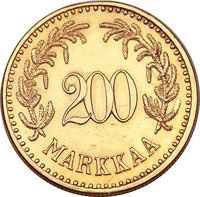
100 markkaa – Finland
Add to wishlist
Finland
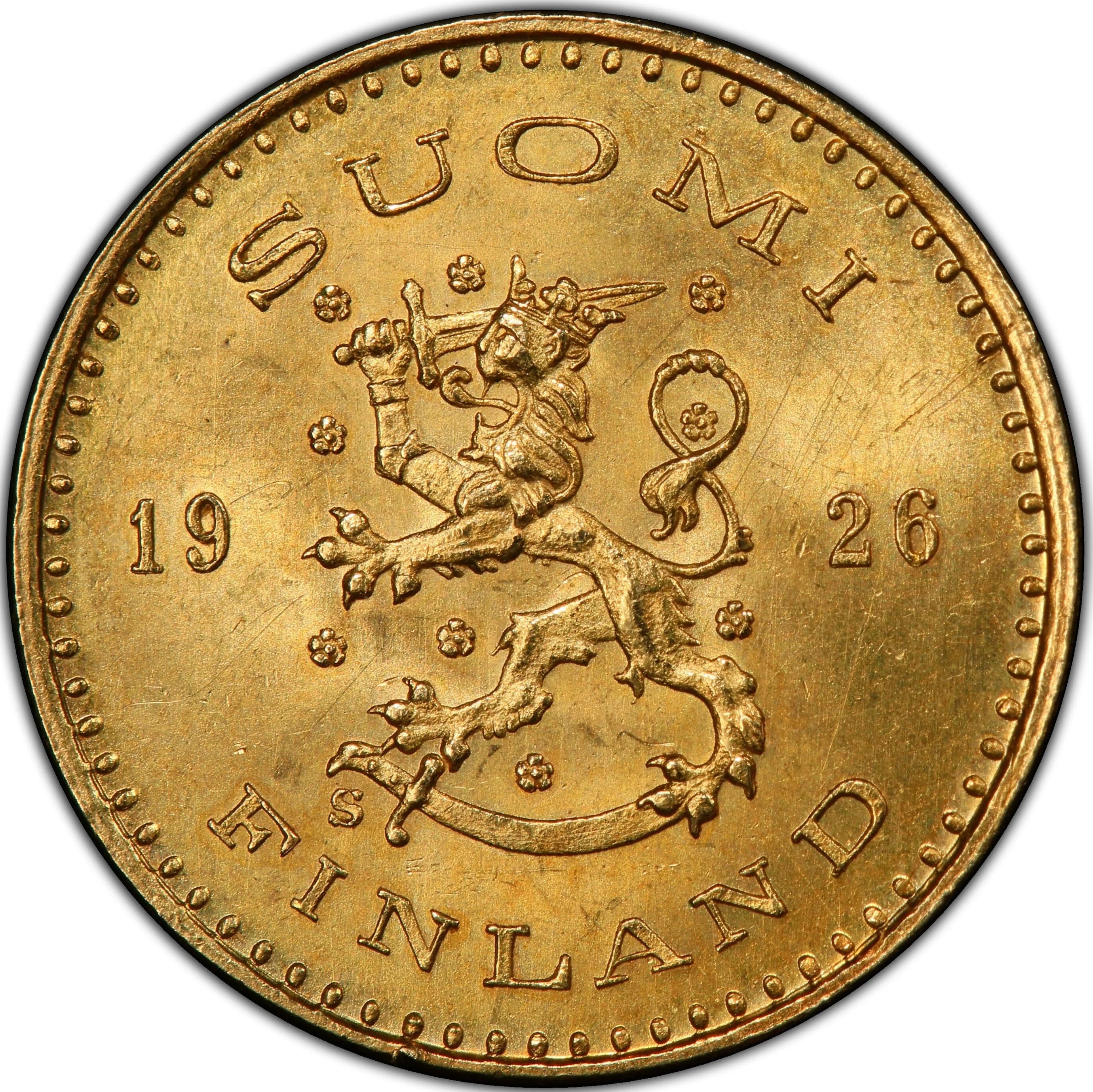
Obverse
Description:
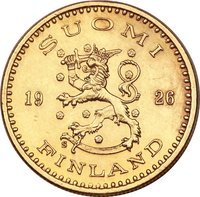
Lion left, date divides legend.
Inscription:
SUOMI
19 26
S
FINLAND
19 26
S
FINLAND
Script: Latin
Engraver: I. Sundell
Reverse
Edge
Categories
| Symbols> Coat of Arms |
| Animal> Feline |
| Plants> Flower |
| Object> Cold weapons |
Mints
| Name | Mark |
|---|---|
| Mint of Finland | — |
Mintings
| Year | Mint Mark | Mintage | Quality | Collection |
|---|---|---|---|---|
| 1926 | — | 50,000 |
Historical background
In 1926, Finland’s currency situation was defined by the stability of the Finnish Markka (markka), which had been successfully pegged to the gold standard since 1924. This followed a period of severe post-war inflation and monetary instability. The Bank of Finland, under the leadership of Governor Risto Ryti, had pursued a rigorous deflationary policy to restore the currency's value, a painful but ultimately successful process that brought credibility and international confidence to the Finnish monetary system.
The gold-backed markka provided a stable foundation for the economy, facilitating trade and investment. However, this stability came at a social cost. The deflation required to achieve the pre-war parity increased the real burden of debt, particularly for farmers and smallholders, leading to widespread agrarian distress and political tension. While the urban industrial sector benefited from lower import costs and stable prices, the rural population faced significant hardship, a divide that influenced the era's politics.
Overall, 1926 represented a calm midpoint in Finland's interwar monetary history. The currency itself was technically secure, but the underlying economic pressures from the preceding stabilization simmered. This period of relative stability would last until the early 1930s, when the global Great Depression and its deflationary shocks forced Finland, like many other nations, to eventually abandon the gold standard in 1931.
The gold-backed markka provided a stable foundation for the economy, facilitating trade and investment. However, this stability came at a social cost. The deflation required to achieve the pre-war parity increased the real burden of debt, particularly for farmers and smallholders, leading to widespread agrarian distress and political tension. While the urban industrial sector benefited from lower import costs and stable prices, the rural population faced significant hardship, a divide that influenced the era's politics.
Overall, 1926 represented a calm midpoint in Finland's interwar monetary history. The currency itself was technically secure, but the underlying economic pressures from the preceding stabilization simmered. This period of relative stability would last until the early 1930s, when the global Great Depression and its deflationary shocks forced Finland, like many other nations, to eventually abandon the gold standard in 1931.
💎 Extremely Rare