


5 euro (Latvijas Banka establishment) – Latvia
Add to wishlist
Non-circulating coins
Commemoration: 100 years the establishment of Latvijas Banka
Latvia
Context
Material
Diameter: 35 mm
Weight: 36.7 g
Silver Weight:: 33.95 g
Shape: Round with cutouts
Composition: 92.5% Silver
Magnetic: No
Technique: Milled
Alignment: Medal alignment
flip

References
KM: #
Numista: #345039
Value
Exchange value: 5 EUR
Bullion value: $83.03
Inflation-adjusted value: 6.51 EUR
Obverse
Description:
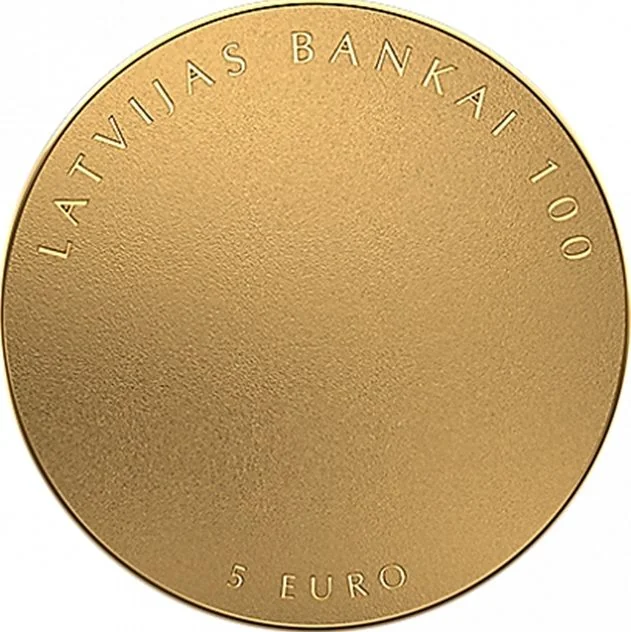
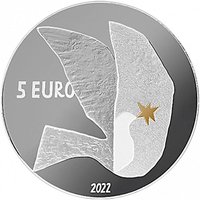
Gilded and frosted, the obverse features LATVIJAS BANKA arched along the top and 5 EURO at the bottom.
Inscription:
LATVIJAS BANKAI 100
5 EURO
5 EURO
Translation:
One hundred years of the Bank of Latvia
5 Euro
5 Euro
Script: Latin
Language: Latvian
Designer: Krista un Reinis Dzudzilo
Reverse
Description:
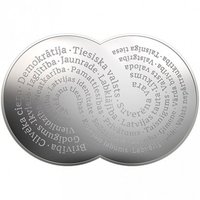
The reverse has nine mirrored steps in relief. The top step is a gilded arc, evoking a sunrise and resembling the Latvijas Banka logo. The year 2022 is at the bottom.
Inscription:
2022
Script: Latin
Designer: Krista un Reinis Dzudzilo
Edge
Plain, gilded
Mints
| Name | Mark |
|---|---|
| Lithuanian Mint | — |
Mintings
| Year | Mint Mark | Mintage | Quality | Collection |
|---|---|---|---|---|
| 2022 | — | 5,000 | Proof |
Historical background
In 2022, Latvia's currency situation was defined by its longstanding membership in the Eurozone, having adopted the euro as its official currency on January 1, 2014. Consequently, the country did not have an independent monetary policy, as it was set by the European Central Bank (ECB) for the entire euro area. This meant Latvia's primary economic tools were fiscal policy and macroprudential measures, while its financial stability was intrinsically linked to the broader Eurosystem and the ECB's responses to union-wide challenges.
The key external pressure on Latvia's economy in 2022 was historically high inflation, driven by the spillover effects of Russia's invasion of Ukraine. Like the rest of the Eurozone, Latvia experienced soaring energy and food prices, with its annual inflation rate peaking at over 22% in the summer—among the highest in the EU. This surge was exacerbated by the country's direct exposure to the conflict due to its geographic proximity and historical economic ties, leading to severe energy price shocks and supply chain disruptions. The national debate, therefore, focused not on exchange rates but on government measures to shield households and businesses from soaring costs.
Domestically, the fixed exchange rate regime of the euro provided stability and eliminated currency risk for trade and investment, which was crucial during a period of global uncertainty. However, it also meant Latvia could not devalue a national currency to gain competitiveness or tailor interest rates specifically to its economic overheating. The Latvian government and Bank of Latvia officials consistently supported the euro as a source of resilience, advocating for coordinated ECB action to tighten monetary policy to combat inflation while implementing targeted national fiscal support to address the severe cost-of-living crisis facing its citizens.
The key external pressure on Latvia's economy in 2022 was historically high inflation, driven by the spillover effects of Russia's invasion of Ukraine. Like the rest of the Eurozone, Latvia experienced soaring energy and food prices, with its annual inflation rate peaking at over 22% in the summer—among the highest in the EU. This surge was exacerbated by the country's direct exposure to the conflict due to its geographic proximity and historical economic ties, leading to severe energy price shocks and supply chain disruptions. The national debate, therefore, focused not on exchange rates but on government measures to shield households and businesses from soaring costs.
Domestically, the fixed exchange rate regime of the euro provided stability and eliminated currency risk for trade and investment, which was crucial during a period of global uncertainty. However, it also meant Latvia could not devalue a national currency to gain competitiveness or tailor interest rates specifically to its economic overheating. The Latvian government and Bank of Latvia officials consistently supported the euro as a source of resilience, advocating for coordinated ECB action to tighten monetary policy to combat inflation while implementing targeted national fiscal support to address the severe cost-of-living crisis facing its citizens.

💎 Extremely Rare