

20000 forint (Hungarian Nationhood) – Hungary
Add to wishlist
Non-circulating coins
Commemoration: 1100th Anniversary of Hungarian Nationhood
Hungary
Context
Material
References
KM: #
Numista: #34482
Value
Exchange value: 20000 HUF
Bullion value: $1057.32
Inflation-adjusted value: 131728.20 HUF
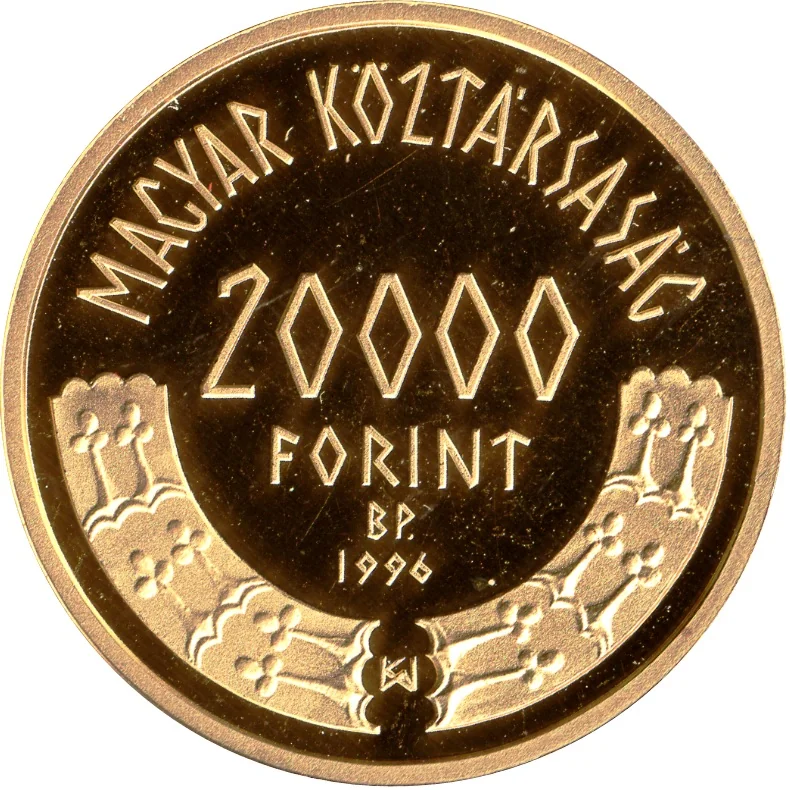
Obverse
Description:
Foliage trim
Inscription:
MAGYAR KÖZTÁRSASÁG
20000
FORINT
BP.
1996
KNA
20000
FORINT
BP.
1996
KNA
Translation:
HUNGARIAN REPUBLIC
20000
FORINT
BP.
1996
KNA
20000
FORINT
BP.
1996
KNA
Script: Latin
Language: Hungarian
Engraver: András Kis Nagy
Reverse
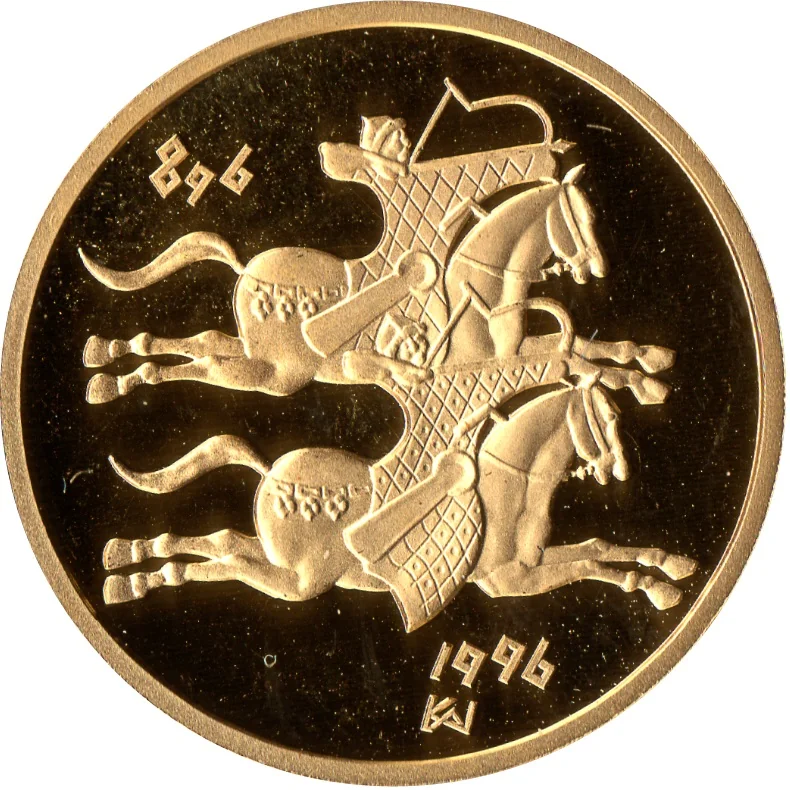
Description:
Two riders arching right.
Inscription:
896
1996
KNA
1996
KNA
Script: Latin
Engraver: András Kis Nagy
Edge
Plain
Mints
| Name | Mark |
|---|---|
| Hungarian mint | BP. |
Mintings
| Year | Mint Mark | Mintage | Quality | Collection |
|---|---|---|---|---|
| 1996 | BP. | 5,000 | Proof |
Historical background
In 1996, Hungary was navigating a critical and delicate phase in its transition from a centrally planned to a market economy. The country had implemented a bold stabilization program in 1995, the "Bokros package," which had successfully tackled a severe current account and fiscal crisis but at a significant social cost. A central feature of this program was the introduction of a pre-announced, crawling peg exchange rate regime for the Hungarian forint (HUF). This system allowed the forint to depreciate against a basket of currencies (50% USD, 50% DEM) at a controlled, pre-set monthly rate, providing much-needed stability and predictability for investors and curbing inflationary expectations.
The currency situation was characterized by a tense balance. The crawling peg, with a monthly devaluation of 1.1% in early 1996, was instrumental in maintaining export competitiveness and guiding inflation downward from its previous hyperinflationary levels. However, it also required high real interest rates to maintain, attracting substantial speculative capital inflows ("hot money") that complicated monetary policy. The National Bank of Hungary faced the constant challenge of sterilizing these inflows to prevent excessive money supply growth, which put pressure on the country's foreign exchange reserves and budget.
Overall, 1996 was a year of consolidation under this managed regime. The forint was stable but not freely convertible, and the government's priority was to use the breathing room provided by the peg to continue fiscal tightening and structural reforms. The success of this period set the stage for the gradual liberalization of the capital account later in the decade and the eventual shift to a wider band and then a free-floating exchange rate regime in the early 2000s, as Hungary prepared for European Union accession.
The currency situation was characterized by a tense balance. The crawling peg, with a monthly devaluation of 1.1% in early 1996, was instrumental in maintaining export competitiveness and guiding inflation downward from its previous hyperinflationary levels. However, it also required high real interest rates to maintain, attracting substantial speculative capital inflows ("hot money") that complicated monetary policy. The National Bank of Hungary faced the constant challenge of sterilizing these inflows to prevent excessive money supply growth, which put pressure on the country's foreign exchange reserves and budget.
Overall, 1996 was a year of consolidation under this managed regime. The forint was stable but not freely convertible, and the government's priority was to use the breathing room provided by the peg to continue fiscal tightening and structural reforms. The success of this period set the stage for the gradual liberalization of the capital account later in the decade and the eventual shift to a wider band and then a free-floating exchange rate regime in the early 2000s, as Hungary prepared for European Union accession.
✨ Legendary