

20 pesos – Mexico
Add to wishlist
Circulating commemorative coins
Commemoration: Bicentennial of the Mexican Navy
Mexico
Context
Material
Diameter: 30 mm
Weight: 12.67 g
Shape: Dodecagonal
Techniques: Latent image, Milled
Alignment: Coin alignment
flip
References
KM: #
Numista: #343433
Value
Exchange value: 20 MXN
Inflation-adjusted value: 23.72 MXN
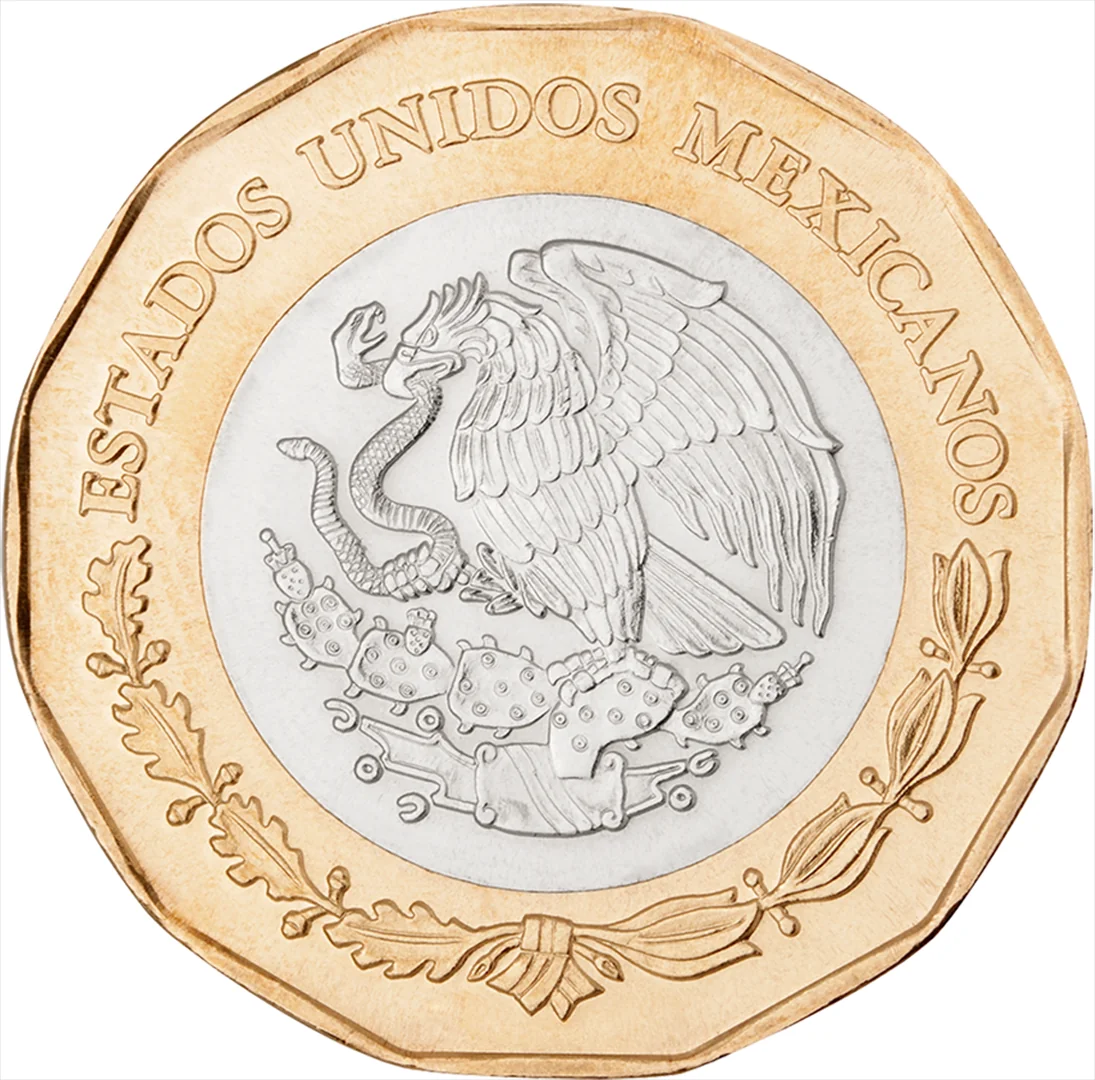
Obverse
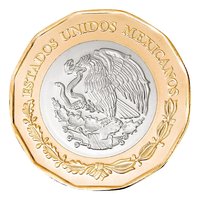
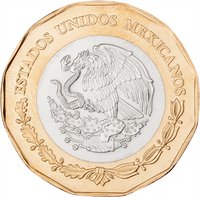
Reverse
Description:
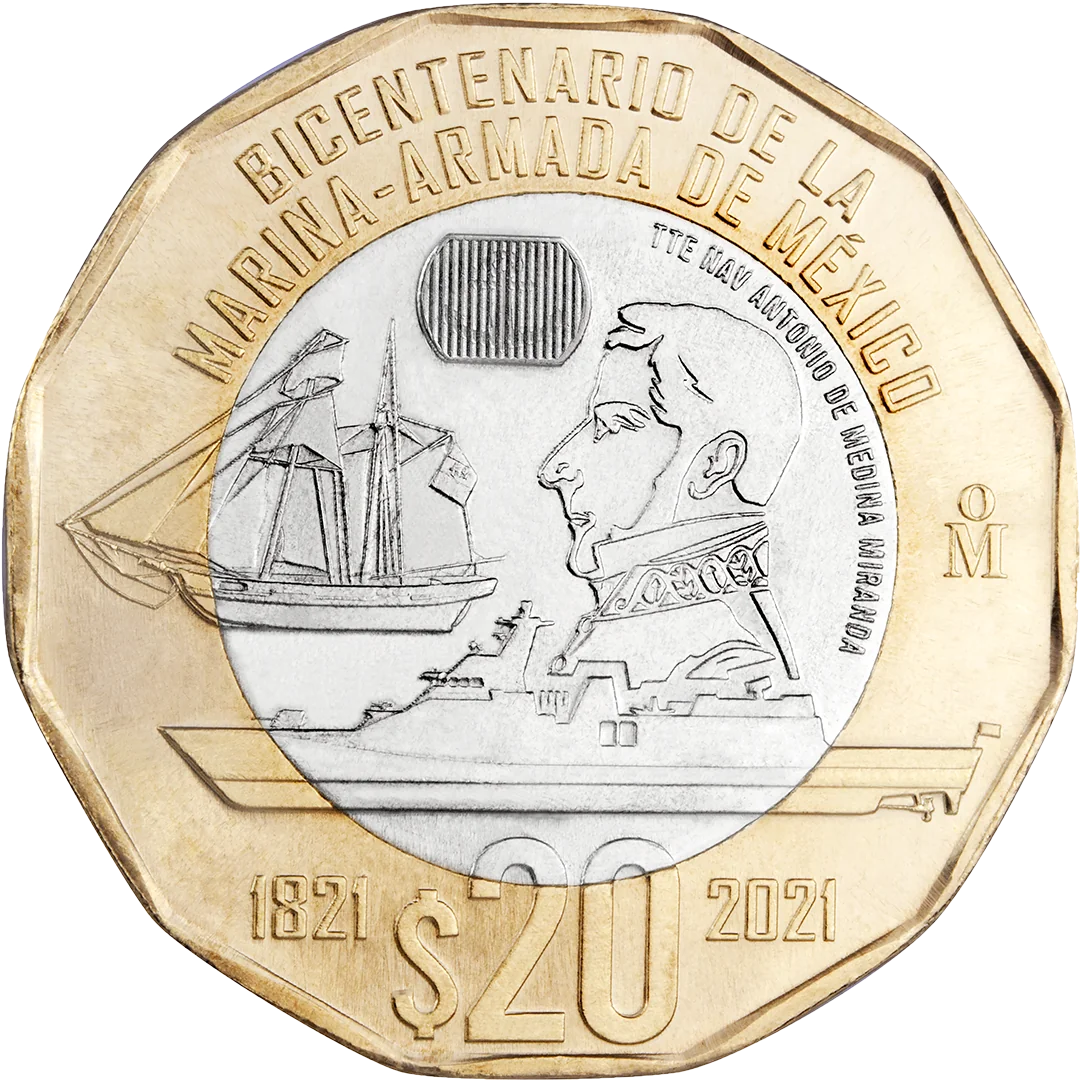
Lieutenant José Antonio de Medina Miranda. To the left, the schooner “Iguala” and, below, the “Patrulla Oceánica de Largo Alcance” vessel. A latent anchor image.
Inscription:
BICENTENARIO DE LA MARINA-ARMADA DE MÉXICO
TTE NAV ANTONIO DE MEDINA MIRANDA
Mo
1821 $20 2021
TTE NAV ANTONIO DE MEDINA MIRANDA
Mo
1821 $20 2021
Translation:
Bicentennial of the Mexican Navy
Lt. Nav. Antonio de Medina Miranda
Mo
1821 $20 2021
Lt. Nav. Antonio de Medina Miranda
Mo
1821 $20 2021
Script: Latin
Language: Spanish
Edge
Segmented reeding.
Categories
| Symbol> Wreath |
| Animal> Bird> Eagle |
| Person> Military leader |
| Symbol> Anchor |
| Symbols> Coat of Arms |
Mints
| Name | Mark |
|---|---|
| Mexican Mint | (Mo) |
Mintings
| Year | Mint Mark | Mintage | Quality | Collection |
|---|---|---|---|---|
| 2022 | Mo | 5,000,000 |
Historical background
In 2022, Mexico's currency, the peso (MXN), demonstrated remarkable resilience in the face of significant global headwinds. The year began with the peso trading around 20.5 per US dollar, and it maintained relative strength throughout, closing the year near 19.5. This performance was notable as it occurred against a backdrop of aggressive interest rate hikes by the U.S. Federal Reserve, which typically triggers capital outflows from emerging markets. The Bank of Mexico (Banxico) played a crucial role by implementing an even more aggressive monetary tightening cycle, raising its benchmark rate from 5.5% at the start of the year to 10.5% by December. This policy differential helped support the peso by attracting foreign investment into higher-yielding Mexican assets.
Several structural factors underpinned the peso's strength. Record-high remittances, which exceeded $58 billion for the year, provided a consistent inflow of US dollars, bolstering the country's current account. Furthermore, Mexico benefited from the ongoing trend of "nearshoring," as global companies sought to relocate supply chains closer to the North American market amid geopolitical and trade tensions. This prospect of increased long-term foreign direct investment boosted investor confidence. Additionally, high prices for Mexico's key commodity exports, particularly oil, contributed to a favorable trade balance during parts of the year.
However, the peso's strength was not without domestic controversy and risk. President Andrés Manuel López Obrador (AMLO) frequently criticized Banxico's rate hikes, creating tension between the government and the autonomous central bank. Investors also monitored the president's contentious energy and mining sector reforms, which created policy uncertainty. While the peso was a regional outperformer in 2022, its stability was tested by global volatility, including the war in Ukraine and persistent inflation. Ultimately, the year highlighted a divergence between a robust currency, supported by monetary policy and external income, and a domestic economy experiencing modest growth and ongoing political debates over the state's role in the economy.
Several structural factors underpinned the peso's strength. Record-high remittances, which exceeded $58 billion for the year, provided a consistent inflow of US dollars, bolstering the country's current account. Furthermore, Mexico benefited from the ongoing trend of "nearshoring," as global companies sought to relocate supply chains closer to the North American market amid geopolitical and trade tensions. This prospect of increased long-term foreign direct investment boosted investor confidence. Additionally, high prices for Mexico's key commodity exports, particularly oil, contributed to a favorable trade balance during parts of the year.
However, the peso's strength was not without domestic controversy and risk. President Andrés Manuel López Obrador (AMLO) frequently criticized Banxico's rate hikes, creating tension between the government and the autonomous central bank. Investors also monitored the president's contentious energy and mining sector reforms, which created policy uncertainty. While the peso was a regional outperformer in 2022, its stability was tested by global volatility, including the war in Ukraine and persistent inflation. Ultimately, the year highlighted a divergence between a robust currency, supported by monetary policy and external income, and a domestic economy experiencing modest growth and ongoing political debates over the state's role in the economy.
🌱 Fairly Common