

2 rand – South Africa
Add to wishlist
Non-circulating coins
Commemoration: 2010 FIFA World Cup, South Africa
South Africa
Context
Material
References
KM: #
Numista: #138885
Value
Exchange value: 2 ZAR
Bullion value: $75.71
Inflation-adjusted value: 5.07 ZAR
Obverse
Description:
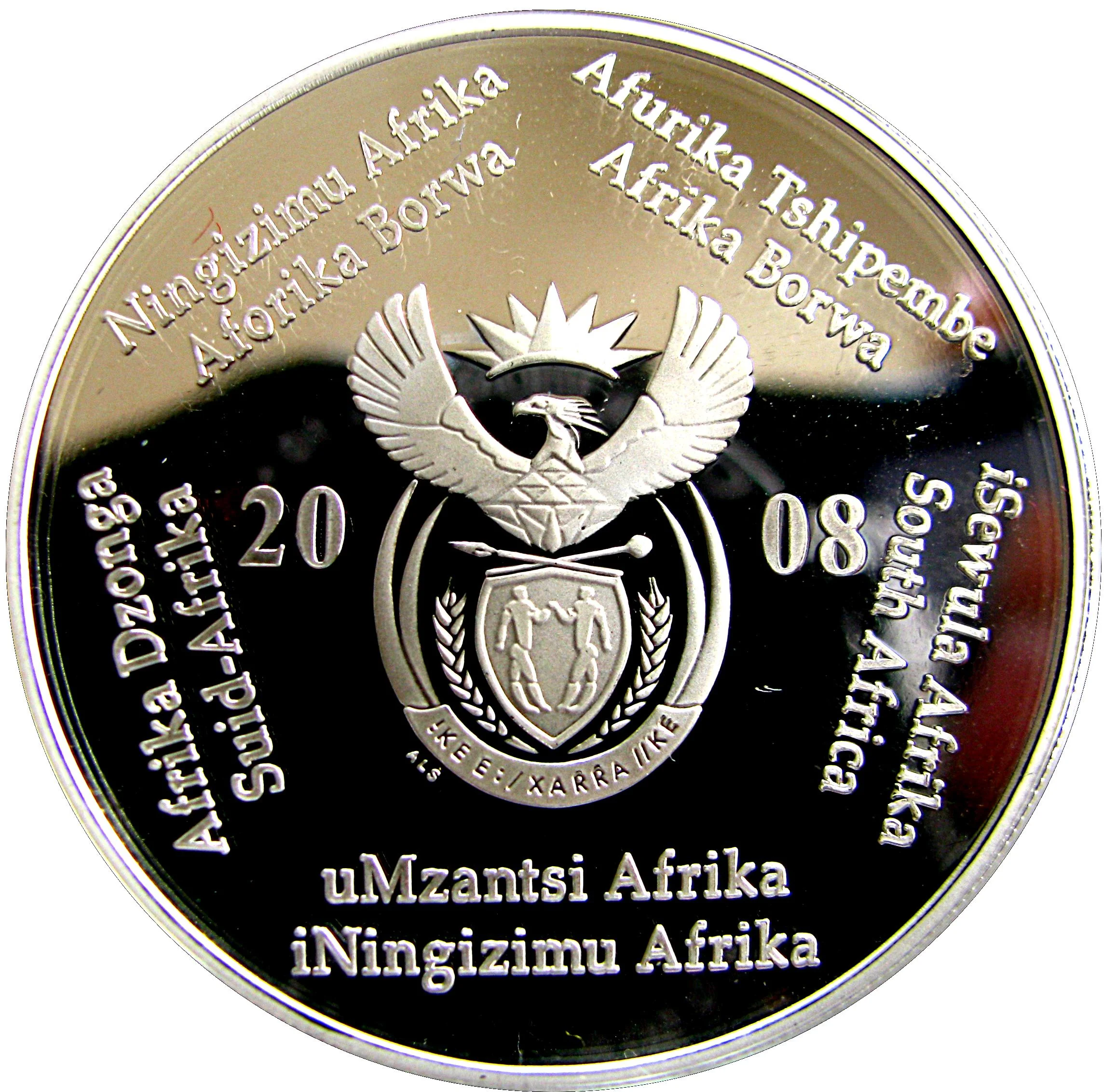
South Africa's coat of arms with its name in ten languages.
Inscription:
Afrika Dzonga
Suid-Afrika
Ningizimu Afrika
Aforika Borwa
Afurika Tshipembe
Afrika Borwa
iSewula Afrika
South Africa
uMzantsi Afrika
iNingizimu Afrika
2008
!KE E: /XARRA //KE
ALS
Suid-Afrika
Ningizimu Afrika
Aforika Borwa
Afurika Tshipembe
Afrika Borwa
iSewula Afrika
South Africa
uMzantsi Afrika
iNingizimu Afrika
2008
!KE E: /XARRA //KE
ALS
Translation:
South Africa
South Africa
South Africa
South Africa
South Africa
South Africa
South Africa
South Africa
South Africa
South Africa
2008
Diverse People Unite
South Africa
South Africa
South Africa
South Africa
South Africa
South Africa
South Africa
South Africa
South Africa
2008
Diverse People Unite
Script: Latin
Languages: Southern Sotho, Afrikaans, Xhosa, Zulu, Southern Ndebele, English, Tsonga, Tshivenda, Swati, Northern Sotho
Engraver: Arthur Sutherland
Reverse
Description:
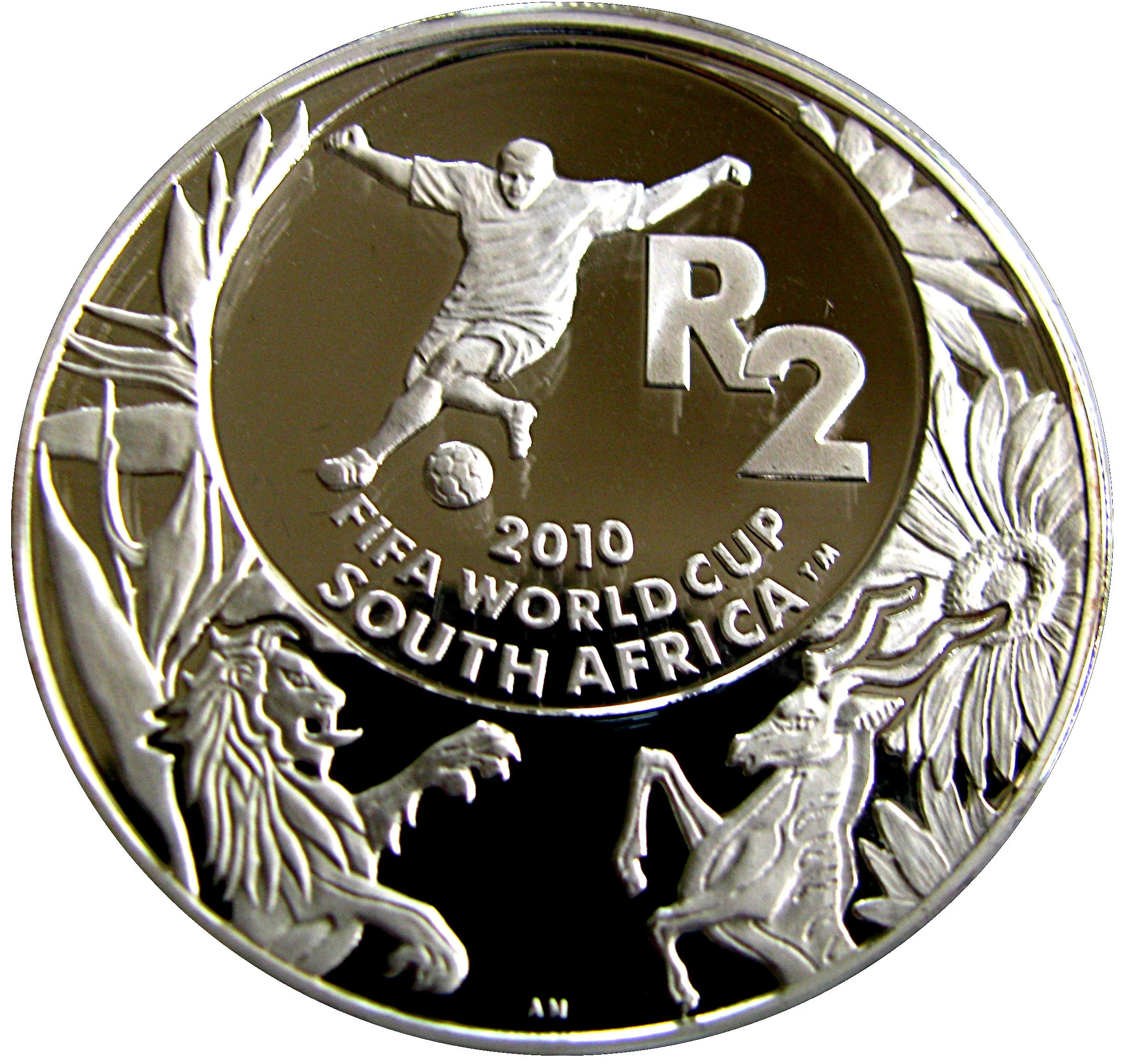
Lion and kudu player with ball.
Inscription:
R2
2010
FIFA World Cup
South Africa
TM
AM
2010
FIFA World Cup
South Africa
TM
AM
Script: Latin
Engraver: Aldrid Minnie
Edge
Reeded
Categories
| Animal> Feline |
| Animal> Cow |
| Sport> Football> FIFA World Cup |
| Plants> Flower |
| Symbols> Coat of Arms |
Mintings
| Year | Mint Mark | Mintage | Quality | Collection |
|---|---|---|---|---|
| 2008 | — | 5,928 | Proof |
Historical background
In 2008, South Africa's currency, the rand, experienced extreme volatility and a sharp depreciation, driven by a "perfect storm" of domestic and international factors. The primary catalyst was the global financial crisis, which triggered a massive flight of capital from emerging markets like South Africa as international investors sought safer havens. This was exacerbated by a sharp decline in commodity prices, which hurt South Africa's key mining exports, and a record current account deficit nearing 9% of GDP, highlighting the economy's reliance on foreign capital inflows to balance its books.
Domestically, the situation was compounded by a severe electricity crisis. Widespread rolling blackouts ("load-shedding") implemented by Eskom from early 2008 crippled mining and industrial output, damaging investor confidence and economic growth prospects. Furthermore, political uncertainty intensified due to a power struggle within the ruling ANC, which led to the recall of President Thabo Mbeki in September 2008. This internal turmoil raised concerns about policy stability and direction, further discouraging investment.
Consequently, the rand plummeted, losing approximately 28% of its value against the US dollar between January and October 2008. The South African Reserve Bank (SARB) faced a difficult policy dilemma: raising interest rates to support the currency and curb inflation (which peaked above 13%) would further stifle an economy entering its first recession in 17 years. Ultimately, the SARB prioritized inflation, keeping rates high, which contributed to a painful economic contraction but helped stabilize the currency by the end of the year as global risk appetite tentatively returned.
Domestically, the situation was compounded by a severe electricity crisis. Widespread rolling blackouts ("load-shedding") implemented by Eskom from early 2008 crippled mining and industrial output, damaging investor confidence and economic growth prospects. Furthermore, political uncertainty intensified due to a power struggle within the ruling ANC, which led to the recall of President Thabo Mbeki in September 2008. This internal turmoil raised concerns about policy stability and direction, further discouraging investment.
Consequently, the rand plummeted, losing approximately 28% of its value against the US dollar between January and October 2008. The South African Reserve Bank (SARB) faced a difficult policy dilemma: raising interest rates to support the currency and curb inflation (which peaked above 13%) would further stifle an economy entering its first recession in 17 years. Ultimately, the SARB prioritized inflation, keeping rates high, which contributed to a painful economic contraction but helped stabilize the currency by the end of the year as global risk appetite tentatively returned.
💎 Extremely Rare