

Obverse
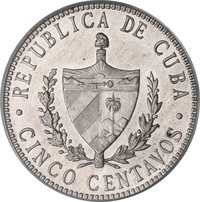
Description:
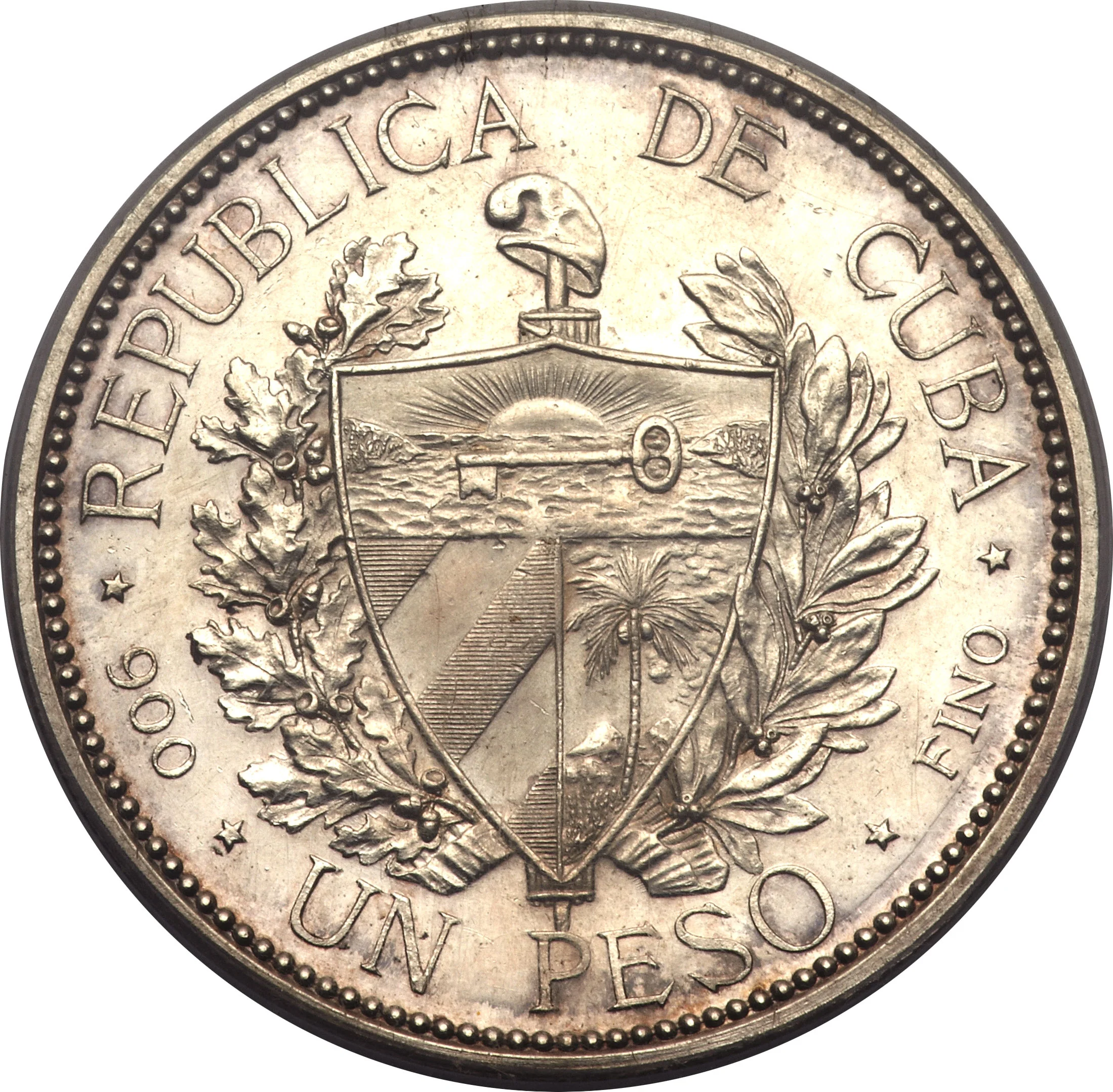
Cuban coat of arms, country name above, face value below, fineness on sides.
Inscription:
* REPUBLICA DE CUBA *
900 * UN PESO * FINO
900 * UN PESO * FINO
Translation:
REPUBLIC OF CUBA
900 * ONE PESO * FINE
900 * ONE PESO * FINE
Script: Latin
Language: Spanish
Engraver: Philip Martiny
Reverse
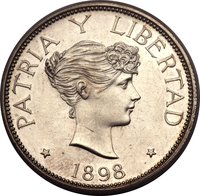
Description:
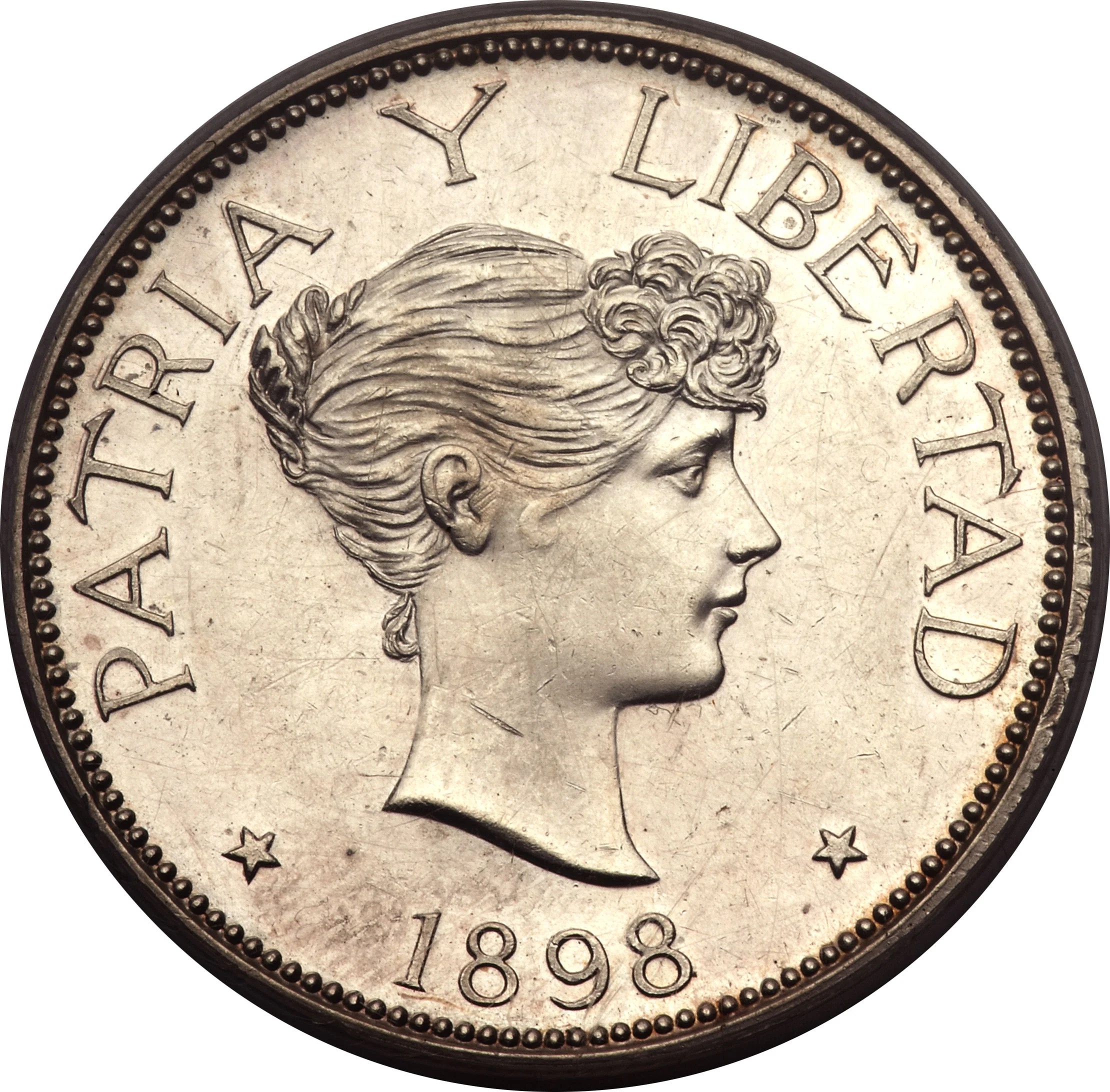
Female head right, symbolizing Republic. Motto above, date below.
Inscription:
PATRIA Y LIBERAD
* 1898 *
* 1898 *
Translation:
Fatherland and Liberty
* 1898 *
* 1898 *
Script: Latin
Language: Spanish
Engraver: Philip Martiny
Edge
Reeded
Categories
| Symbol> Allegory |
| Symbols> Coat of Arms |
Mints
| Name | Mark |
|---|---|
| Gorham Manufacturing Company | — |
Mintings
| Year | Mint Mark | Mintage | Quality | Collection |
|---|---|---|---|---|
| 1898 | — | 1,000 | ||
| 1898 | — | — | Proof |
Historical background
In 1898, Cuba was in the final, devastating phase of its War of Independence from Spain (1895-1898). The conflict had shattered the island's economy, and its currency system was a chaotic reflection of colonial collapse and wartime exigencies. The official currency was the Spanish peso, often called the peso fuerte, but its value and availability were severely disrupted. To finance the war, both the Spanish colonial government and the Cuban insurgents had issued their own paper money. The Spanish issued large quantities of billetes de curso forzoso (forced circulation notes), which rapidly depreciated due to lack of confidence and overprinting. Meanwhile, the Cuban Republic-in-arms, through its delegates abroad, issued its own bonds and notes, though these had limited circulation and were not a unified currency.
This monetary fragmentation was exacerbated by the U.S. military intervention in April 1898. With the arrival of American forces, the U.S. dollar was introduced as a de facto currency for all major transactions, especially those related to the war effort and the occupying military government established after Spain's defeat. The dollar immediately became the dominant and most trusted medium of exchange, creating a dual-currency system where the unstable Spanish and insurgent currencies circulated at steep discounts alongside the strong U.S. dollar. This situation placed the Cuban population, already suffering from reconcentration and economic ruin, in a precarious position regarding their savings and daily purchases.
Thus, by the end of 1898, with the signing of the Treaty of Paris in December, Cuba's currency situation was in a state of transition and uncertainty. The Spanish colonial monetary system was defunct, the insurgent notes were notional, and the U.S. dollar was the practical currency of power. This financial vacuum and dependence on the dollar set the stage for the monetary policies of the subsequent U.S. military occupation (1899-1902), which would formally integrate the Cuban economy into the U.S. financial sphere, a relationship that would define the island's economic life for decades.
This monetary fragmentation was exacerbated by the U.S. military intervention in April 1898. With the arrival of American forces, the U.S. dollar was introduced as a de facto currency for all major transactions, especially those related to the war effort and the occupying military government established after Spain's defeat. The dollar immediately became the dominant and most trusted medium of exchange, creating a dual-currency system where the unstable Spanish and insurgent currencies circulated at steep discounts alongside the strong U.S. dollar. This situation placed the Cuban population, already suffering from reconcentration and economic ruin, in a precarious position regarding their savings and daily purchases.
Thus, by the end of 1898, with the signing of the Treaty of Paris in December, Cuba's currency situation was in a state of transition and uncertainty. The Spanish colonial monetary system was defunct, the insurgent notes were notional, and the U.S. dollar was the practical currency of power. This financial vacuum and dependence on the dollar set the stage for the monetary policies of the subsequent U.S. military occupation (1899-1902), which would formally integrate the Cuban economy into the U.S. financial sphere, a relationship that would define the island's economic life for decades.
💎 Extremely Rare