

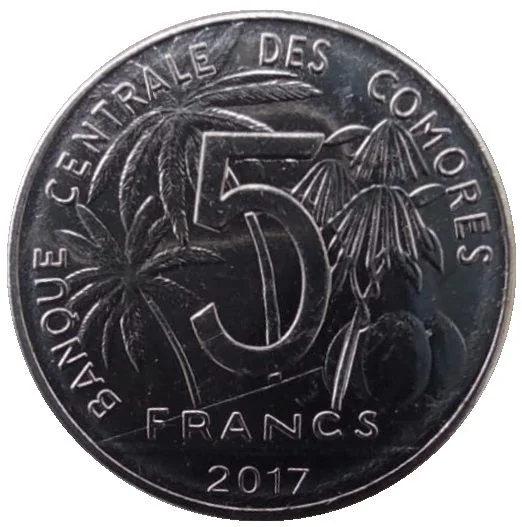
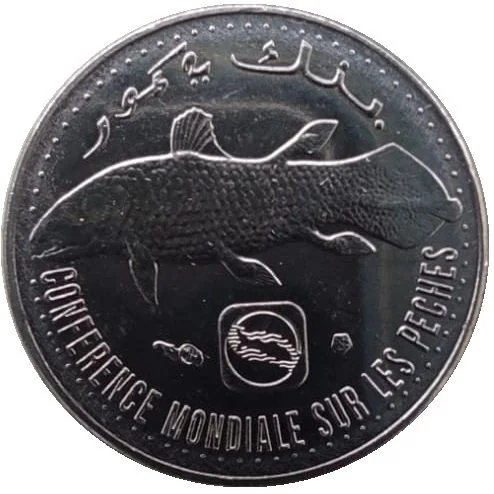
5 francs – Comoro Islands
Add to wishlist
Context
Year: 2017
Issuer: Comoro Islands
Issuing organization: Central Bank of the Comoros
Period:
(since 2001)
Currency:
(since 1976)
Material
References
Numista: #341505
Value
Exchange value: 5 KMF
Obverse
Reverse
Edge
Plain
Mints
| Name | Mark |
|---|---|
| Monnaie de Paris | — |
Mintings
| Year | Mint Mark | Mintage | Quality | Collection |
|---|---|---|---|---|
| 2017 | — | — |
Historical background
In 2017, the currency situation in the Comoro Islands was defined by its use of the Comorian franc (KMF), which has been pegged to the euro at a fixed exchange rate of 491.96775 KMF to 1 EUR since 1999. This arrangement, managed through an operational agreement with the French Treasury, provided significant monetary stability and low inflation for the Union of the Comoros. The peg offered credibility and predictability for foreign transactions, which was crucial for an economy heavily dependent on imports of essential goods and remittances from its diaspora, primarily in France.
However, this stability came with notable economic constraints. The fixed peg, aligned with the relatively strong euro, made Comorian exports less competitive and did not allow for independent monetary policy to address domestic economic shocks. The economy faced persistent structural challenges, including a narrow production base reliant on vanilla, cloves, and ylang-ylang, high unemployment, and widespread poverty. Consequently, the benefits of currency stability were unevenly felt, with many citizens struggling within a fragile economic environment.
Furthermore, 2017 saw the Comoros continuing its engagement with international financial institutions, notably the International Monetary Fund (IMF), under an Extended Credit Facility arrangement. A key focus of this program was on fiscal consolidation and public financial management reforms to address chronic budget deficits and a rising public debt burden. Therefore, while the external currency regime was stable and unchanging, the domestic financial situation required careful management to maintain the viability of the fixed peg and support broader economic development goals.
However, this stability came with notable economic constraints. The fixed peg, aligned with the relatively strong euro, made Comorian exports less competitive and did not allow for independent monetary policy to address domestic economic shocks. The economy faced persistent structural challenges, including a narrow production base reliant on vanilla, cloves, and ylang-ylang, high unemployment, and widespread poverty. Consequently, the benefits of currency stability were unevenly felt, with many citizens struggling within a fragile economic environment.
Furthermore, 2017 saw the Comoros continuing its engagement with international financial institutions, notably the International Monetary Fund (IMF), under an Extended Credit Facility arrangement. A key focus of this program was on fiscal consolidation and public financial management reforms to address chronic budget deficits and a rising public debt burden. Therefore, while the external currency regime was stable and unchanging, the domestic financial situation required careful management to maintain the viability of the fixed peg and support broader economic development goals.
💎 Extremely Rare