

100000 forint – Hungary
Add to wishlist
Non-circulating coins
Commemoration: Saint Elizabeth of Hungary
Hungary
Context
Year: 2021
Issuer: Hungary
Issuing organization: Magyar Pénzverő
Period:
(since 1989)
Currency:
(since 1946)
Total mintage: 2,000
Material
References
Numista: #341391
Value
Exchange value: 100000 HUF
Bullion value: $1049.24
Inflation-adjusted value: 150597.00 HUF
Obverse
Description:
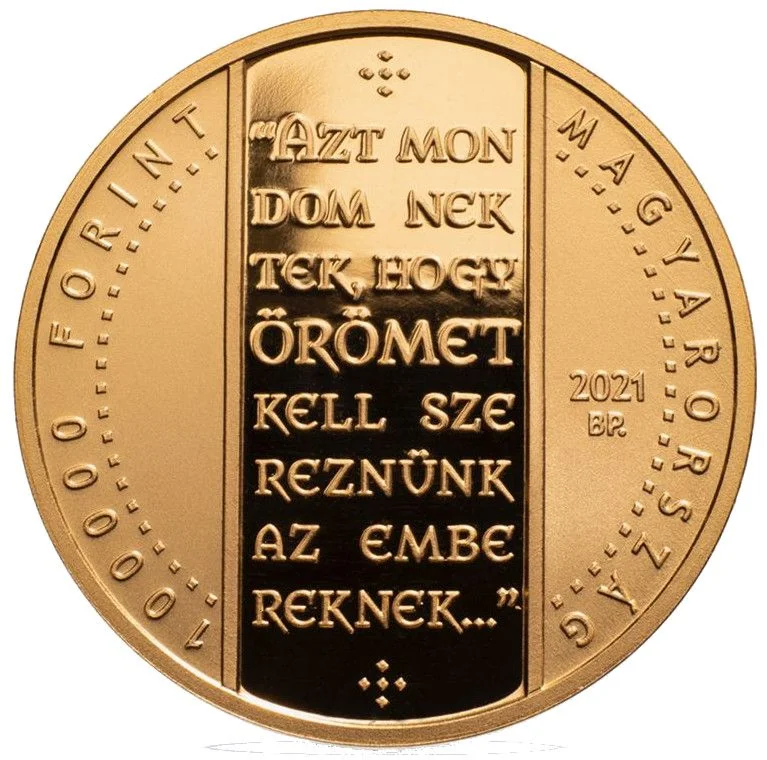
Saint Elizabeth of Hungary, patroness of wives, young mothers, Franciscan tertiaries, and charities, was a beloved medieval saint. Daughter of King Andrew II of Hungary and wife of Louis of Thuringia, she was deeply inspired by St. Francis. She founded an orphanage, a hospital, and distributed food during a famine. Widowed young, she refused an imperial marriage to live austerely serving the poor until her death at 24. Canonized in 1235, her legendary charity made her a model for her time and beyond.
Inscription:
100000 FORINT
MAGYARORSZÁG
2021
BP.
"AZT MONDOM NEKTEK, HOGY ÖRÖMET KELL SZEREZNÜNK AZ EMBEREKNEK."
MAGYARORSZÁG
2021
BP.
"AZT MONDOM NEKTEK, HOGY ÖRÖMET KELL SZEREZNÜNK AZ EMBEREKNEK."
Translation:
ONE HUNDRED THOUSAND FORINT
HUNGARY
2021
BP.
"I SAY TO YOU, THAT WE MUST BRING JOY TO THE PEOPLE."
HUNGARY
2021
BP.
"I SAY TO YOU, THAT WE MUST BRING JOY TO THE PEOPLE."
Script: Latin
Language: Hungarian
Designer: Zoltán Endrődy
Reverse
Description:
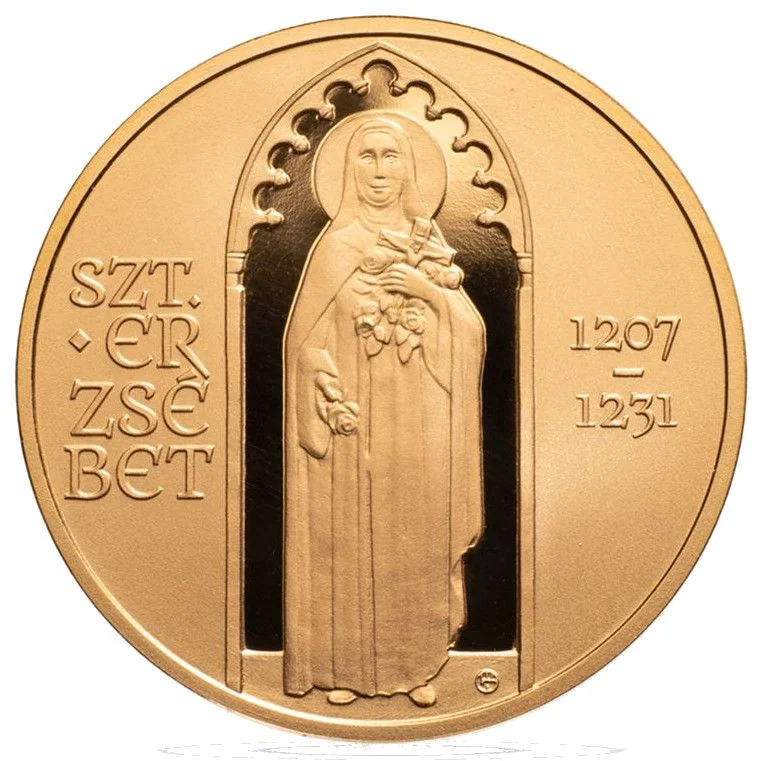
The reverse depicts St. Elizabeth of Hungary under an arch, based on a statue in Budapest. It references her miracles of the roses and the crucified Christ, symbolizing her widespread veneration. "SZT. ERZSÉBET" is left of the image, her dates "1207–1231" are on the right, and Zoltán Endrődy's master mark is at the lower right.
Inscription:
SZT.
· ER
ZSÉ
BET
1207
-
1231
· ER
ZSÉ
BET
1207
-
1231
Translation:
Lord Béla
1207
-
1231
1207
-
1231
Script: Latin
Designer: Zoltán Endrődy
Edge
Plain
Categories
| Building> Religious building |
Mints
| Name | Mark |
|---|---|
| Hungarian mint | BP. |
Mintings
| Year | Mint Mark | Mintage | Quality | Collection |
|---|---|---|---|---|
| 2021 | BP. | 2,000 |
Historical background
In 2021, Hungary's currency, the forint (HUF), operated within a complex environment shaped by monetary policy divergence and post-pandemic recovery. The National Bank of Hungary (MNB), under Governor György Matolcsy, maintained a relatively dovish stance for much of the year, keeping its base rate at a historic low of 0.60% until June. This policy, aimed at supporting economic rebound, contributed to the forint being one of the region's weaker performers. However, rising global and domestic inflation—which surged well above the MNB's target—began to exert significant pressure, forcing a pivotal shift in strategy.
The turning point came in the summer, as the MNB initiated a cycle of interest rate hikes to combat inflation, which would eventually exceed 7% by year's end. Starting in June, the central bank raised its base rate in a series of aggressive moves, increasing it to 3.30% by December. This hawkish pivot was a direct response to soaring price growth, driven by supply chain disruptions, rising energy costs, and strong domestic demand fueled by fiscal stimulus. Despite these hikes, the forint remained volatile, sensitive to global risk sentiment and the pace of policy tightening compared to other major central banks.
Throughout 2021, the currency was also influenced by protracted negotiations with the European Union over the release of pandemic recovery funds, which were conditional on addressing rule-of-law concerns. This political-economic uncertainty added a layer of risk premium, occasionally weakening the forint. By the year's close, the MNB's commitment to fighting inflation had become the dominant narrative, setting the stage for continued monetary tightening into 2022, with the forint's stability heavily tied to the central bank's credibility in this ongoing battle.
The turning point came in the summer, as the MNB initiated a cycle of interest rate hikes to combat inflation, which would eventually exceed 7% by year's end. Starting in June, the central bank raised its base rate in a series of aggressive moves, increasing it to 3.30% by December. This hawkish pivot was a direct response to soaring price growth, driven by supply chain disruptions, rising energy costs, and strong domestic demand fueled by fiscal stimulus. Despite these hikes, the forint remained volatile, sensitive to global risk sentiment and the pace of policy tightening compared to other major central banks.
Throughout 2021, the currency was also influenced by protracted negotiations with the European Union over the release of pandemic recovery funds, which were conditional on addressing rule-of-law concerns. This political-economic uncertainty added a layer of risk premium, occasionally weakening the forint. By the year's close, the MNB's commitment to fighting inflation had become the dominant narrative, setting the stage for continued monetary tightening into 2022, with the forint's stability heavily tied to the central bank's credibility in this ongoing battle.
✨ Legendary