

20 cents – Danish West Indies
Add to wishlist
United States
Context
Year: 1907
Country: United States
Issuer: Danish West Indies
Ruler: Frederick VIII
Currency:
(1849—1905)
Demonetization: 15 July 1935
Total mintage: 101,010
Material
References
KM: #
Numista: #34074
Value
Bullion value: $10.04
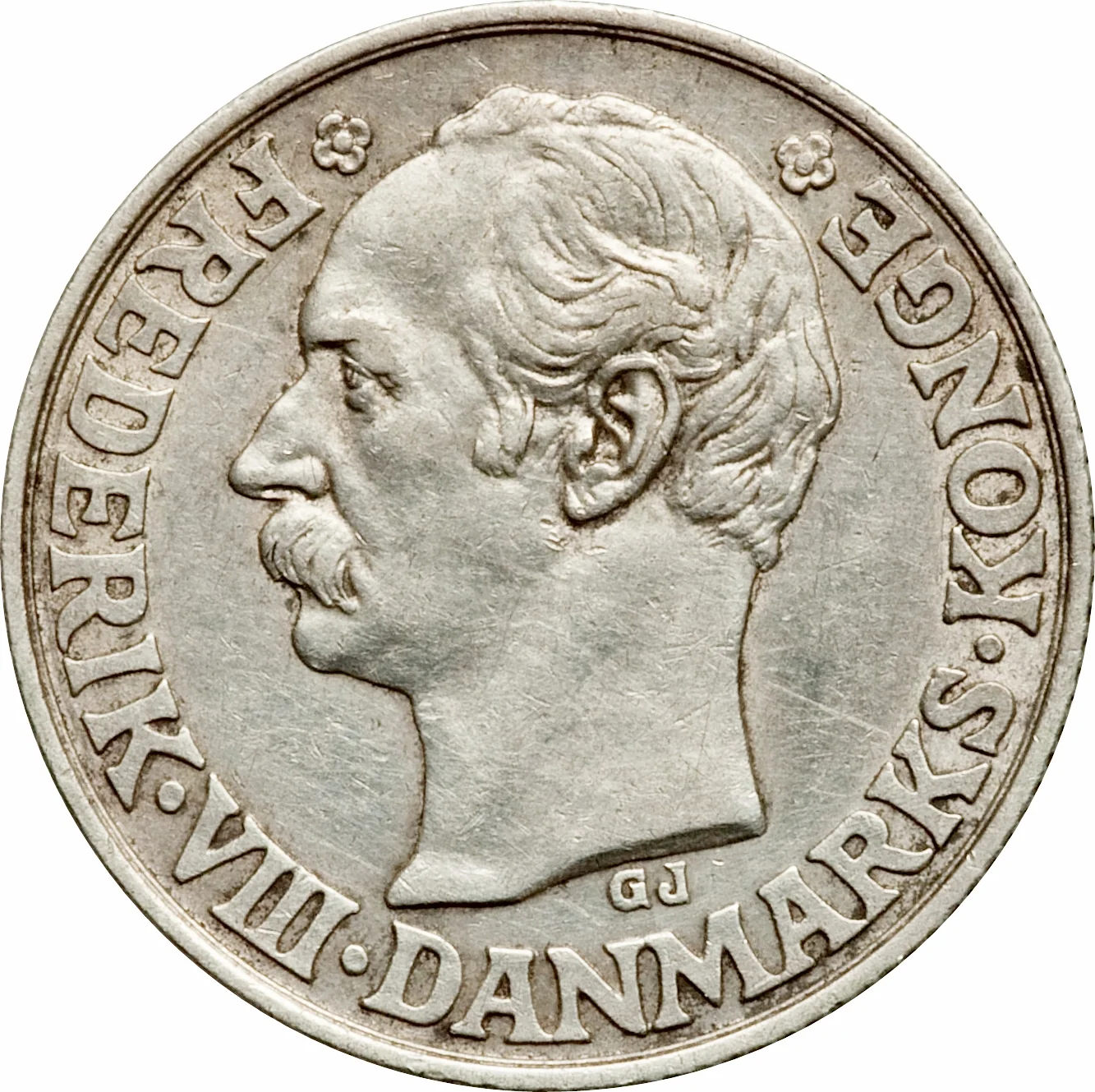
Obverse
Description:
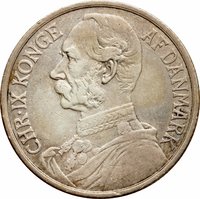
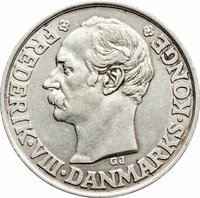
Left-facing bust
Inscription:
*FREDERIK. VIII. DANMARKS. KONGE*
Translation:
FREDERIK VIII DENMARK'S KING
Script: Latin
Language: Danish
Engraver: Gunnar Jensen
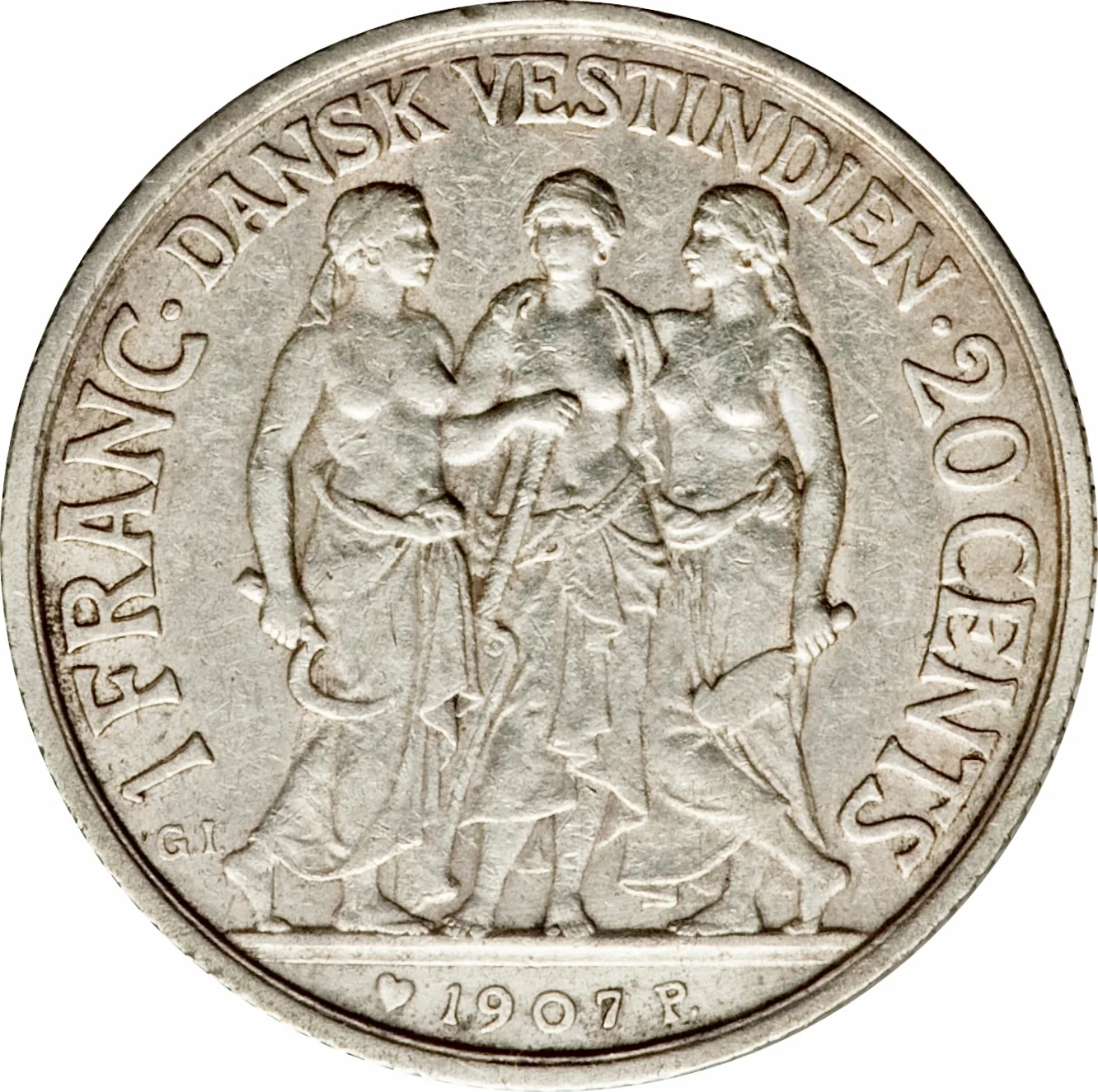
Reverse
Description:
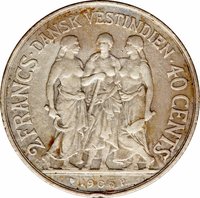
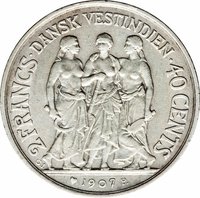
Three female saints.
Inscription:
1 FRANC • DANSK VESTINDIEN • 20 CENTS
G.I.
❤ 1907 P.
G.I.
❤ 1907 P.
Translation:
1 Franc • Danish West Indies • 20 Cents
G.I.
❤ 1907 P.
G.I.
❤ 1907 P.
Script: Latin
Engravers: Gunnar Jensen, Vilhelm Buchard Poulsen
Edge
Reeded
Categories
| Person> Monarch |
| Mustache/Beard |
| Symbol> Allegory |
Mints
| Name | Mark |
|---|---|
| Royal Danish Mint | ❤ |
Mintings
| Year | Mint Mark | Mintage | Quality | Collection |
|---|---|---|---|---|
| 1907 | P❤GI | 101,000 | ||
| 1907 | P❤GI | 10 | Prooflike |
Historical background
In 1907, the currency situation in the Danish West Indies (now the U.S. Virgin Islands) was a complex and problematic system of competing monies, reflecting the islands' position as a commercial crossroads. The official currency was the Danish West Indian rigsdaler, fixed to the gold standard and divisible into 100 cents. However, this formal system was overshadowed in daily practice by the widespread circulation of foreign silver coins, primarily the United States dollar and the British sovereign and sterling coins. This multiplicity created constant confusion and inconvenience for both the local population and international merchants.
The core of the problem lay in the fact that while government accounts and official transactions were conducted in rigsdaler, the vast majority of retail trade and wages were paid in fluctuating foreign silver. This required constant mental calculation and exchange, leading to disputes and inefficiency. Furthermore, the value of the dominant US silver dollar had been depreciating against gold since the 1870s, causing its exchange rate against the gold-backed rigsdaler to be unstable. This instability discouraged investment and complicated banking, as merchants struggled to account for exchange rate losses.
By 1907, this chaotic monetary environment was widely recognized as a significant hindrance to the islands' economic development. The local business community and planters had been petitioning for reform for decades, arguing for either a modernization and strengthening of the rigsdaler or, more popularly, a full adoption of the stable US gold dollar. This mounting pressure for clarity and stability set the stage for the major monetary reform that would come just seven years later, when the islands formally adopted the US dollar as their sole legal tender in 1914.
The core of the problem lay in the fact that while government accounts and official transactions were conducted in rigsdaler, the vast majority of retail trade and wages were paid in fluctuating foreign silver. This required constant mental calculation and exchange, leading to disputes and inefficiency. Furthermore, the value of the dominant US silver dollar had been depreciating against gold since the 1870s, causing its exchange rate against the gold-backed rigsdaler to be unstable. This instability discouraged investment and complicated banking, as merchants struggled to account for exchange rate losses.
By 1907, this chaotic monetary environment was widely recognized as a significant hindrance to the islands' economic development. The local business community and planters had been petitioning for reform for decades, arguing for either a modernization and strengthening of the rigsdaler or, more popularly, a full adoption of the stable US gold dollar. This mounting pressure for clarity and stability set the stage for the major monetary reform that would come just seven years later, when the islands formally adopted the US dollar as their sole legal tender in 1914.
⭐ Rare