

20 Gulden – Netherlands
Netherlands
Context
Years: 1850–1853
Issuer: Netherlands 
Ruler: William III
Currency:
(1817—2001)
Demonetized: Yes
Total mintage: 2,636
Material
References
KM: #Click to copy to clipboard96
Numista: #34050
Value
Exchange value: 20 NLG
Bullion value: $2020.59
Obverse
Description:
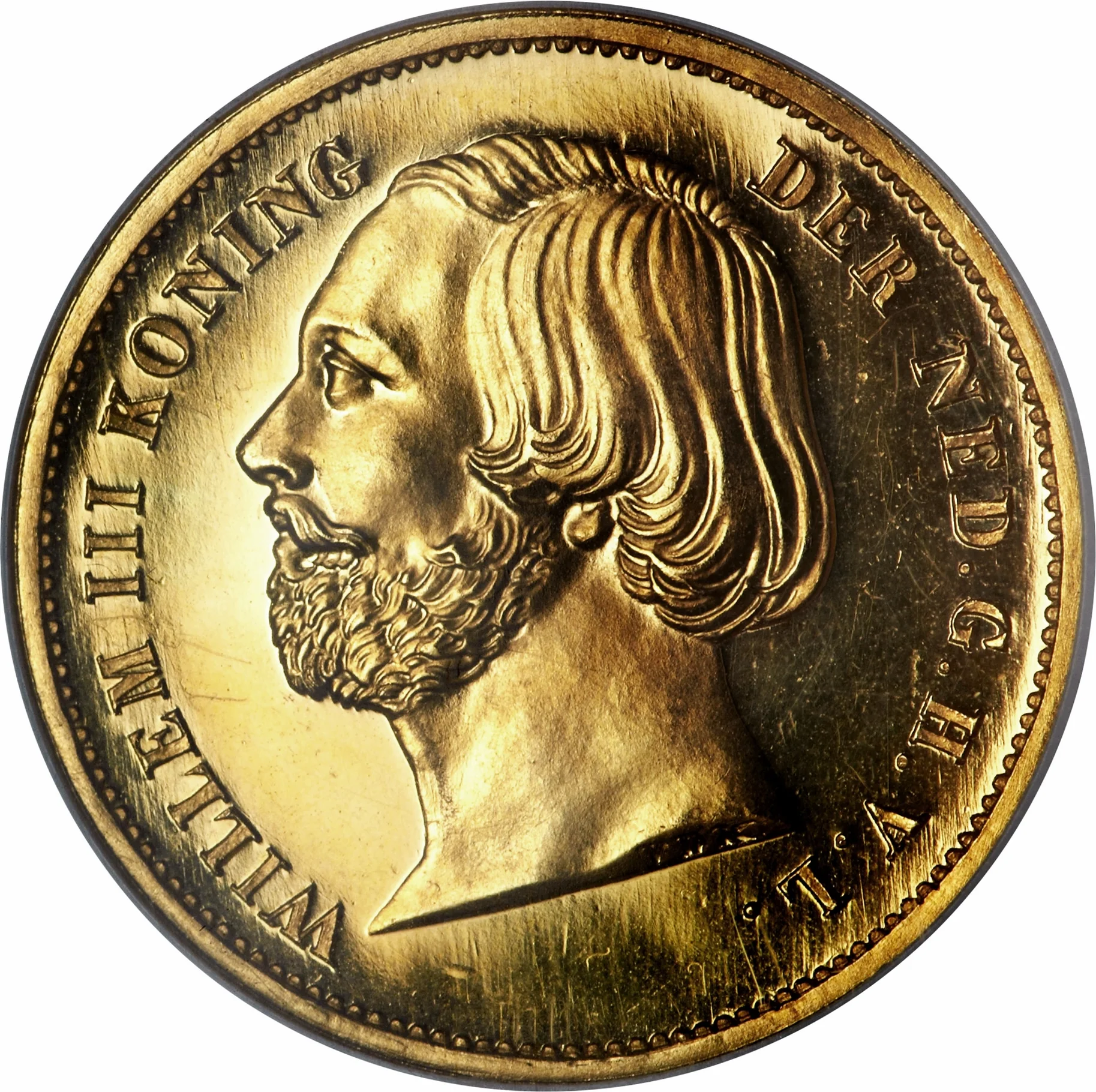
King William III facing left.
Inscription:
WILLEM III KONING DER NED. G.H.V.L.
Translation:
WILLIAM III KING OF THE NED. G.H.V.L.
Script: Latin
Language: Dutch
Engraver: David van der Kellen Jr.
Reverse
Description:
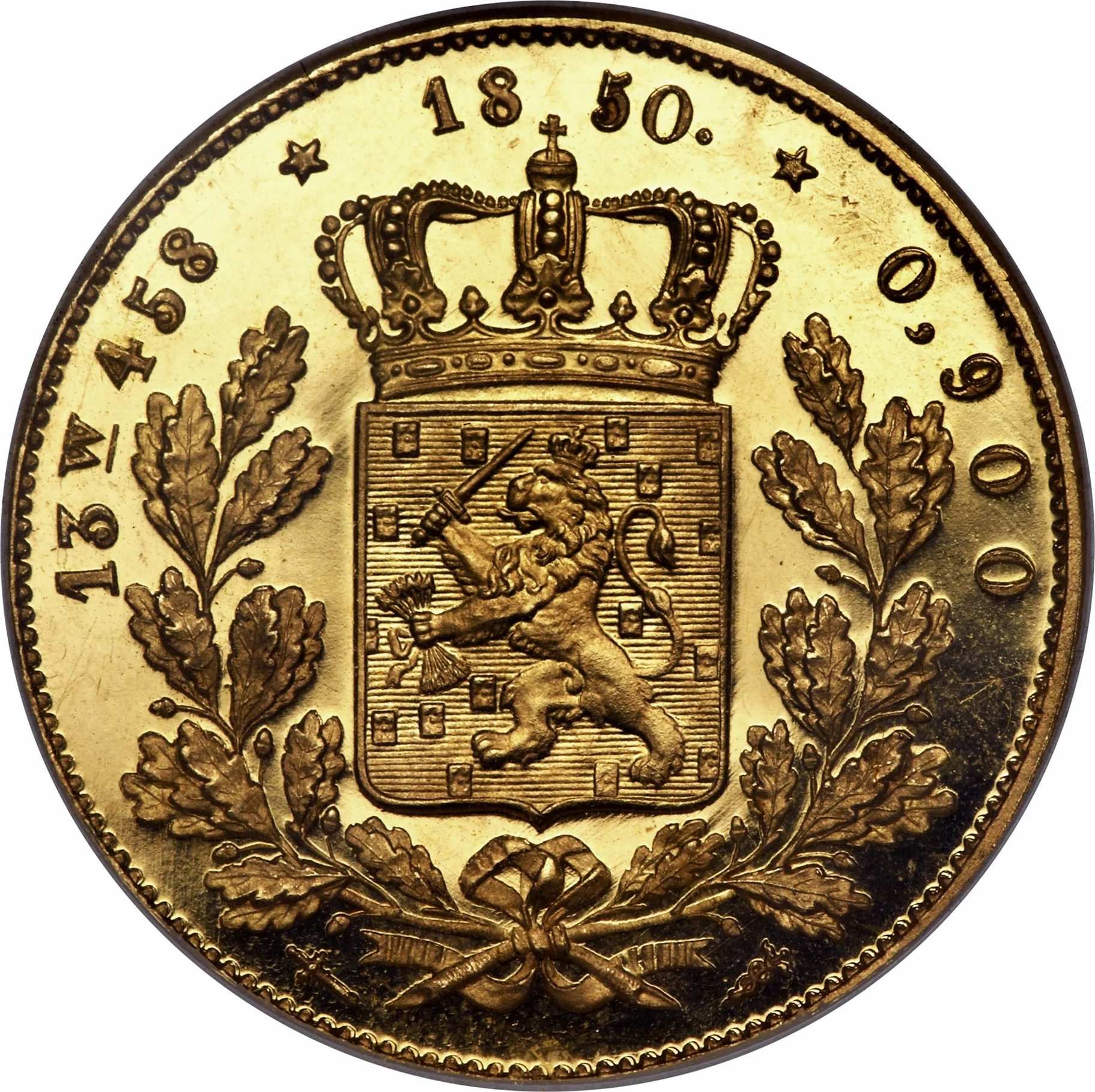
Crowned Dutch coat of arms on an oak wreath with acorns, tied with a ribbon.
Inscription:
13 ᵂ 458 ★ 1850. ★ 0,900
Translation:
13 W 458 ★ 1850. ★ 0,900
Script: Latin
Language: English
Engraver: David van der Kellen Jr.
Edge
Mints
| Name | Mark |
|---|---|
| Royal Dutch Mint | — |
Mintings
| Year | Mint Mark | Mintage | Quality | Collection |
|---|---|---|---|---|
| 1850 | — | — | ||
| 1851 | — | 2,500 | ||
| 1853 | — | 136 |
Historical background
In 1850, the Netherlands found itself in a complex and transitional monetary period, characterized by a dual-currency system. The primary unit was the silver guilder (also called the florin), which had been the cornerstone of Dutch currency for centuries and was part of the Latin Monetary Union's sphere of influence. However, alongside silver, gold coins also circulated with official rates, creating a practical bimetallic standard. This system was inherently unstable, as the fluctuating market values of gold and silver often caused one metal to be undervalued at the mint, leading to its disappearance from circulation—a consequence of Gresham's Law.
The period was further complicated by the legacy of the French occupation (1795-1813), which had left a variety of foreign coins, particularly French francs, in circulation. While the Dutch government had reasserted the guilder after the Napoleonic Wars, the financial upheavals of the early 19th century, including the costly Belgian Revolution (1830-1839), had strained public finances and caused periodic distrust in paper money. As a result, the actual money in use was a heterogeneous mix of Dutch silver and gold coins, foreign specie, and banknotes whose acceptance depended heavily on public confidence.
Recognizing the inefficiencies of this situation, the mid-19th century was a time of active reform. The year 1850 sits just on the cusp of significant change. In 1847, the government had already introduced new, standardized silver coinage. The major turning point came with the Bank Act of 1863, which would establish the Dutch Bank (De Nederlandsche Bank) as the sole issuer of banknotes and solidify the monetary system. Therefore, the situation in 1850 is best understood as one of consolidation, where the state was moving decisively away from a fragmented past toward a modern, uniform, and state-controlled national currency based on the silver guilder.
The period was further complicated by the legacy of the French occupation (1795-1813), which had left a variety of foreign coins, particularly French francs, in circulation. While the Dutch government had reasserted the guilder after the Napoleonic Wars, the financial upheavals of the early 19th century, including the costly Belgian Revolution (1830-1839), had strained public finances and caused periodic distrust in paper money. As a result, the actual money in use was a heterogeneous mix of Dutch silver and gold coins, foreign specie, and banknotes whose acceptance depended heavily on public confidence.
Recognizing the inefficiencies of this situation, the mid-19th century was a time of active reform. The year 1850 sits just on the cusp of significant change. In 1847, the government had already introduced new, standardized silver coinage. The major turning point came with the Bank Act of 1863, which would establish the Dutch Bank (De Nederlandsche Bank) as the sole issuer of banknotes and solidify the monetary system. Therefore, the situation in 1850 is best understood as one of consolidation, where the state was moving decisively away from a fragmented past toward a modern, uniform, and state-controlled national currency based on the silver guilder.
✨ Legendary