

10 Cash – Honan Province
China
Context
Years: 1913–1914
Country: China 
Issuer: Honan Province
Period:
(1912—1949)
Currency:
(1905—1949)
Demonetized: Yes
Material
References
Y: #Click to copy to clipboardA392.1
Numista: #34021
Obverse
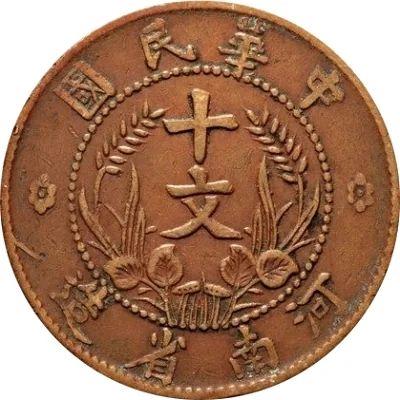
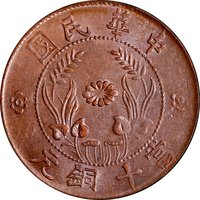
Description:
Two Chinese characters in a wreath, encircled by more characters.
Inscription:
國民華中
十
文
造省南河
十
文
造省南河
Translation:
Republic of China
Ten
Cash
Made in Henan Province
Ten
Cash
Made in Henan Province
Language: Chinese
Reverse
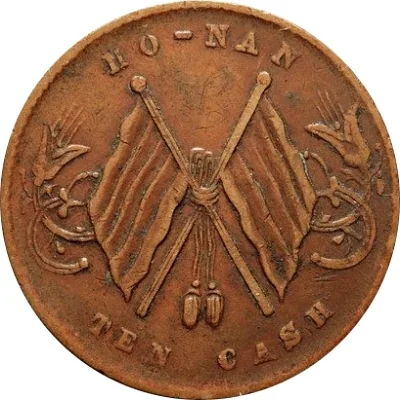
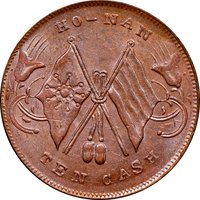
Description:
Crossed flags flanked by flowers, with English text above and below.
Inscription:
HO-NAN
TEN CASH
TEN CASH
Edge
Plain
Mintings
| Year | Mint Mark | Mintage | Quality | Collection |
|---|---|---|---|---|
| — | — | — |
Historical background
In 1913, Honan Province, like much of China, was in a state of monetary disarray following the collapse of the Qing Dynasty in 1911. The new Republic of China under Yuan Shikai had yet to establish a unified national currency system. Consequently, Honan’s economy operated on a complex and unstable mixture of old imperial copper cash coins (wen), silver sycee (ingots weighed in taels), and a limited circulation of foreign-minted silver dollars, primarily Mexican "Eagle" dollars. This multiplicity of currencies, each with fluctuating exchange rates, created significant hurdles for trade and taxation, burdening peasants and merchants alike.
The provincial authorities in Kaifeng had little power to impose order. While the central government was promoting the new "Yuan Shikai" silver dollar, its circulation in Honan was sparse and largely confined to major commercial centers and military payments. The real monetary power often lay with local militarists, merchant guilds, and even large pawnshops, which issued their own private notes and scrip. This localized issuance led to frequent episodes of inflation and deflation, and notes from one district might be heavily discounted or refused in another, severely hampering internal commerce.
This chaotic currency environment reflected the broader political fragmentation of the early Republic. With Yuan Shikai consolidating central power in Beijing, but facing provincial autonomy and rising unrest, Honan’s monetary situation was a microcosm of a nation struggling to unify. The lack of a reliable, standardized medium of exchange stifled economic development and exacerbated social tensions, leaving the province vulnerable to the deeper turmoil that would follow in the coming years of warlordism.
The provincial authorities in Kaifeng had little power to impose order. While the central government was promoting the new "Yuan Shikai" silver dollar, its circulation in Honan was sparse and largely confined to major commercial centers and military payments. The real monetary power often lay with local militarists, merchant guilds, and even large pawnshops, which issued their own private notes and scrip. This localized issuance led to frequent episodes of inflation and deflation, and notes from one district might be heavily discounted or refused in another, severely hampering internal commerce.
This chaotic currency environment reflected the broader political fragmentation of the early Republic. With Yuan Shikai consolidating central power in Beijing, but facing provincial autonomy and rising unrest, Honan’s monetary situation was a microcosm of a nation struggling to unify. The lack of a reliable, standardized medium of exchange stifled economic development and exacerbated social tensions, leaving the province vulnerable to the deeper turmoil that would follow in the coming years of warlordism.
🌟 Uncommon