


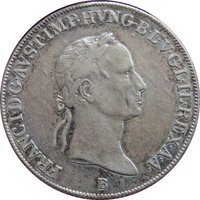
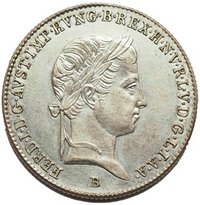
Obverse
Description:
Laurel-wreathed bare bust facing right, ribbons at back.
Inscription:
FRANC I . D .G . AVST . IMP . HVNG . B . L . V . G . L . IL . REX . A . A .
Translation:
FRANCIS I BY THE GRACE OF GOD EMPEROR OF AUSTRIA, APOSTOLIC KING OF HUNGARY, BOHEMIA, LOMBARDY, VENETIA, GALICIA, LODOMERIA, ILLYRIA, KING OF JERUSALEM, ARCHDUKE OF AUSTRIA.
Language: Latin
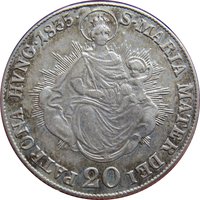
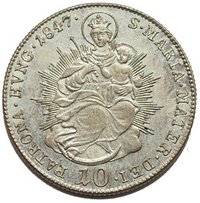
Reverse
Description:
Radiant Madonna and Child enthroned on a crescent moon.
Inscription:
S · MARIA MATER DEI · PATRONA · HUNG · 1831 ·
Translation:
Saint Mary, Mother of God, Patron of Hungary, 1831.
Language: Latin
Edge
Mints
| Name | Mark |
|---|---|
| Kremnica | B |
Historical background
In 1831, Hungary operated within the complex monetary system of the Habsburg Empire, which was characterized by a chronic shortage of stable, trusted currency. The official currency was the Austrian silver guilder (or florin), but the economy relied heavily on paper banknotes issued by the Habsburg state. These notes, known as Einlösungsscheine (redemption notes), had been introduced during the Napoleonic Wars and were not fully convertible to silver, leading to frequent depreciation and a wide gap between their face value and their actual market worth. This created a dual system where transactions often had to account for both the "convention coin" (silver) premium and the discounted paper rate, causing confusion and hindering commerce.
The situation was exacerbated by Hungary's specific economic position within the Empire. As a largely agrarian society, its financial system was less developed than the Austrian lands, and the unreliable currency hampered investment and trade. Furthermore, a significant portion of the circulating medium consisted of so-called Krajcár coins (kreuzers), small fractional coins made from debased silver or copper. The poor quality and easy counterfeiting of these coins added another layer of instability to everyday transactions, affecting peasants, merchants, and nobles alike.
This monetary instability contributed to broader economic grievances and was a point of contention between the Hungarian Diet and the Viennese court. Reform-minded Hungarian estates, part of the growing national reform movement led by figures like Count István Széchenyi, saw currency reform as essential for modernization. They argued for a unified, stable monetary system to facilitate the development of industry, banking, and infrastructure. Thus, the currency situation in 1831 was not merely a financial issue but a political one, intertwined with Hungary's struggle for greater economic autonomy and modernization within the framework of the Empire.
The situation was exacerbated by Hungary's specific economic position within the Empire. As a largely agrarian society, its financial system was less developed than the Austrian lands, and the unreliable currency hampered investment and trade. Furthermore, a significant portion of the circulating medium consisted of so-called Krajcár coins (kreuzers), small fractional coins made from debased silver or copper. The poor quality and easy counterfeiting of these coins added another layer of instability to everyday transactions, affecting peasants, merchants, and nobles alike.
This monetary instability contributed to broader economic grievances and was a point of contention between the Hungarian Diet and the Viennese court. Reform-minded Hungarian estates, part of the growing national reform movement led by figures like Count István Széchenyi, saw currency reform as essential for modernization. They argued for a unified, stable monetary system to facilitate the development of industry, banking, and infrastructure. Thus, the currency situation in 1831 was not merely a financial issue but a political one, intertwined with Hungary's struggle for greater economic autonomy and modernization within the framework of the Empire.
✨ Legendary