

½ Thaler – Hungary
Hungary
Context

Material
References
KM: #Click to copy to clipboard423
Numista: #33878
Value
Bullion value: $33.45
Obverse
Description:
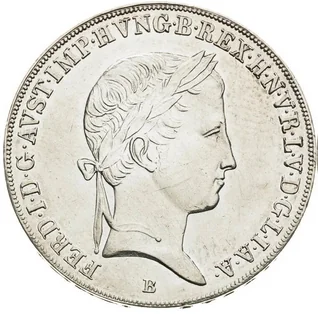
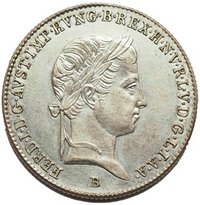
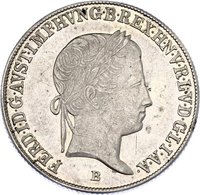
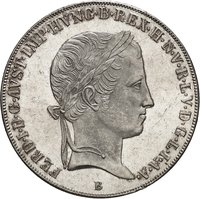
Ferdinand I facing right, surrounded by abbreviated legend.
Inscription:
FERD · I · D · G · AVST · IMP · HVNG · B · REX · H · N · V · R · L · V · D · G · L · I · A · A ·
Translation:
FERDINAND I, BY THE GRACE OF GOD, AUSTRIAN EMPEROR, HUNGARIAN, BOHEMIAN KING, DALMATIA, CROATIA, SLOVENIA, LODOMERIA, ILLYRIA, GALICIA AND LODOMERIA, GRAND DUKE OF LOMBARDY-VENETIA, ARCHDUKE OF AUSTRIA.
Script: Latin
Language: Latin
Reverse
Edge
Mints
| Name | Mark |
|---|---|
| Kremnica | B |
Historical background
In 1837, the currency situation in the Kingdom of Hungary, part of the Habsburg Empire, was characterized by a complex and often unstable dual system. The official currency was the Austrian silver gulden (forint in Hungarian), part of the Conventionsthaler standard established across the empire. However, Hungary also had its own long-standing accounting unit, the Hungarian forint, which was divided into 100 krajcár. The critical issue was a severe shortage of physical silver and gold coinage in circulation, leading to widespread use of depreciated paper money and subsidiary coins.
The primary source of instability was the over-issuance of paper banknotes (bankó-jegyek) by the Habsburg state's Wiener Stadt-Banco. These notes, known as bankócédulák, were not convertible to silver on demand and had been issued heavily to finance state debts and military campaigns, notably the Napoleonic Wars. Consequently, they traded at a significant and fluctuating discount against the silver forint, creating a confusing system of dual prices and hampering trade. This period was part of the longer "Age of Banknotes" (bankócédula-korszak), marked by inflationary pressure and public distrust in paper currency.
Economic reformers and the Hungarian Diet pressed Vienna for monetary stability and the establishment of a Hungarian national bank to control currency issuance, viewing the chaotic monetary situation as an impediment to modern commerce and a symbol of Vienna's neglect of Hungarian economic interests. While a partial currency reform in the 1830s aimed to stabilize the exchange rate between silver and paper, lasting resolution would not come until the major reforms of the 1840s, which introduced the new silver forint (közönséges forint) and finally restored convertibility, temporarily ending the era of depreciated paper money.
The primary source of instability was the over-issuance of paper banknotes (bankó-jegyek) by the Habsburg state's Wiener Stadt-Banco. These notes, known as bankócédulák, were not convertible to silver on demand and had been issued heavily to finance state debts and military campaigns, notably the Napoleonic Wars. Consequently, they traded at a significant and fluctuating discount against the silver forint, creating a confusing system of dual prices and hampering trade. This period was part of the longer "Age of Banknotes" (bankócédula-korszak), marked by inflationary pressure and public distrust in paper currency.
Economic reformers and the Hungarian Diet pressed Vienna for monetary stability and the establishment of a Hungarian national bank to control currency issuance, viewing the chaotic monetary situation as an impediment to modern commerce and a symbol of Vienna's neglect of Hungarian economic interests. While a partial currency reform in the 1830s aimed to stabilize the exchange rate between silver and paper, lasting resolution would not come until the major reforms of the 1840s, which introduced the new silver forint (közönséges forint) and finally restored convertibility, temporarily ending the era of depreciated paper money.
Series: 1837 Hungary circulation coins
✨ Legendary