

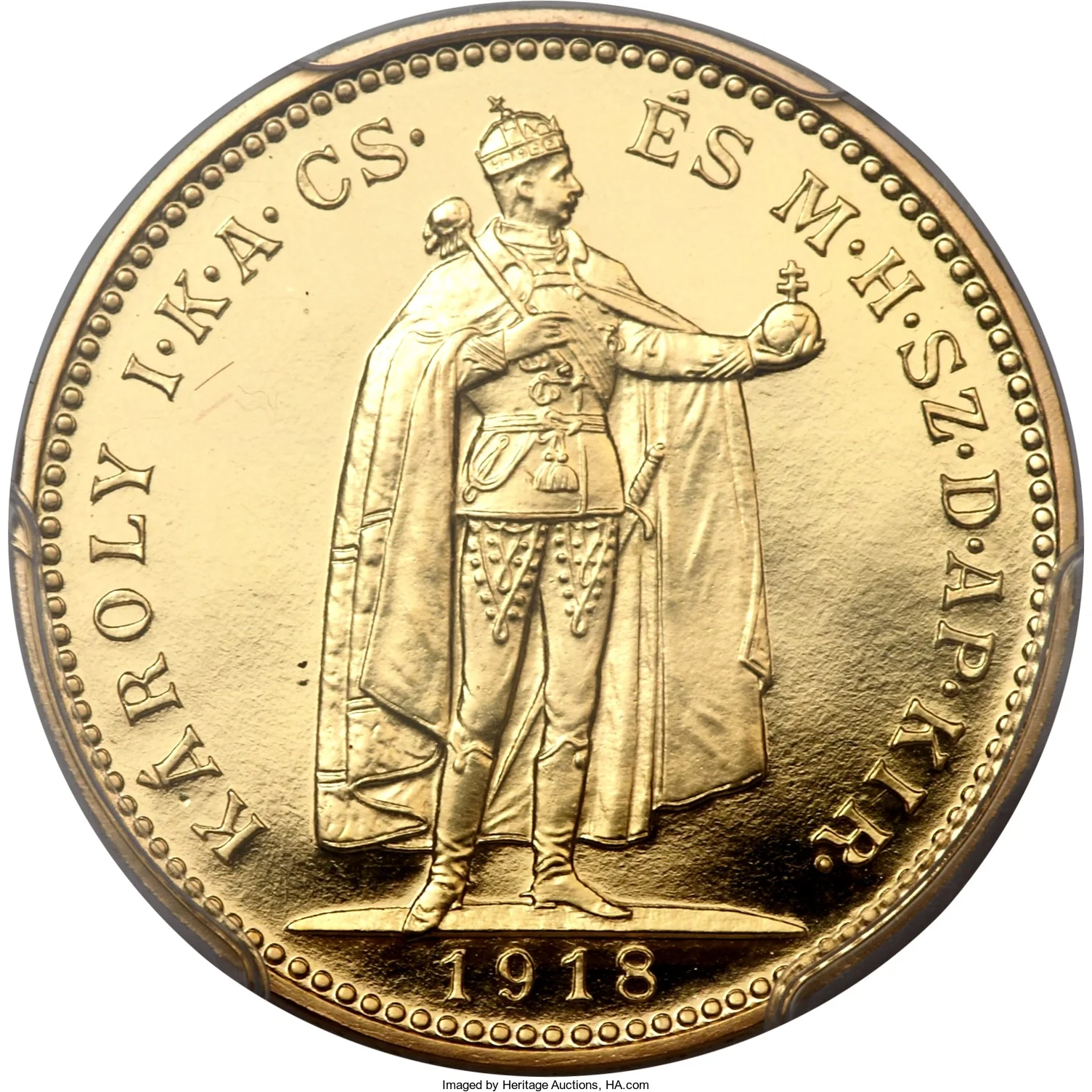
Obverse
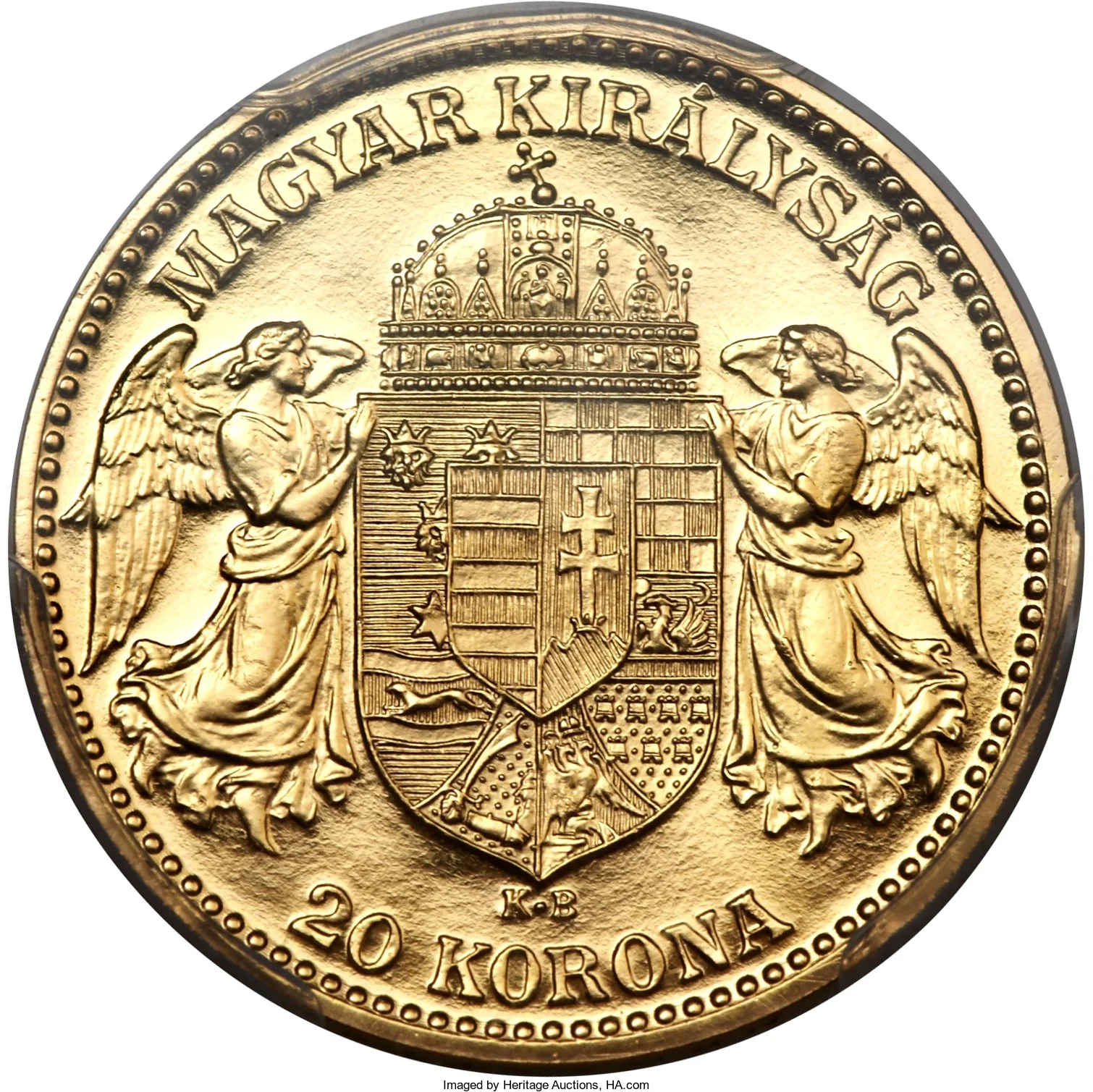
Reverse
Description:
Emperor Franz Joseph holding the royal orb and scepter.
Inscription:
FERENCZ.JÓZSEF I.K.A.CS ÉS M.H.S.D.O.AP.KIR.
1914
1914
Translation:
Francis Joseph the First, by the Grace of God, Emperor of Austria, Apostolic King of Hungary, Croatia, Slavonia, and Dalmatia.
1914
1914
Script: Latin
Engraver: Josef Reisner
Edge
Script:Latin
Legend:
BIZALMAM AZ ŐSI ERÉNYBEN
Translation:
My trust is in ancient virtue.
Language: Hungarian
Mints
| Name | Mark |
|---|---|
| Kremnica | — |
Mintings
| Year | Mint Mark | Mintage | Quality | Collection |
|---|---|---|---|---|
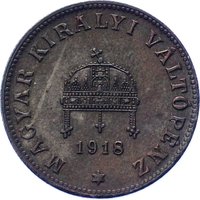
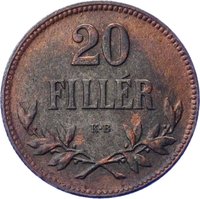
| 1918 | — | — |
Historical background
Following the Austro-Hungarian Compromise of 1867, Hungary used the Austro-Hungarian gulden (forint) and, from 1892, the Austro-Hungarian krone (korona), which were shared currencies of the Dual Monarchy. However, the economic catastrophe of the First World War fundamentally destabilized this system. By 1918, the Habsburg Empire was financing the war through massive borrowing and the unrestrained printing of money, leading to severe inflation. The Hungarian korona, no longer backed by gold, began a rapid depreciation, losing both domestic purchasing power and international value as the war effort neared collapse.
The political dissolution of the Austro-Hungarian Empire in the autumn of 1918 created a sudden and profound currency crisis. With the armistice in November and the establishment of the independent Hungarian Democratic Republic, the old imperial korona became a legacy currency without a central state to guarantee it. The new Hungarian government inherited a collapsing economy, a massive public debt, and a printing press that continued to run to cover state expenses, accelerating the inflationary spiral. This period marked the chaotic transition from a unified imperial currency to a not-yet-stable national monetary system.
Thus, by the end of 1918, Hungary was plunged into a vacuum of monetary sovereignty, grappling with a sharply devalued korona as the medium of exchange. This unstable foundation set the stage for the hyperinflation that would cripple the country in the early 1920s, ultimately necessitating a comprehensive currency reform with the introduction of the pengő in 1927. The currency situation of late 1918 was therefore a direct consequence of wartime finance and the immediate, disorderly aftermath of imperial disintegration.
The political dissolution of the Austro-Hungarian Empire in the autumn of 1918 created a sudden and profound currency crisis. With the armistice in November and the establishment of the independent Hungarian Democratic Republic, the old imperial korona became a legacy currency without a central state to guarantee it. The new Hungarian government inherited a collapsing economy, a massive public debt, and a printing press that continued to run to cover state expenses, accelerating the inflationary spiral. This period marked the chaotic transition from a unified imperial currency to a not-yet-stable national monetary system.
Thus, by the end of 1918, Hungary was plunged into a vacuum of monetary sovereignty, grappling with a sharply devalued korona as the medium of exchange. This unstable foundation set the stage for the hyperinflation that would cripple the country in the early 1920s, ultimately necessitating a comprehensive currency reform with the introduction of the pengő in 1927. The currency situation of late 1918 was therefore a direct consequence of wartime finance and the immediate, disorderly aftermath of imperial disintegration.
✨ Legendary