


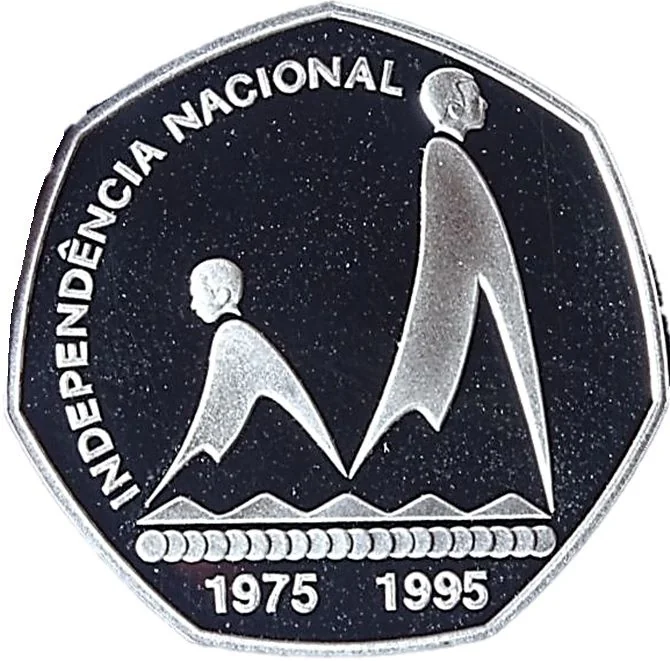
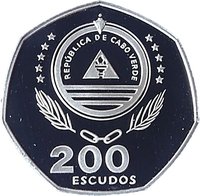
200 escudos (national independence) – Cape Verde
Add to wishlist
Non-circulating coins
Commemoration: 20th Anniversary of national independence
Cape Verde
Context
Material
Diameter: 30 mm
Weight: 18 g
Silver Weight:: 16.65 g
Shape: Heptagonal
Composition: 92.5% Silver
Magnetic: No
Technique: Milled
Alignment: Medal alignment
flip
References
KM: #
Numista: #337790
Value
Exchange value: 200 CVE
Bullion value: $42.39
Obverse
Inscription:
REPÚBLICA DE CABO VERDE
200
ESCUDOS
200
ESCUDOS
Translation:
Republic of Cape Verde
200
Escudos
200
Escudos
Script: Latin
Language: Portuguese
Reverse
Inscription:
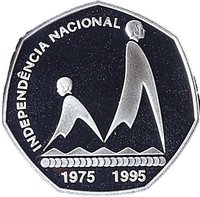
INDEPENDÊNCIA NACIONAL
1975 1995
1975 1995
Translation:
National Independence
1975 1995
1975 1995
Script: Latin
Language: Portuguese
Edge
Plain
Categories
| Event> Independence |
| Symbols> Coat of Arms |
Mints
| Name | Mark |
|---|---|
| Royal Mint | — |
Mintings
| Year | Mint Mark | Mintage | Quality | Collection |
|---|---|---|---|---|
| 1995 | — | — |
Historical background
In 1995, the currency situation in Cape Verde was defined by stability and a deliberate, managed peg to a basket of international currencies. Following independence in 1975, the country had introduced the Cape Verdean escudo (CVE) to replace the Portuguese escudo. By the mid-1990s, the monetary authority had established a credible fixed exchange rate regime, primarily pegging the escudo to a weighted basket of currencies from its major trading partners, with the Portuguese escudo (and soon the euro) being the dominant anchor. This policy was a cornerstone of the government's economic strategy, aimed at controlling inflation and fostering a predictable environment for trade and investment.
This stability was hard-won and followed a period of economic difficulty. The early 1990s saw Cape Verde implement significant structural reforms under IMF and World Bank programs, transitioning from a centrally-planned economy to a more market-oriented one. These reforms, which included fiscal austerity and trade liberalization, were crucial for supporting the fixed exchange rate. By 1995, the peg was largely successful, with inflation under control and foreign exchange reserves at manageable levels, providing a stark contrast to the high inflation and volatility experienced by many other developing nations.
The currency regime in 1995 was thus a key instrument for national economic policy. It supported the country's growing openness, facilitated vital remittances from the large diaspora, and underpinned a budding tourism sector. The commitment to a fixed peg reflected a political consensus on prioritizing macroeconomic stability as a foundation for development, a choice that would characterize Cape Verde's monetary policy for decades to come.
This stability was hard-won and followed a period of economic difficulty. The early 1990s saw Cape Verde implement significant structural reforms under IMF and World Bank programs, transitioning from a centrally-planned economy to a more market-oriented one. These reforms, which included fiscal austerity and trade liberalization, were crucial for supporting the fixed exchange rate. By 1995, the peg was largely successful, with inflation under control and foreign exchange reserves at manageable levels, providing a stark contrast to the high inflation and volatility experienced by many other developing nations.
The currency regime in 1995 was thus a key instrument for national economic policy. It supported the country's growing openness, facilitated vital remittances from the large diaspora, and underpinned a budding tourism sector. The commitment to a fixed peg reflected a political consensus on prioritizing macroeconomic stability as a foundation for development, a choice that would characterize Cape Verde's monetary policy for decades to come.


💎 Extremely Rare