


3 rubles – Russian Federation
Add to wishlist
Non-circulating coins
Commemoration: International Tiger Conservation Forum
Russia
Context
Year: 2022
Country: Russia
Issuer: Russian Federation
Period:
(since 1991)
Currency:
(since 1998)
Total mintage: 3,000
Material
Weight: 33.94 g
Silver Weight:: 31.39 g
Thickness: 2.4 mm
Shape: Rectangular
Composition: 92.5% Silver
Magnetic: No
Technique: Milled
Alignment: Medal alignment
flip

References
Value
Exchange value: 3 RUB
Bullion value: $79.92
Inflation-adjusted value: 4.78 RUB
Obverse
Description:
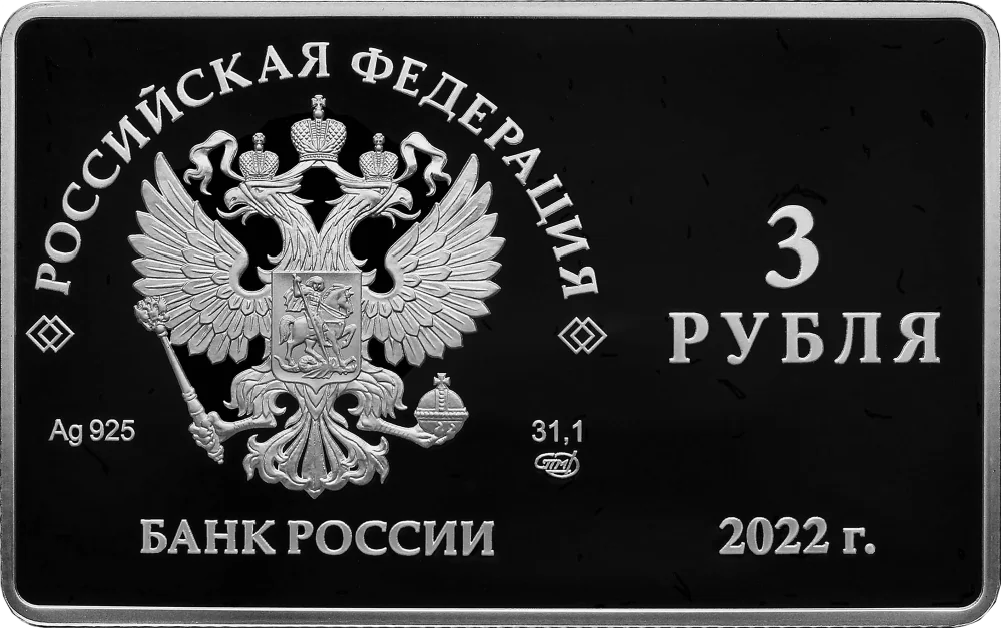
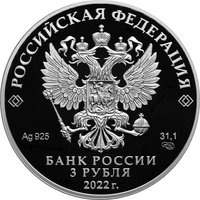
The obverse features the Russian coat of arms, inscriptions for "Russian Federation" and "Bank of Russia," the denomination "3 Roubles," the issue year "2022," metal specifications, the mint mark, and fine metal content.
Inscription:
РОССИЙСКАЯ ФЕДЕРАЦИЯ
3
РУБЛЯ
Ag .925 31,1
СПМД
БАНК РОССИИ 2022 г.
3
РУБЛЯ
Ag .925 31,1
СПМД
БАНК РОССИИ 2022 г.
Translation:
RUSSIAN FEDERATION
3
RUBLES
Ag .925 31.1
SPMD
BANK OF RUSSIA 2022
3
RUBLES
Ag .925 31.1
SPMD
BANK OF RUSSIA 2022
Language: Russian
Engraver: Alexandra Arsenyevna Dolgopolova
Designer: Elena Viktorovna Kramskaya
Reverse
Description:
The reverse features the 2nd International Tiger Forum logo.
Inscription:
II Международный
форум по сохранению тигра
Владивосток-2022
форум по сохранению тигра
Владивосток-2022
Translation:
II International
Forum on Tiger Conservation
Vladivostok-2022
Forum on Tiger Conservation
Vladivostok-2022
Script: Cyrillic
Language: Russian
Designer: Fedor Sergeevich Andronov
Edge
300 corrugations
Mints
| Name | Mark |
|---|---|
| Saint Petersburg | (СПМД) |
Mintings
| Year | Mint Mark | Mintage | Quality | Collection |
|---|---|---|---|---|
| 2022 | СПМД | 3,000 | Proof |
Historical background
Following the onset of extensive international sanctions in February 2022, the Russian financial system faced an immediate and severe currency crisis. The ruble plummeted to historic lows, losing nearly half its value against the U.S. dollar as capital fled and trade was disrupted. In response, the Central Bank of Russia (CBR) enacted drastic emergency measures: sharply raising the key interest rate to 20%, imposing strict capital controls to prevent the outflow of foreign currency, and mandating that exporters convert 80% of their foreign exchange earnings into rubles. These aggressive actions, combined with a collapse in imports due to sanctions, artificially created a shortage of foreign currency within Russia and stabilized the ruble's fall.
By mid-2022, the situation had dramatically reversed, with the ruble becoming one of the world's best-performing currencies. This "recovery" was largely artificial and driven by policy rather than economic health. The mandatory conversion of export revenues, alongside soaring global prices for Russia's key commodities—oil and gas—ensured a continued influx of foreign currency even as imports collapsed. With Western markets largely closed, Russia's current account surplus swelled to record levels. However, this strong ruble posed new problems, hurting budget revenues (which are based on dollar-denominated energy sales) and making non-commodity exports less competitive, thereby exacerbating the domestic economic downturn.
The long-term structural consequences for the Russian currency are profound. To sustain stability, the state has effectively prioritized financial defense over economic growth, maintaining capital controls and heavily managing the exchange rate. The currency's international role has diminished, with the "de-dollarization" of trade accelerating through settlements in rubles, Chinese yuan, and other currencies. Ultimately, while the ruble's extreme volatility was contained, it exists within a smaller, more isolated economy, with its value increasingly dictated by administrative measures and the fluctuating price of a narrowing range of commodity exports, rather than by broad market confidence or diversified economic fundamentals.
By mid-2022, the situation had dramatically reversed, with the ruble becoming one of the world's best-performing currencies. This "recovery" was largely artificial and driven by policy rather than economic health. The mandatory conversion of export revenues, alongside soaring global prices for Russia's key commodities—oil and gas—ensured a continued influx of foreign currency even as imports collapsed. With Western markets largely closed, Russia's current account surplus swelled to record levels. However, this strong ruble posed new problems, hurting budget revenues (which are based on dollar-denominated energy sales) and making non-commodity exports less competitive, thereby exacerbating the domestic economic downturn.
The long-term structural consequences for the Russian currency are profound. To sustain stability, the state has effectively prioritized financial defense over economic growth, maintaining capital controls and heavily managing the exchange rate. The currency's international role has diminished, with the "de-dollarization" of trade accelerating through settlements in rubles, Chinese yuan, and other currencies. Ultimately, while the ruble's extreme volatility was contained, it exists within a smaller, more isolated economy, with its value increasingly dictated by administrative measures and the fluctuating price of a narrowing range of commodity exports, rather than by broad market confidence or diversified economic fundamentals.
✨ Legendary