

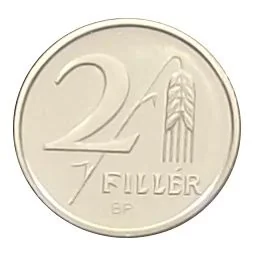
2 fillér (Forint) – Hungary
Add to wishlist
Non-circulating coins
Commemoration: 60th Anniversary of Forint
Hungary
Context
Material
References
Numista: #33568
Value
Exchange value: 0.02 HUF
Bullion value: $8.84
Inflation-adjusted value: 0.05 HUF
Obverse
Description:
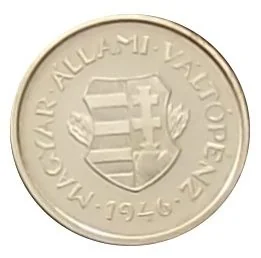
2006 restrike of the Kossuth Shield, proof silver from original dies.
Inscription:
MAGYAR·ÁLLAMI·VÁLTÓPÉNZ
·1946·
·1946·
Translation:
Hungarian State Substitute Money
·1946·
·1946·
Script: Latin
Language: Hungarian
Engraver: Iván István
Reverse
Edge
Plain
Mints
| Name | Mark |
|---|---|
| Hungarian mint | BP. |
Mintings
| Year | Mint Mark | Mintage | Quality | Collection |
|---|---|---|---|---|
| 2006 | BP | 2,500 | Proof |
Historical background
In 2006, Hungary faced a severe currency crisis rooted in longstanding fiscal imbalances. For years, the country had run high budget and current account deficits, financed by foreign borrowing, which made its economy vulnerable. This vulnerability was exposed in the spring of 2006 when pre-election spending promises and a leaked speech by Prime Minister Ferenc Gyurcsány admitting to lying about the economy's state shattered investor confidence. The resulting loss of trust triggered massive capital outflows and put intense downward pressure on the Hungarian forint (HUF).
The situation reached a critical point in the summer and autumn of 2006. As global risk aversion increased, investors began to flee emerging markets, and Hungary, with its twin deficits, was a prime target. The forint plummeted to record lows against the euro and the Swiss franc, a particularly dangerous development as many Hungarian households and businesses held loans denominated in these foreign currencies. The rapid depreciation dramatically increased the local currency cost of servicing this debt, pushing the country toward a potential wave of defaults and a deep economic downturn.
In response, the Hungarian government, in coordination with the International Monetary Fund (IMF) and the European Union, was forced to implement a harsh austerity program in October 2006. This included significant tax hikes, spending cuts, and a commitment to reduce the budget deficit. While these measures eventually stabilized the forint and restored some international confidence, they came at a high social cost, leading to widespread public discontent, a sharp economic slowdown, and a prolonged period of political instability. The 2006 crisis left a lasting legacy of economic caution and public distrust.
The situation reached a critical point in the summer and autumn of 2006. As global risk aversion increased, investors began to flee emerging markets, and Hungary, with its twin deficits, was a prime target. The forint plummeted to record lows against the euro and the Swiss franc, a particularly dangerous development as many Hungarian households and businesses held loans denominated in these foreign currencies. The rapid depreciation dramatically increased the local currency cost of servicing this debt, pushing the country toward a potential wave of defaults and a deep economic downturn.
In response, the Hungarian government, in coordination with the International Monetary Fund (IMF) and the European Union, was forced to implement a harsh austerity program in October 2006. This included significant tax hikes, spending cuts, and a commitment to reduce the budget deficit. While these measures eventually stabilized the forint and restored some international confidence, they came at a high social cost, leading to widespread public discontent, a sharp economic slowdown, and a prolonged period of political instability. The 2006 crisis left a lasting legacy of economic caution and public distrust.

✨ Legendary