

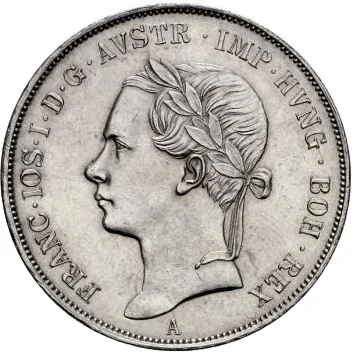
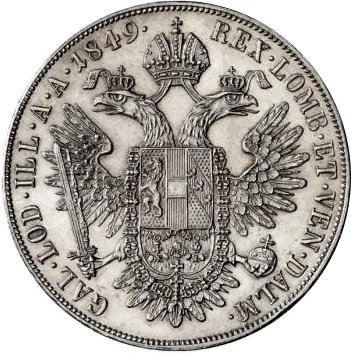
1 Thaler (early reign) – Austrian Empire
Non-circulating coins
Commemoration: First years of reign
Austria
Context
Years: 1848–1851
Country: Austria 
Issuer: Austrian Empire
Ruler: Francis Joseph I
Currency:
(1754—1857)
Demonetization: 31 December 1892
Material
References
KM: #Click to copy to clipboard2241
Numista: #33525
Value
Bullion value: $64.98
Obverse
Description:
Franz Joseph I in profile, crowned with laurel.
Inscription:
FRANC IOS I D G AVST IMP HVNG BOH REX
A
A
Translation:
Francis Joseph I, by the Grace of God, August Emperor of Austria, King of Hungary, King of Bohemia.
Script: Latin
Language: Latin
Engraver: Konrad Lange
Reverse
Description:
Imperial eagle bearing Habsburg-Lorraine and Austrian arms.
Inscription:
REX LOMB ET VEN DALM GAL LOD ILL A A date
Translation:
King of Lombardy and Venice, Dalmatia, Galicia, Lodomeria, and Illyria, Archduke of Austria
Script: Latin
Language: Latin
Engraver: Konrad Lange
Edge
Mintings
| Year | Mint Mark | Mintage | Quality | Collection |
|---|---|---|---|---|
| 1848 | A | — | ||
| 1849 | A | — | ||
| 1850 | A | — | ||
| 1851 | A | — |
Historical background
The currency situation in the Austrian Empire in 1848 was a legacy of chronic state bankruptcy and fiscal instability. The empire operated on a paper currency system, the Wiener Währung (Vienna Currency), centered on the paper gulden. These notes were not convertible into silver, and their value had been in steady decline for decades due to the state's practice of printing money to finance its deficits, particularly during the Napoleonic Wars and subsequent financial crises. By 1848, public confidence in this paper money was extremely low, and it circulated at a significant and fluctuating discount compared to silver coinage, which was hoarded and scarce.
The outbreak of revolution in March 1848 precipitated a full-blown financial panic, exacerbating the existing crisis. As political unrest spread across the empire, there was a massive run on banks and savings institutions. Fearful citizens rushed to convert their paper banknotes into tangible assets or silver, but the state's reserves were utterly inadequate. The government, under Finance Minister Philipp von Krauß, responded with emergency measures, including the forced conversion of private bank deposits into state bonds and the issuance of even more paper money to cover the costs of suppressing the revolutions and funding the war in Hungary. This led to rapid inflation and a further collapse in the value of the paper gulden.
By the end of 1848, the currency was in a state of near collapse, losing roughly half its nominal value. The financial chaos severely hampered the imperial government's ability to function, fund its military, and maintain economic stability. This monetary disintegration was both a cause and a consequence of the revolutionary turmoil, starkly revealing the profound weakness of the Habsburg state's finances. The crisis set the stage for the major monetary reforms of the 1850s, which would eventually introduce the silver-based Vereinsthaler and, later, the gold-convertible Gulden as part of a forced stabilization under Minister von Bruck.
The outbreak of revolution in March 1848 precipitated a full-blown financial panic, exacerbating the existing crisis. As political unrest spread across the empire, there was a massive run on banks and savings institutions. Fearful citizens rushed to convert their paper banknotes into tangible assets or silver, but the state's reserves were utterly inadequate. The government, under Finance Minister Philipp von Krauß, responded with emergency measures, including the forced conversion of private bank deposits into state bonds and the issuance of even more paper money to cover the costs of suppressing the revolutions and funding the war in Hungary. This led to rapid inflation and a further collapse in the value of the paper gulden.
By the end of 1848, the currency was in a state of near collapse, losing roughly half its nominal value. The financial chaos severely hampered the imperial government's ability to function, fund its military, and maintain economic stability. This monetary disintegration was both a cause and a consequence of the revolutionary turmoil, starkly revealing the profound weakness of the Habsburg state's finances. The crisis set the stage for the major monetary reforms of the 1850s, which would eventually introduce the silver-based Vereinsthaler and, later, the gold-convertible Gulden as part of a forced stabilization under Minister von Bruck.
✨ Legendary