

25 dollars – United States
Add to wishlist
United States
Context
Material
Diameter: 22 mm
Weight: 7.78 g
Platinum Weight:: 7.78 g
Shape: Round
Composition: 99.95% Platinum
Standard: Silver quarter ounce
Technique: Milled
Alignment: Coin alignment
flip
References
KM: #
Numista: #101848
Value
Exchange value: 25 USD = $25.00
Bullion value: $524.52
Inflation-adjusted value: 44.62 USD
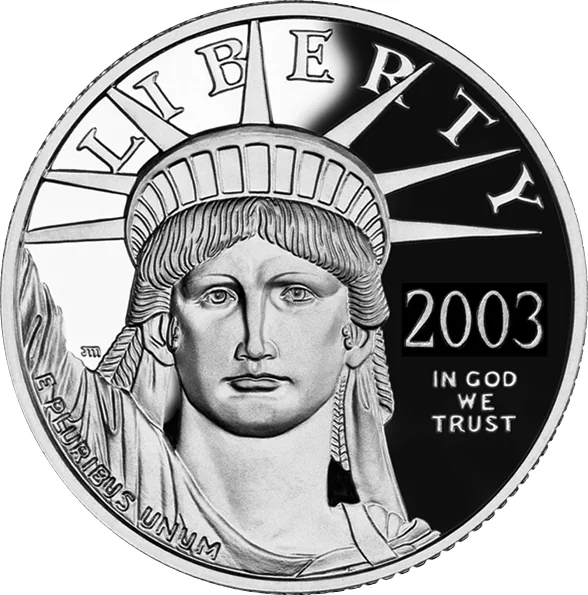
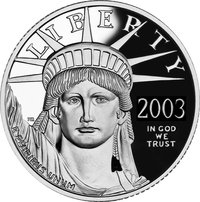
Obverse
Description:
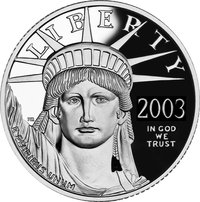
Liberty Enlightening the World
Inscription:
LIBERTY
2003
IN GOD
WE
TRUST
E PLURIBUS UNUM
2003
IN GOD
WE
TRUST
E PLURIBUS UNUM
Script: Latin
Engraver: John M. Mercanti
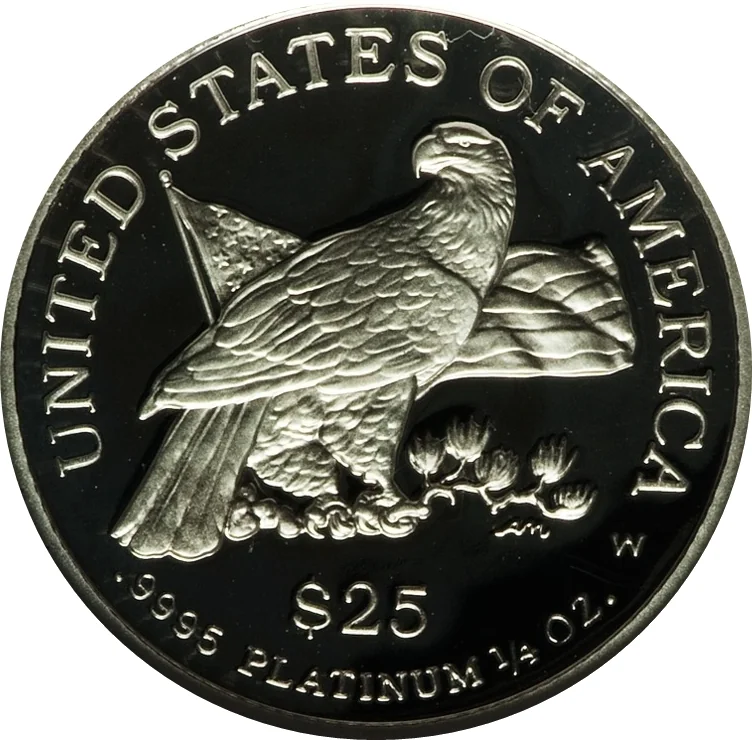
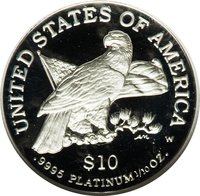
Reverse
Description:
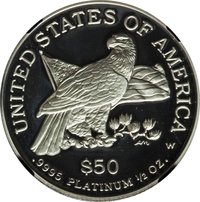
Bald eagle on a pine branch before an American flag.
Inscription:
UNITED STATES OF AMERICA
.9995
PLATINUM
1/4 OZ.
W
$25
.9995
PLATINUM
1/4 OZ.
W
$25
Script: Latin
Engraver: Alfred Maletsky
Edge
Reeded
Mints
| Name | Mark |
|---|---|
| United States Mint of West Point | W |
Mintings
| Year | Mint Mark | Mintage | Quality | Collection |
|---|---|---|---|---|
| 2003 | W | 7,044 | Proof |
Historical background
In 2003, the United States currency situation was characterized by a period of deliberate dollar depreciation and low domestic inflation. The U.S. Dollar Index, which measures the dollar against a basket of major currencies, fell approximately 15% over the course of the year. This decline was largely engineered by the Federal Reserve under Chairman Alan Greenspan, who maintained a historically low federal funds rate of 1% to combat deflationary fears and stimulate the economy following the 2001 recession and the market turmoil of the early 2000s. The weak dollar policy was tacitly supported by the Bush administration, as it aimed to boost exports by making American goods cheaper abroad, providing a crucial lift to the manufacturing sector.
Internationally, the dollar's weakness created significant tension, particularly with major trading partners in Europe and Japan. European officials publicly expressed concern that the euro's sharp appreciation was damaging their export-driven economies. More significantly, the focus of global currency friction shifted towards Asia, where China maintained a strict peg of its yuan to the dollar. The U.S. Treasury and manufacturing groups argued this peg was artificially undervalued, giving China an unfair trade advantage and contributing to the growing U.S. trade deficit. This set the stage for prolonged political pressure on China to revalue its currency.
Despite the dollar's external decline, the domestic economic environment remained stable with contained inflation, allowing the Fed to keep interest rates low. This monetary environment, combined with tax cuts, fueled a recovery in consumer spending and a rebound in the housing market. However, these very conditions—cheap credit and a search for yield—also began sowing the seeds for excessive risk-taking in mortgage lending and housing speculation. Thus, the currency situation of 2003 was a dual-sided story: a tool for short-term economic stimulus and trade rebalancing that also contributed to the financial imbalances that would culminate in the later crisis.
Internationally, the dollar's weakness created significant tension, particularly with major trading partners in Europe and Japan. European officials publicly expressed concern that the euro's sharp appreciation was damaging their export-driven economies. More significantly, the focus of global currency friction shifted towards Asia, where China maintained a strict peg of its yuan to the dollar. The U.S. Treasury and manufacturing groups argued this peg was artificially undervalued, giving China an unfair trade advantage and contributing to the growing U.S. trade deficit. This set the stage for prolonged political pressure on China to revalue its currency.
Despite the dollar's external decline, the domestic economic environment remained stable with contained inflation, allowing the Fed to keep interest rates low. This monetary environment, combined with tax cuts, fueled a recovery in consumer spending and a rebound in the housing market. However, these very conditions—cheap credit and a search for yield—also began sowing the seeds for excessive risk-taking in mortgage lending and housing speculation. Thus, the currency situation of 2003 was a dual-sided story: a tool for short-term economic stimulus and trade rebalancing that also contributed to the financial imbalances that would culminate in the later crisis.
✨ Legendary