



500 Francs (Liberation of Paris) – France
Non-circulating coins
Commemoration: 50th Anniversary of the Liberation of Paris
France



Obverse
Description:
Uniformed bust facing left
Inscription:
RF
DWIGHT DAVID EISENHOWER
DWIGHT DAVID EISENHOWER
Script: Latin
Engraver: Émile Rousseau
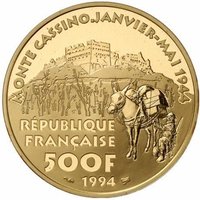
Reverse
Edge
Plain
Mints
| Name | Mark |
|---|---|
| Monnaie de Paris | — |
Mintings
| Year | Mint Mark | Mintage | Quality | Collection |
|---|---|---|---|---|
| 1994 | — | 307 | Proof |
Historical background
In 1994, France's currency situation was defined by its pivotal role within the European Exchange Rate Mechanism (ERM), the system designed to stabilize currencies ahead of the planned single currency. The French franc was a cornerstone of this mechanism, maintaining a strong and stable parity against the German Deutsche Mark within narrow fluctuation bands. This stability, known as the "franc fort" (strong franc) policy, was a central tenet of French economic strategy, prioritizing low inflation and credibility with Germany's Bundesbank to ensure France's place at the heart of the future Economic and Monetary Union (EMU).
This commitment, however, came at a significant economic cost. To defend the franc's high peg, the Banque de France was compelled to maintain high interest rates throughout the early 1990s, even as the country grappled with a severe recession and rising unemployment. This monetary tightness constrained growth and fueled public discontent, creating a tension between the demands of European integration and domestic economic pressures. The situation was further strained by the memory of the 1992-1993 ERM crises, which had forced several currencies, including the British pound, to devalue or exit the system, though the franc had ultimately weathered the storms.
By 1994, the immediate turbulence had subsided, and the franc's stability was seen as a triumph, solidifying France's path toward the euro. The year was characterized by a cautious optimism as the country met the Maastricht Treaty convergence criteria on inflation and interest rates, though it struggled with high public debt and deficit levels. Thus, the currency background was one of hard-won stability achieved through austerity, setting the stage for the final push to qualify for the single currency, which would ultimately replace the franc in 1999.
This commitment, however, came at a significant economic cost. To defend the franc's high peg, the Banque de France was compelled to maintain high interest rates throughout the early 1990s, even as the country grappled with a severe recession and rising unemployment. This monetary tightness constrained growth and fueled public discontent, creating a tension between the demands of European integration and domestic economic pressures. The situation was further strained by the memory of the 1992-1993 ERM crises, which had forced several currencies, including the British pound, to devalue or exit the system, though the franc had ultimately weathered the storms.
By 1994, the immediate turbulence had subsided, and the franc's stability was seen as a triumph, solidifying France's path toward the euro. The year was characterized by a cautious optimism as the country met the Maastricht Treaty convergence criteria on inflation and interest rates, though it struggled with high public debt and deficit levels. Thus, the currency background was one of hard-won stability achieved through austerity, setting the stage for the final push to qualify for the single currency, which would ultimately replace the franc in 1999.



✨ Legendary