

500 Lire – Vatican City
Vatican City
Context
Years: 1959–1962
Issuer: Vatican City 
Ruler: John XXIII
Currency:
(1929—2001)
Demonetized: Yes
Total mintage: 120,000
Material
References
KM: #Click to copy to clipboard65
Numista: #33338
Value
Exchange value: 500 VAL
Bullion value: $26.48
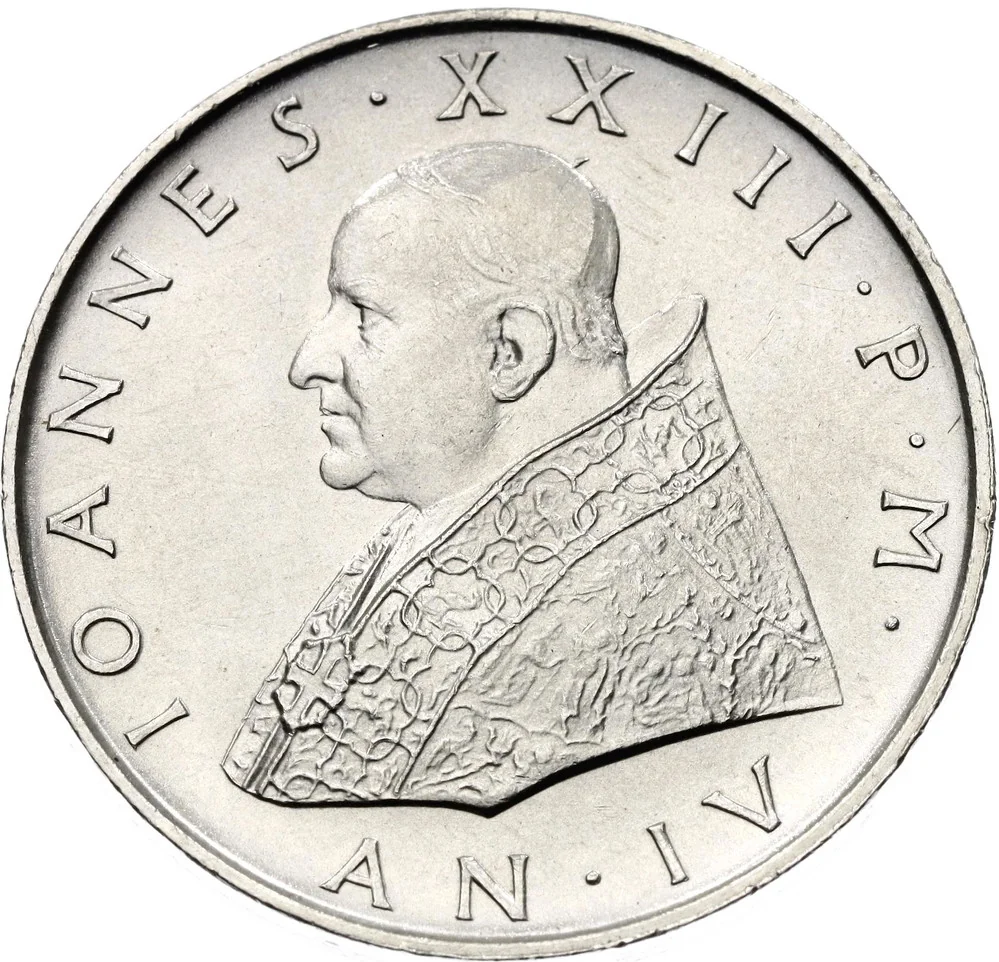
Obverse
Description:
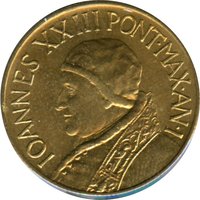
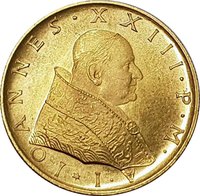
Portrait of Pope John XXIII, left-facing.
Inscription:
IOANNES. XXIII. P. M.
AN.III
AN.III
Translation:
JOHN THE TWENTY-THIRD, PONTIFF MAXIMUS,
YEAR THREE
YEAR THREE
Script: Latin
Language: Latin
Engraver: Pietro Giampaoli
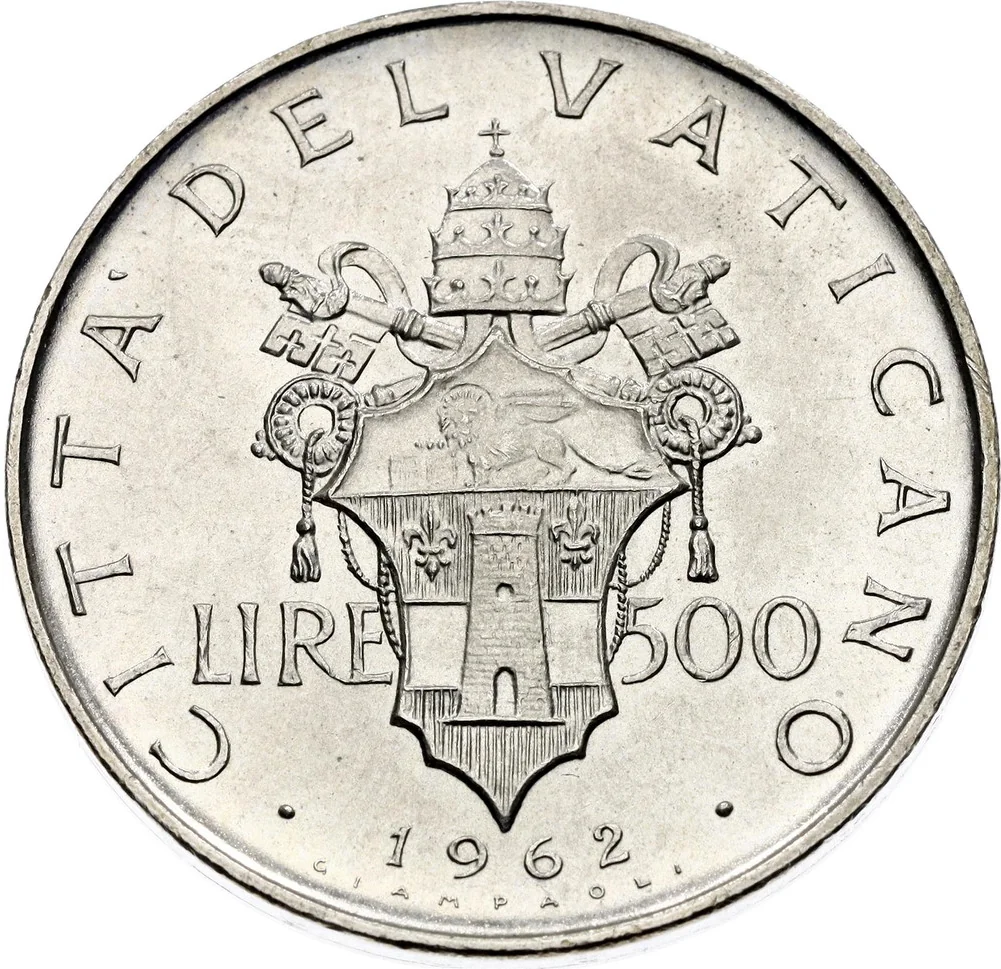
Reverse
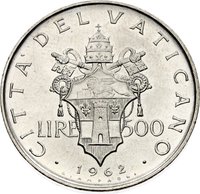
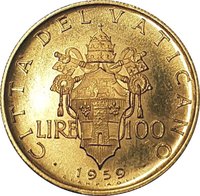
Description:
Ioannes XXIII coat of arms splits value, date beneath.
Inscription:
CITTA DEL VATICANO
LIRE 500
1961
GIAMPAOLI
LIRE 500
1961
GIAMPAOLI
Translation:
Vatican City
500 Lire
1961
Giampaoli
500 Lire
1961
Giampaoli
Script: Latin
Language: Italian
Engraver: Pietro Giampaoli
Edge
Categories
| Person> Monarch |
| Person> Religious figure |
| Religion> Religious objects |
| Symbols> Coat of Arms |
Mints
| Name | Mark |
|---|---|
| Rome | — |
Mintings
| Year | Mint Mark | Mintage | Quality | Collection |
|---|---|---|---|---|
| 1959 | — | 30,000 | ||
| 1960 | — | 30,000 | ||
| 1961 | — | 30,000 | ||
| 1962 | — | 30,000 |
Historical background
In 1959, Vatican City's currency situation was defined by the Lateran Treaty of 1929, which established its independence and granted it the right to issue its own money. As a result, the Vatican lira was the official currency, circulating at par and being legally interchangeable with the Italian lira. This arrangement was practical, as the Italian lira was the dominant currency used in daily transactions within the tiny city-state, given its economic integration with Rome and Italy. The Vatican's coinage, minted in limited quantities and often featuring the image of the reigning Pope (in this case, Pope John XXIII), was primarily intended for collectors and tourists rather than for widespread commercial use.
The monetary system was managed through a special agreement with the Italian government and the Bank of Italy. The Vatican could issue its own coins and, for a brief period from 1929 to 1939, also banknotes, but its issuing rights were constrained by treaty to amounts proportionate to the needs of the city-state. Crucially, the Vatican's coinage was backed by a deposit of equivalent value in Italian lire held at the Bank of Italy, ensuring stability and parity. This meant the Vatican did not have an independent monetary policy but operated within the framework of the Italian financial system.
The year 1959 itself was not marked by a monetary crisis or significant change, but it fell within a period of quiet preparation. Pope John XXIII, who had been elected in 1958, was laying the groundwork for the Second Vatican Council, a focus that overshadowed financial matters. However, the underlying system faced growing anachronisms. The Italian lira, and by extension the Vatican lira, was part of the Bretton Woods system of fixed exchange rates, but Italy was on the cusp of its post-war "economic miracle." Inflationary pressures that would later challenge the fixed parity were building, setting the stage for future monetary adjustments in the decades to follow.
The monetary system was managed through a special agreement with the Italian government and the Bank of Italy. The Vatican could issue its own coins and, for a brief period from 1929 to 1939, also banknotes, but its issuing rights were constrained by treaty to amounts proportionate to the needs of the city-state. Crucially, the Vatican's coinage was backed by a deposit of equivalent value in Italian lire held at the Bank of Italy, ensuring stability and parity. This meant the Vatican did not have an independent monetary policy but operated within the framework of the Italian financial system.
The year 1959 itself was not marked by a monetary crisis or significant change, but it fell within a period of quiet preparation. Pope John XXIII, who had been elected in 1958, was laying the groundwork for the Second Vatican Council, a focus that overshadowed financial matters. However, the underlying system faced growing anachronisms. The Italian lira, and by extension the Vatican lira, was part of the Bretton Woods system of fixed exchange rates, but Italy was on the cusp of its post-war "economic miracle." Inflationary pressures that would later challenge the fixed parity were building, setting the stage for future monetary adjustments in the decades to follow.
🌟 Uncommon