

1 dollar – Canada
Add to wishlist
Non-circulating coins
Commemoration: Platinum Jubilee of Her Majesty Queen Elizabeth II
Canada
Context
Material
References
KM: #
Numista: #333041
Value
Exchange value: 1 CAD
Bullion value: $57.76
Inflation-adjusted value: 1.14 CAD
Obverse
Description:
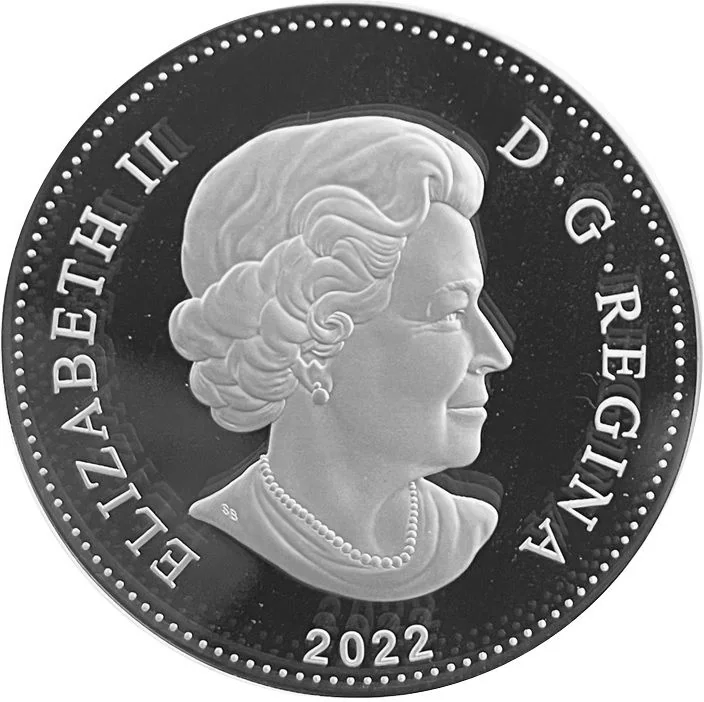
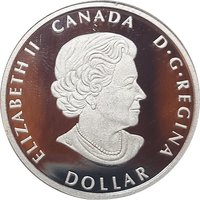
Queen Elizabeth II at 77, facing right, wearing a necklace and earrings.
Inscription:
ELIZABETH II D•G•REGINA
2022
2022
Translation:
Elizabeth II by the Grace of God Queen
2022
2022
Script: Latin
Engraver: Susan Taylor
Designer: Susanna Blunt
Reverse
Description:
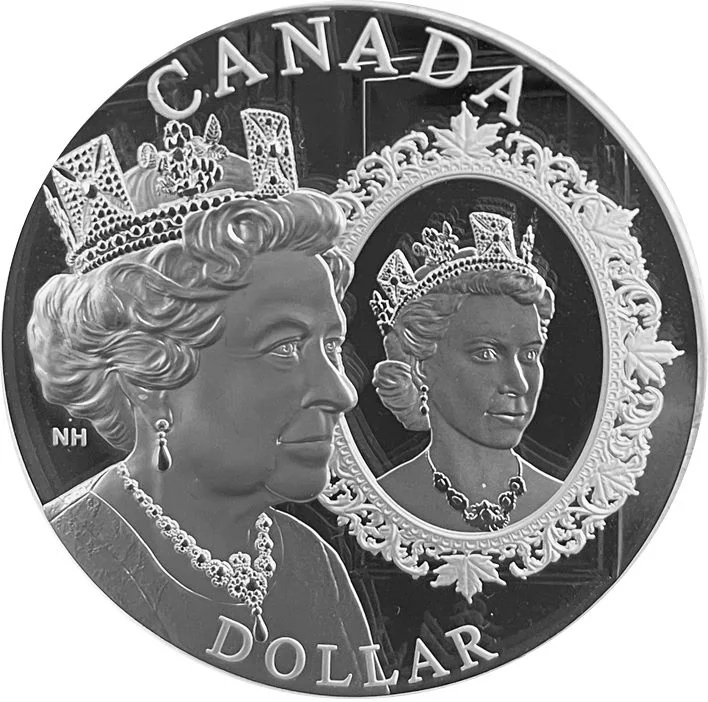
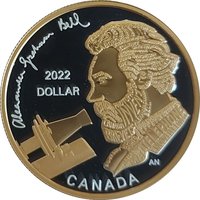
Designed by Neil Hamelin, this proof silver dollar's reverse honors Queen Elizabeth II's Platinum Jubilee with a double portrait. It features her current likeness alongside her 1952 accession portrait, framed with maple leaves as a tribute to the Queen of Canada.
Inscription:
CANADA
NH
DOLLAR
NH
DOLLAR
Script: Latin
Designer: Neil Hamelin
Edge
Serrated
Mints
| Name | Mark |
|---|---|
| Royal Canadian Mint of Ottawa | — |
Mintings
| Year | Mint Mark | Mintage | Quality | Collection |
|---|---|---|---|---|
| 2022 | — | 25,000 | Proof |
Historical background
In 2022, Canada's currency situation was dominated by the Bank of Canada's aggressive shift in monetary policy to combat decades-high inflation. The year began with the Canadian dollar (CAD) trading strongly, buoyed by soaring global commodity prices—particularly for oil, natural gas, and wheat—following Russia's invasion of Ukraine. As a major commodity exporter, Canada initially benefited from these price spikes, which supported the "loonie" and contributed to inflationary pressures. However, the primary narrative quickly became the central bank's series of rapid interest rate hikes, moving its policy rate from the emergency low of 0.25% at the start of the year to 4.25% by December.
This forceful tightening cycle, one of the most assertive among advanced economies, was a direct response to inflation that peaked at 8.1% in June. While the rate hikes aimed to cool domestic demand, they also created a complex dynamic for the CAD. Typically, rising interest rates bolster a currency by attracting foreign capital. However, throughout 2022, the Canadian dollar often weakened against the resilient US dollar, which was itself strengthened by even more hawkish expectations from the U.S. Federal Reserve and a global "flight to safety" in turbulent markets. The CAD's performance was therefore a tug-of-war between supportive domestic rates and volatile global risk sentiment.
By the end of 2022, the currency landscape was marked by uncertainty and the looming risk of recession. The Bank of Canada's rapid tightening began to slow economic activity, particularly in the interest-sensitive housing market. While inflation showed tentative signs of moderating in the final months, the policy-induced slowdown raised concerns about economic contraction. Consequently, the year closed with the Canadian dollar facing headwinds from both a slowing domestic economy and a broader global slowdown threatening commodity demand, setting the stage for a precarious 2023.
This forceful tightening cycle, one of the most assertive among advanced economies, was a direct response to inflation that peaked at 8.1% in June. While the rate hikes aimed to cool domestic demand, they also created a complex dynamic for the CAD. Typically, rising interest rates bolster a currency by attracting foreign capital. However, throughout 2022, the Canadian dollar often weakened against the resilient US dollar, which was itself strengthened by even more hawkish expectations from the U.S. Federal Reserve and a global "flight to safety" in turbulent markets. The CAD's performance was therefore a tug-of-war between supportive domestic rates and volatile global risk sentiment.
By the end of 2022, the currency landscape was marked by uncertainty and the looming risk of recession. The Bank of Canada's rapid tightening began to slow economic activity, particularly in the interest-sensitive housing market. While inflation showed tentative signs of moderating in the final months, the policy-induced slowdown raised concerns about economic contraction. Consequently, the year closed with the Canadian dollar facing headwinds from both a slowing domestic economy and a broader global slowdown threatening commodity demand, setting the stage for a precarious 2023.


⭐ Rare