

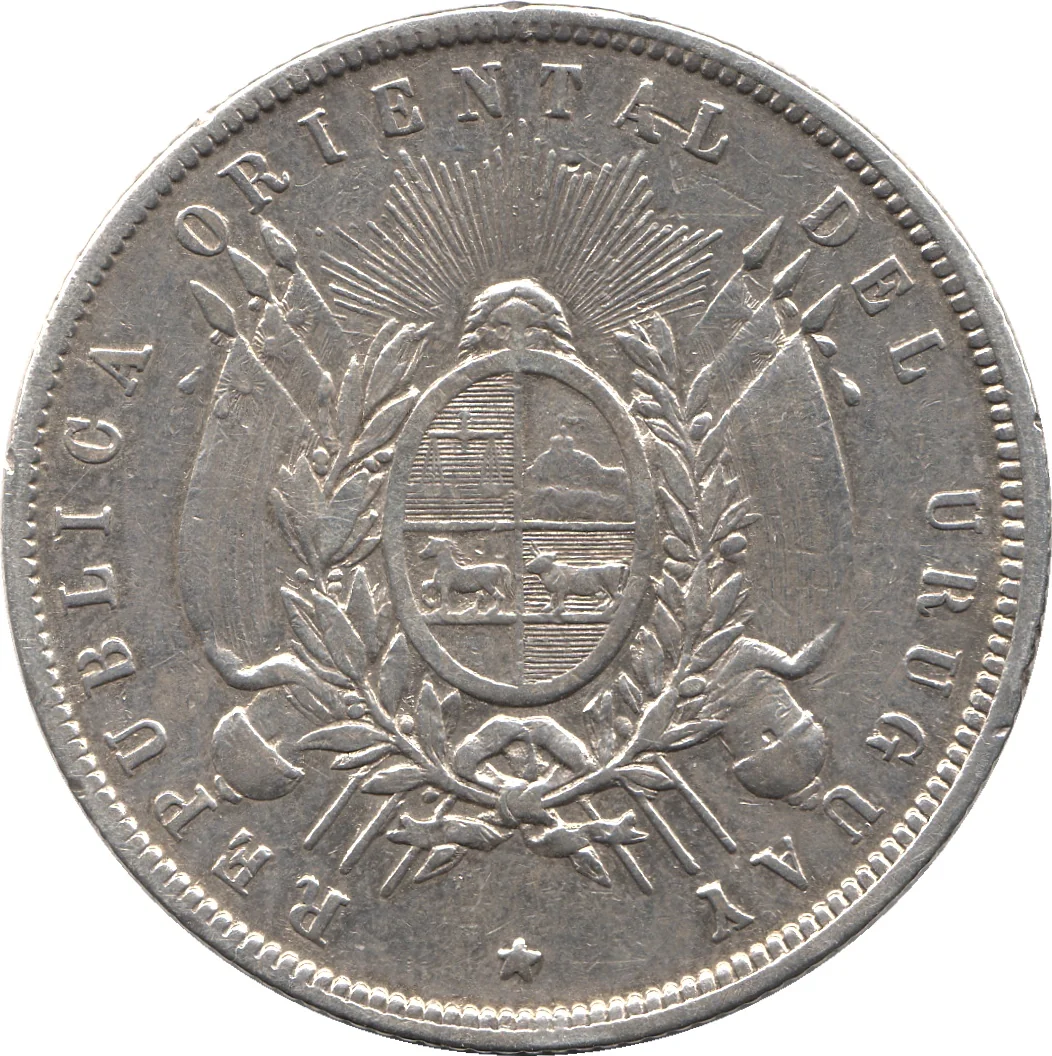
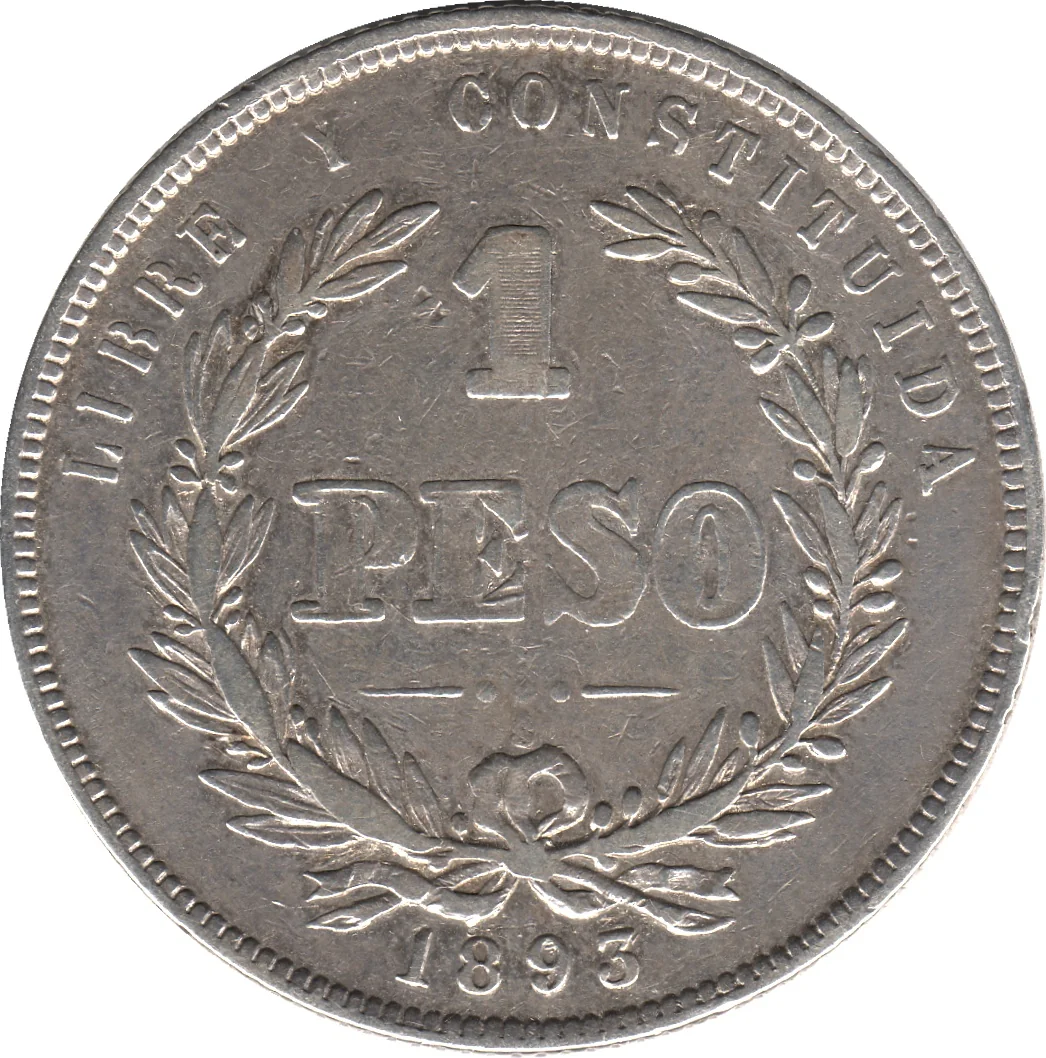
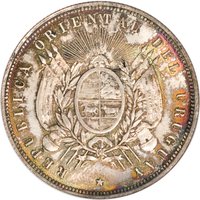
Obverse
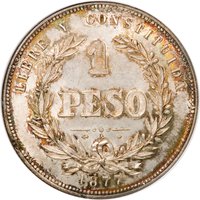
Reverse
Description:
Value in wreath, date beneath.
Inscription:
LIBRE Y CONSTITUIDA
1
PESO
1893
1
PESO
1893
Script: Latin
Edge
Reeded
Mints
| Name | Mark |
|---|---|
| Buenos Aires | — |
| Monnaie de Paris | A |
| Casa de Moneda de Chile | (So) |
Mintings
| Year | Mint Mark | Mintage | Quality | Collection |
|---|---|---|---|---|
| 1878 | A | 100,000 | ||
| 1893 | — | 600,000 | ||
| 1893 | So | 500,000 | ||
| 1895 | — | 1,000,000 |
Historical background
By 1878, Uruguay was grappling with a severe and complex monetary crisis rooted in decades of fiscal instability. The national government, chronically short of revenue due to civil conflicts (the Guerra Grande and later internal revolts) and a weak tax base, had long relied on the issuance of inconvertible paper money to finance its deficits. This practice, beginning in the 1860s, led to the coexistence of two currencies: the gold-backed peso fuerte (strong peso) used for international trade, and the depreciating paper peso moneda corriente (current money peso). The value of the paper peso fluctuated wildly based on political fortunes and the state's credibility, creating profound economic uncertainty.
The situation reached a critical point in the mid-1870s under the military government of Lorenzo Latorre, who sought to modernize the state. While Latorre promoted key reforms in land tenure and security, the currency chaos stifled commerce and foreign investment. By 1878, the paper peso had lost a significant portion of its nominal value, and the public had little confidence in it. The instability hampered every economic transaction, as merchants and estancieros (ranchers) struggled with unpredictable exchange rates between paper, gold, and the currencies of major trading partners like Britain and Brazil.
Consequently, 1878 represented a pivotal moment just before decisive action. The Latorre regime, recognizing that monetary reform was essential for its modernization project and for attracting the foreign capital needed for infrastructure, was actively preparing for a major overhaul. This groundwork would culminate in the landmark Law of Monetary Conversion in 1896, but the pressures and dysfunctions of 1878—marked by a deeply divided circulation, rampant speculation, and inflationary pressures on everyday prices—made the urgent need for a single, stable currency abundantly clear to the government and the business community alike.
The situation reached a critical point in the mid-1870s under the military government of Lorenzo Latorre, who sought to modernize the state. While Latorre promoted key reforms in land tenure and security, the currency chaos stifled commerce and foreign investment. By 1878, the paper peso had lost a significant portion of its nominal value, and the public had little confidence in it. The instability hampered every economic transaction, as merchants and estancieros (ranchers) struggled with unpredictable exchange rates between paper, gold, and the currencies of major trading partners like Britain and Brazil.
Consequently, 1878 represented a pivotal moment just before decisive action. The Latorre regime, recognizing that monetary reform was essential for its modernization project and for attracting the foreign capital needed for infrastructure, was actively preparing for a major overhaul. This groundwork would culminate in the landmark Law of Monetary Conversion in 1896, but the pressures and dysfunctions of 1878—marked by a deeply divided circulation, rampant speculation, and inflationary pressures on everyday prices—made the urgent need for a single, stable currency abundantly clear to the government and the business community alike.
🌟 Limited