

50 piastres (United Arab Republic founding) – Syria
Add to wishlist
Circulating commemorative coins
Commemoration: 1st Anniversary - Founding of United Arab Republic
Syria
Context
Year: 1959
Islamic (Hijri) Year:: 1378
Issuer: Syria
Period:
(1958—1961)
Currency:
(since 1919)
Demonetization: 1962
Total mintage: 1,500,000
Material
References
KM: #
Numista: #13828
Value
Exchange value: 0.50 SYP
Bullion value: $7.34
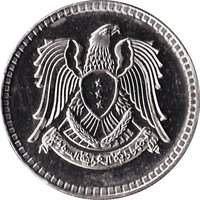
Obverse
Description:
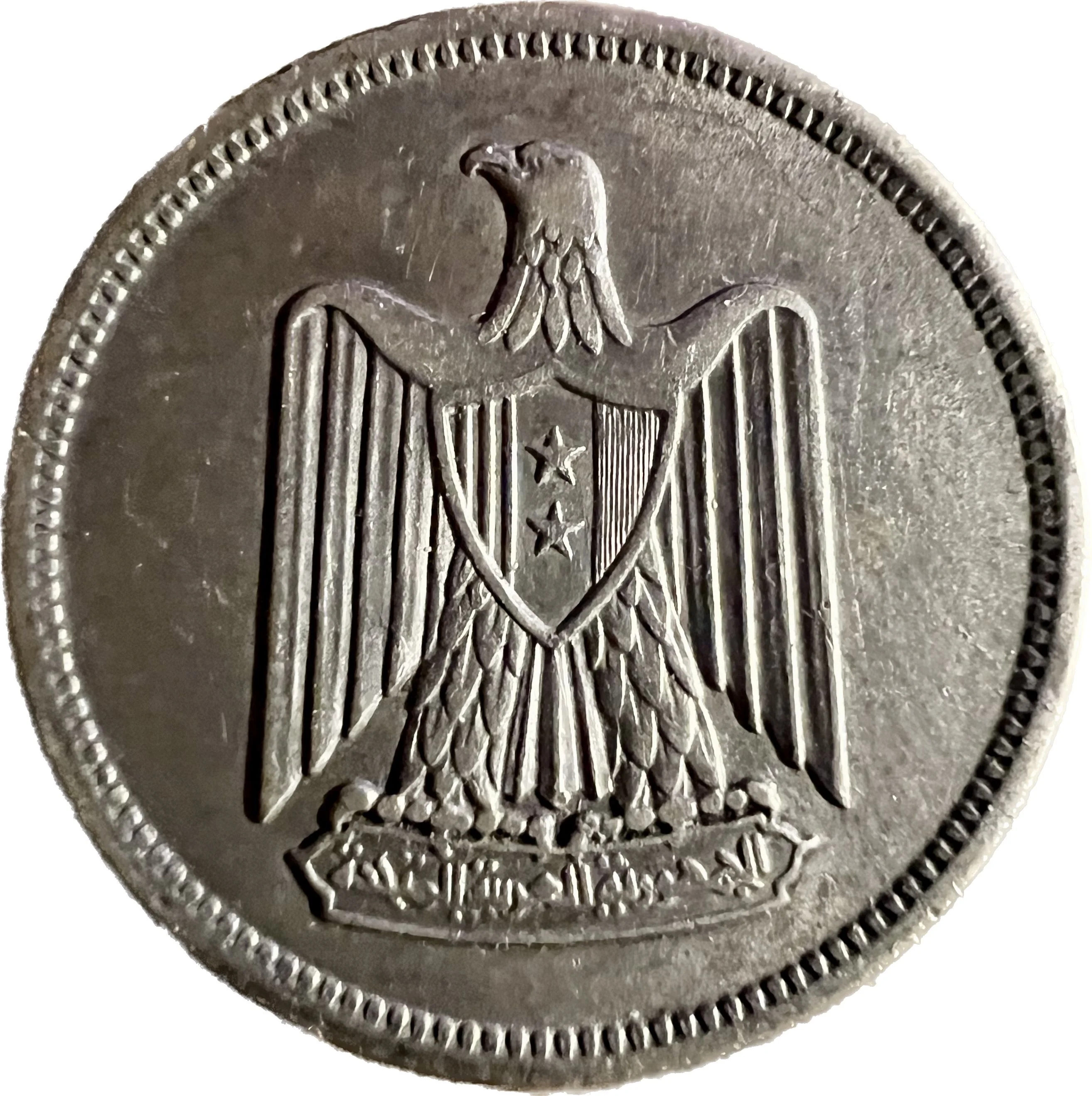
United Arab Republic coat of arms (1958-1961): A left-facing Saladin eagle with outstretched wings, holding an Arabic scroll. On its chest is a shield divided into three, featuring two stars on the central band.
Inscription:
الجمهورية العربية المتحدة
Translation:
The United Arab Republic
Script: Arabic
Language: Arabic
Reverse
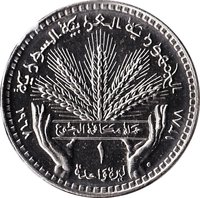
Description:
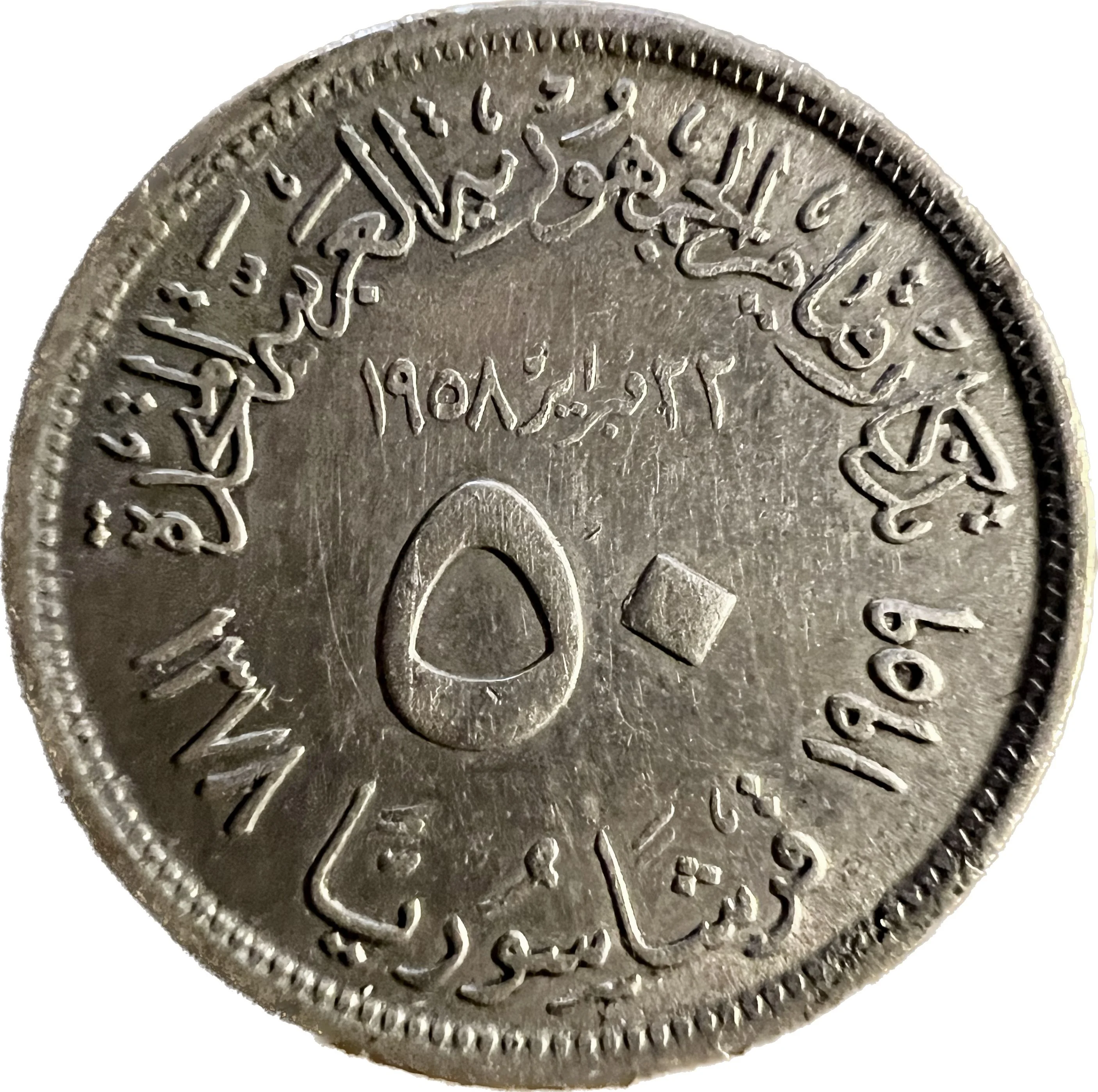
UAR founding date (22 February 1958) above in Arabic. Denomination below in Arabic.
Inscription:
تذكار قيام الجمهُورية العَربيَّة المتحدة
٢٢ قيران ١٩٥٨
٥۰
۱۳۷۸ ۱۹٥۹
قرشاً سُوريّاً
٢٢ قيران ١٩٥٨
٥۰
۱۳۷۸ ۱۹٥۹
قرشاً سُوريّاً
Translation:
Commemoration of the Establishment of the United Arab Republic
22 Quirran 1958
50
1378 1959
Syrian Qirsh
22 Quirran 1958
50
1378 1959
Syrian Qirsh
Script: Arabic
Language: Arabic
Edge
Reeded
Mintings
| Year | Mint Mark | Mintage | Quality | Collection |
|---|---|---|---|---|
| 1959 | — | 1,500,000 |
Historical background
In 1959, Syria's currency situation was fundamentally defined by its political union with Egypt within the United Arab Republic (UAR), established in 1958. Prior to the union, Syria used the Syrian pound, which was issued by the Banque de Syrie et du Liban. A key early act of the UAR government was the creation of a unified central bank, the Central Bank of the United Arab Republic, which began operations in 1959 with the mandate to issue a single currency for both regions.
Consequently, the Syrian pound was officially replaced by the new "UAR pound" (also known as the Egyptian pound) at par. While the new banknotes bore the name of the United Arab Republic, the practical implementation was complex. Old Syrian and Egyptian notes remained in circulation alongside the new issue, creating a de facto dual-currency system within the unified framework. This monetary merger was a symbolic and administrative pillar of the political union, aiming to facilitate trade and economic integration between the two regions.
However, this currency union was fraught with underlying economic tensions. Syria and Egypt had vastly different economic structures and fiscal policies, with Syria possessing a stronger currency and healthier reserves at the time of unification. The merger effectively obligated Damascus to share its financial resources with Cairo, leading to concerns over inflation and the outflow of Syrian capital. These economic disparities, symbolized by the imposed currency union, became a significant point of contention and would later contribute to the political grievances leading to Syria's secession from the UAR in 1961.
Consequently, the Syrian pound was officially replaced by the new "UAR pound" (also known as the Egyptian pound) at par. While the new banknotes bore the name of the United Arab Republic, the practical implementation was complex. Old Syrian and Egyptian notes remained in circulation alongside the new issue, creating a de facto dual-currency system within the unified framework. This monetary merger was a symbolic and administrative pillar of the political union, aiming to facilitate trade and economic integration between the two regions.
However, this currency union was fraught with underlying economic tensions. Syria and Egypt had vastly different economic structures and fiscal policies, with Syria possessing a stronger currency and healthier reserves at the time of unification. The merger effectively obligated Damascus to share its financial resources with Cairo, leading to concerns over inflation and the outflow of Syrian capital. These economic disparities, symbolized by the imposed currency union, became a significant point of contention and would later contribute to the political grievances leading to Syria's secession from the UAR in 1961.
🌟 Uncommon