

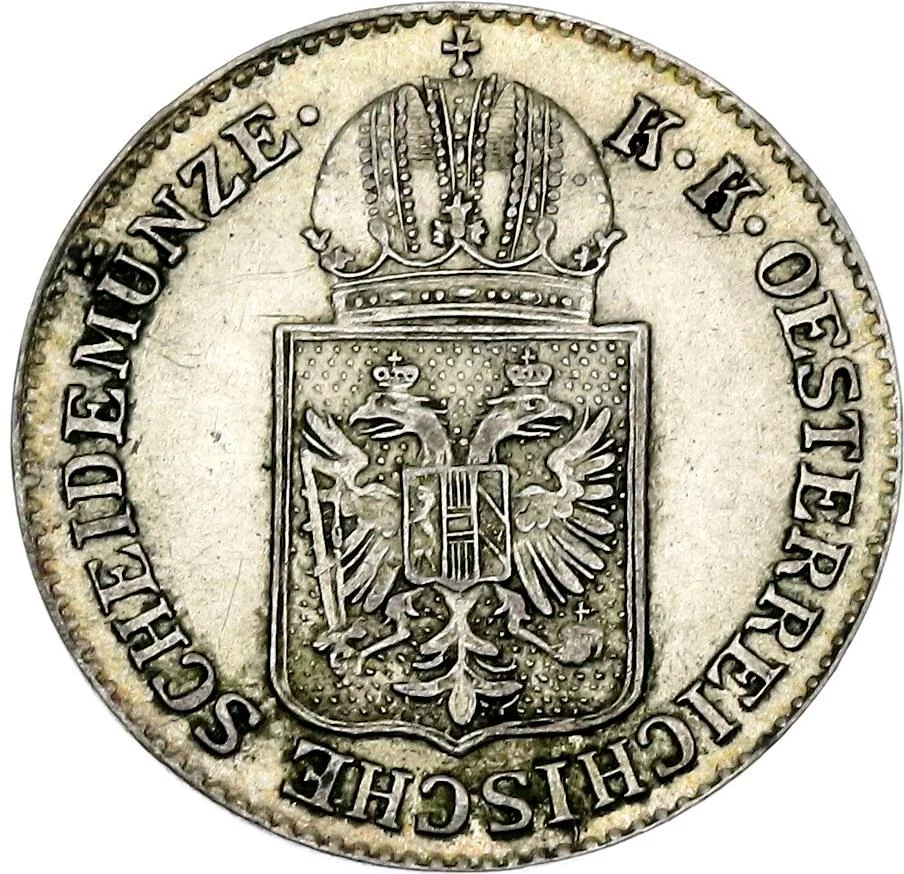
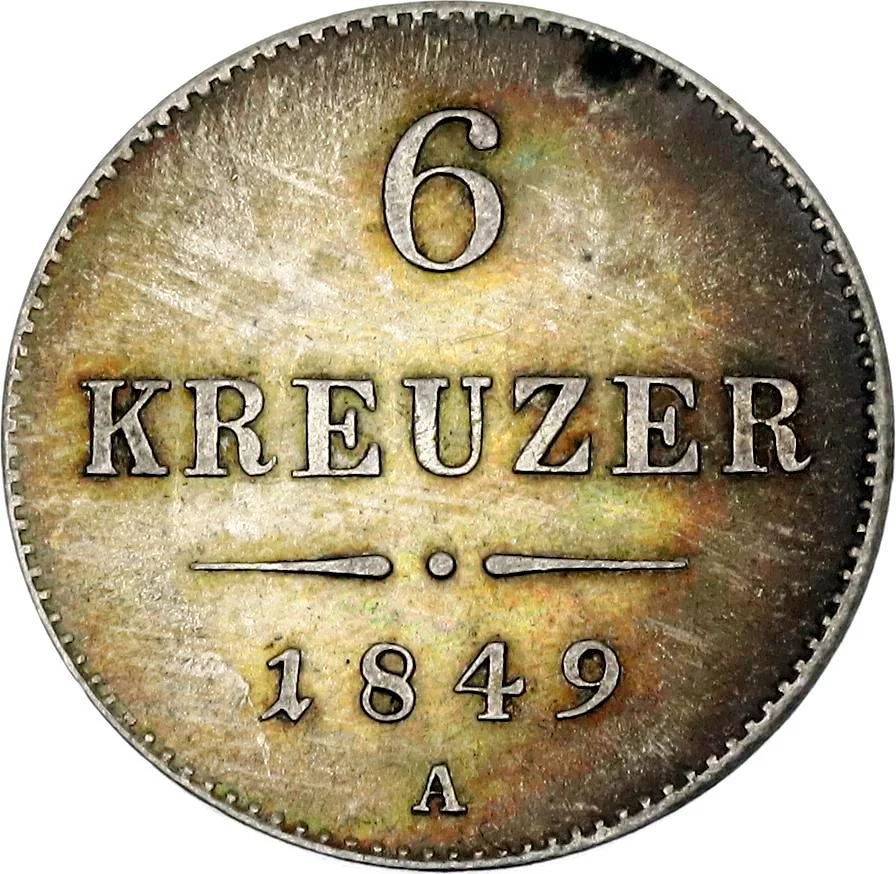
6 Kreuzers – Austrian Empire
Austria
Context
Year: 1849
Country: Austria 
Issuer: Austrian Empire
Ruler: Francis Joseph I
Currency:
(1754—1857)
Demonetization: 31 July 1870
Total mintage: 254,530,028
Material
References
KM: #Click to copy to clipboard2200
Numista: #13821
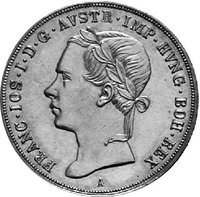
Obverse
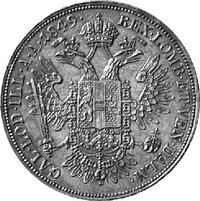
Reverse
Edge
Plain
Mints
| Name | Mark |
|---|---|
| Münze Österreich | — |
Mintings
| Year | Mint Mark | Mintage | Quality | Collection |
|---|---|---|---|---|
| 1849 | A | 251,879,231 | ||
| 1849 | B | 2,650,797 | ||
| 1849 | C | — |
Historical background
By 1849, the Austrian Empire was grappling with a severe and multifaceted currency crisis, a direct legacy of the revolutionary upheavals of 1848. The costly military campaigns to suppress rebellions across the empire, from Italy to Hungary and Vienna itself, had drained state finances. With traditional tax revenues collapsing and credit exhausted, the government under Minister of Finance Philipp von Krauss resorted to the continuous printing of unbacked paper money. This led to a dramatic devaluation of the Austrian paper gulden (known as Bankozettel), causing it to trade at a steep and widening discount against the theoretical silver gulden (Conventionsmünze).
The situation created a chaotic dual-currency system. While official debts and taxes were calculated in silver gulden, daily transactions were conducted in rapidly depreciating paper notes. This disparity bred widespread economic distress, crippling trade and causing rampant price inflation that punished wage-earners and savers. Public confidence in the paper currency evaporated, and a thriving black market for silver and foreign coinage emerged. The state's attempt to stabilize matters by decreeing a fixed exchange rate between paper and silver was utterly ineffective, as the market rate continued to plummet, undermining all economic planning.
Recognizing the existential threat to the state's fiscal integrity, the Austrian government embarked on a fundamental reform in 1849. The provisional patent of June 15th introduced the Vereinsmünz standard, pegging the new silver gulden to the currency of the German Customs Union, and promised a future return to convertibility. More concretely, it laid the legal groundwork for the establishment of the Austrian National Bank (Österreichische Nationalbank), chartered in 1850, which was granted a monopoly on note issue with the goal of restoring sound money. Thus, 1849 represents the painful nadir of the currency collapse and the first, tentative step toward the hard fiscal discipline that would characterize the Neoabsolutist era under Minister-President Felix zu Schwarzenberg.
The situation created a chaotic dual-currency system. While official debts and taxes were calculated in silver gulden, daily transactions were conducted in rapidly depreciating paper notes. This disparity bred widespread economic distress, crippling trade and causing rampant price inflation that punished wage-earners and savers. Public confidence in the paper currency evaporated, and a thriving black market for silver and foreign coinage emerged. The state's attempt to stabilize matters by decreeing a fixed exchange rate between paper and silver was utterly ineffective, as the market rate continued to plummet, undermining all economic planning.
Recognizing the existential threat to the state's fiscal integrity, the Austrian government embarked on a fundamental reform in 1849. The provisional patent of June 15th introduced the Vereinsmünz standard, pegging the new silver gulden to the currency of the German Customs Union, and promised a future return to convertibility. More concretely, it laid the legal groundwork for the establishment of the Austrian National Bank (Österreichische Nationalbank), chartered in 1850, which was granted a monopoly on note issue with the goal of restoring sound money. Thus, 1849 represents the painful nadir of the currency collapse and the first, tentative step toward the hard fiscal discipline that would characterize the Neoabsolutist era under Minister-President Felix zu Schwarzenberg.
🌱 Common