

5 pounds – United Kingdom
Add to wishlist
Non-circulating coins
Commemoration: The end of the second millennium AD
United Kingdom
Context
Material
Diameter: 38.61 mm
Weight: 28.28 g
Shape: Round
Composition: Copper-nickel
Technique: Milled
Alignment: Medal alignment
flip
References
KM: #
Numista: #331902
Value
Exchange value: 5 GBP
Inflation-adjusted value: 11.07 GBP
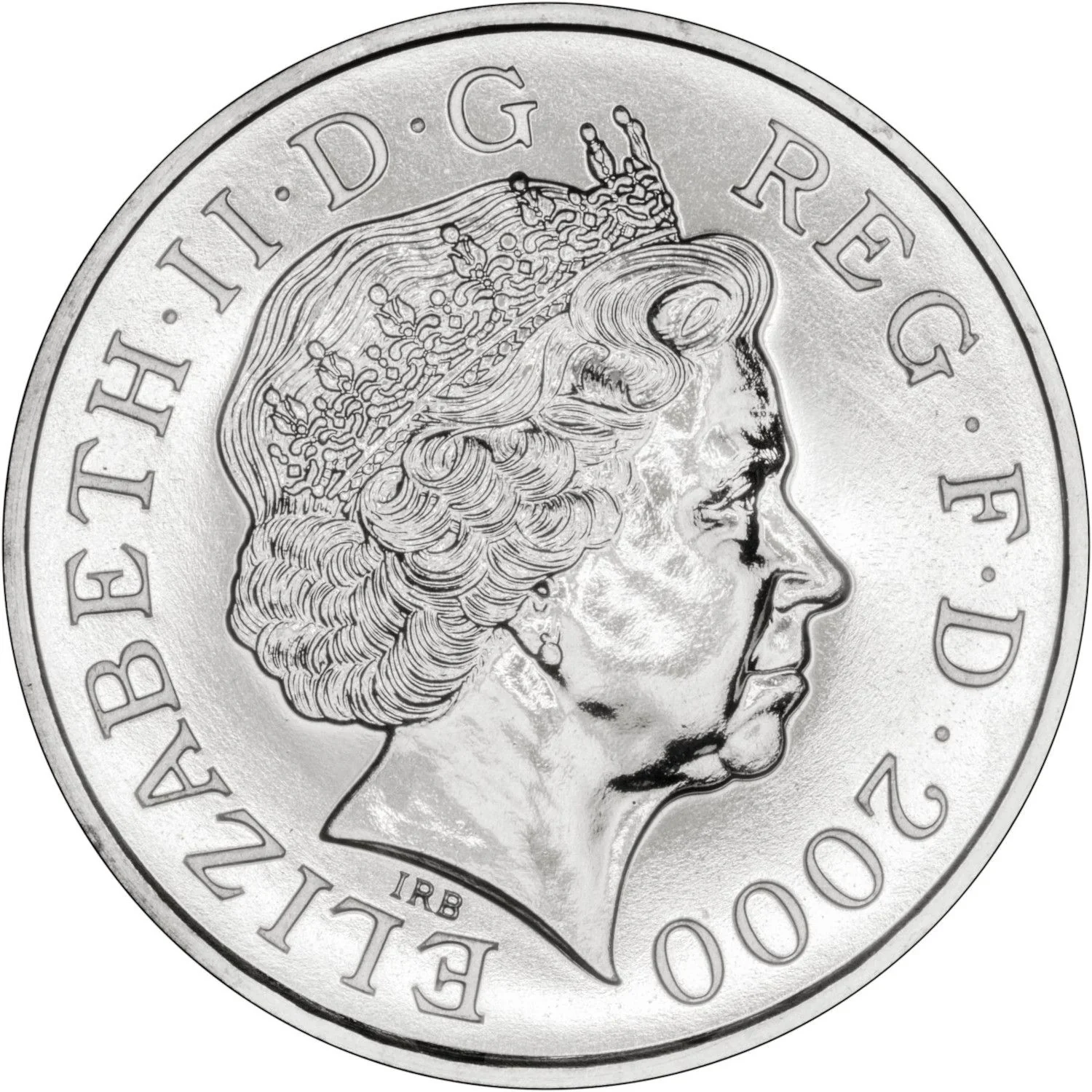
Obverse
Description:
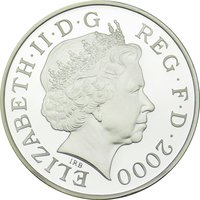
Queen Elizabeth IV facing right, wearing the Girls of Great Britain and Ireland tiara.
Inscription:
ELIZABETH·II·D·G REG·F·D·2000
IRB
IRB
Translation:
Elizabeth II by the Grace of God Queen Defender of the Faith 2000
Script: Latin
Engraver: Ian Rank-Broadley
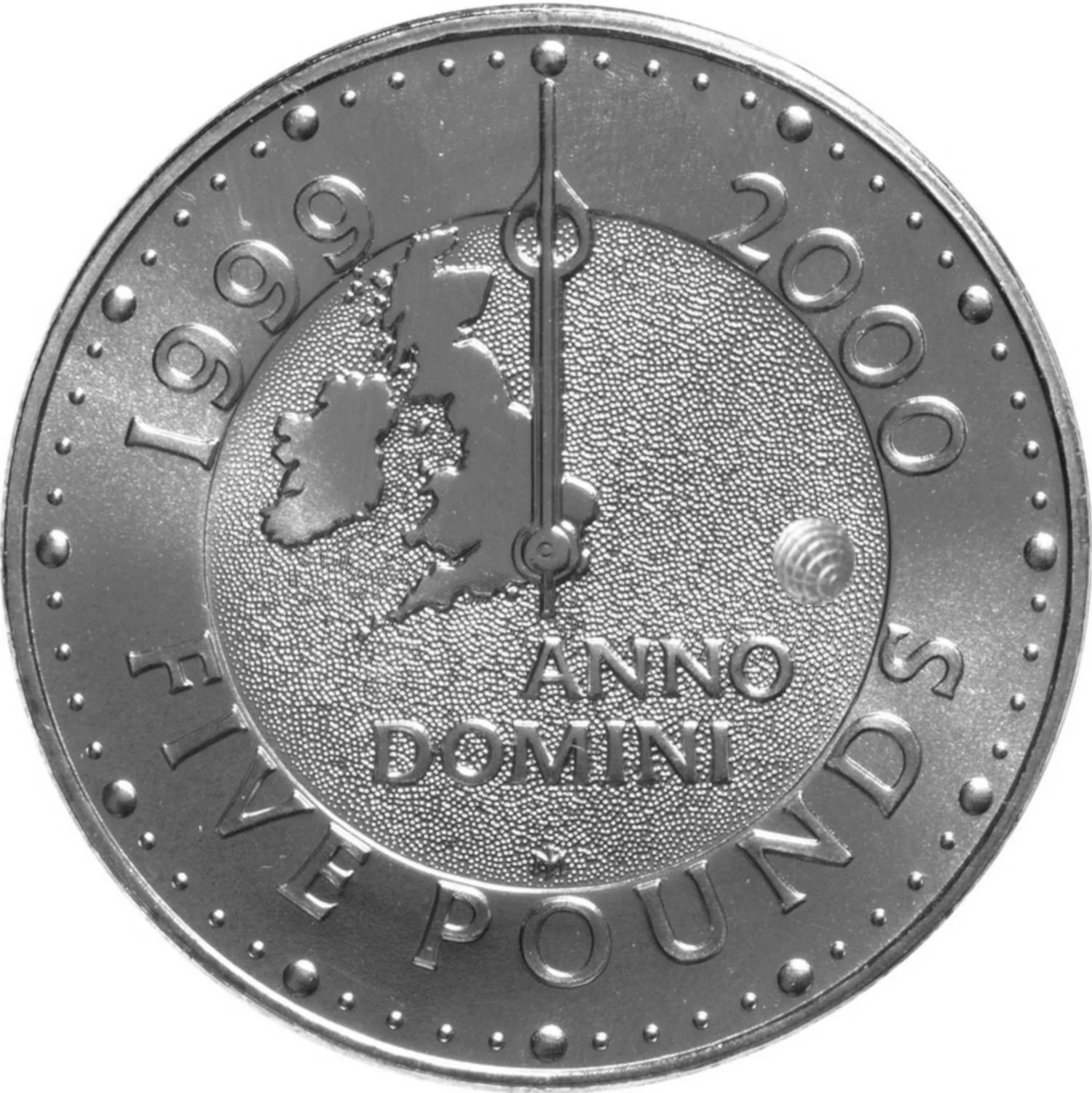
Reverse
Description:
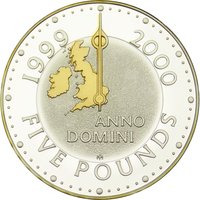
British Isles design with clock hands set to twelve, pivoted on Greenwich. Commemorative dates flank the clock, denomination below, privy mark at 3 o'clock.
Inscription:
1999 2000
ANNO DOMINI
JM
FIVE POUNDS
ANNO DOMINI
JM
FIVE POUNDS
Translation:
ANNO DOMINI
JM
FIVE POUNDS
JM
FIVE POUNDS
Script: Latin
Engraver: Jeffrey Matthews
Edge
Plain with incuse lettering
Legend:
WHAT'S PAST IS PROLOGUE
Categories
| Event> Millennium |
Mints
| Name | Mark |
|---|---|
| Royal Mint | — |
Mintings
| Year | Mint Mark | Mintage | Quality | Collection |
|---|---|---|---|---|
| 2000 | — | — | BU |
Historical background
In the year 2000, the United Kingdom's currency situation was defined by its notable and deliberate absence from the Eurozone. While eleven other European Union members had adopted the euro as their common currency in 1999 (with notes and coins entering circulation in 2002), the UK, under the Labour government of Tony Blair, maintained its opt-out secured in the Maastricht Treaty. The official government policy, set out by Chancellor Gordon Brown, was one of cautious "prepare and decide," guided by five economic tests that had to be met before any recommendation to join could be made. These tests assessed convergence, flexibility, investment, financial services, and growth, effectively placing the decision on hold for the foreseeable future.
Consequently, the pound sterling (£) remained the nation's strong and independent currency, with its value determined by foreign exchange markets. The period around 2000 saw a relatively strong pound, particularly against the newly launched euro, which initially weakened after its introduction. This strength reflected robust economic growth and higher interest rates in the UK compared to the Eurozone, but it also posed challenges for British exporters by making their goods more expensive abroad. The Bank of England, which had been granted operational independence over monetary policy in 1997, managed this dynamic by setting interest rates to target domestic inflation, further cementing sterling's autonomous monetary framework.
The political and public debate over the euro was a significant undercurrent throughout the year. While the government and much of the business community were broadly in favour of eventual membership in principle, there was deep-seated public scepticism and strong opposition from the Conservative Party, which framed the issue as one of national sovereignty. This division meant that despite periodic statements from pro-European voices, the government had no immediate plans to hold a promised referendum. Thus, the currency situation in 2000 was one of stable and managed isolation, with the UK watching the euro experiment from the sidelines while enjoying the benefits and bearing the costs of a buoyant independent pound.
Consequently, the pound sterling (£) remained the nation's strong and independent currency, with its value determined by foreign exchange markets. The period around 2000 saw a relatively strong pound, particularly against the newly launched euro, which initially weakened after its introduction. This strength reflected robust economic growth and higher interest rates in the UK compared to the Eurozone, but it also posed challenges for British exporters by making their goods more expensive abroad. The Bank of England, which had been granted operational independence over monetary policy in 1997, managed this dynamic by setting interest rates to target domestic inflation, further cementing sterling's autonomous monetary framework.
The political and public debate over the euro was a significant undercurrent throughout the year. While the government and much of the business community were broadly in favour of eventual membership in principle, there was deep-seated public scepticism and strong opposition from the Conservative Party, which framed the issue as one of national sovereignty. This division meant that despite periodic statements from pro-European voices, the government had no immediate plans to hold a promised referendum. Thus, the currency situation in 2000 was one of stable and managed isolation, with the UK watching the euro experiment from the sidelines while enjoying the benefits and bearing the costs of a buoyant independent pound.
🌟 Limited