

¼ Florin – Austrian Empire
Austria
Context
Years: 1859–1865
Country: Austria 
Issuer: Austrian Empire
Ruler: Francis Joseph I
Currency:
(1857—1892)
Demonetization: 31 May 1893
Total mintage: 132,208,216
Material
References
KM: #Click to copy to clipboard2214
Numista: #13806
Value
Bullion value: $7.96
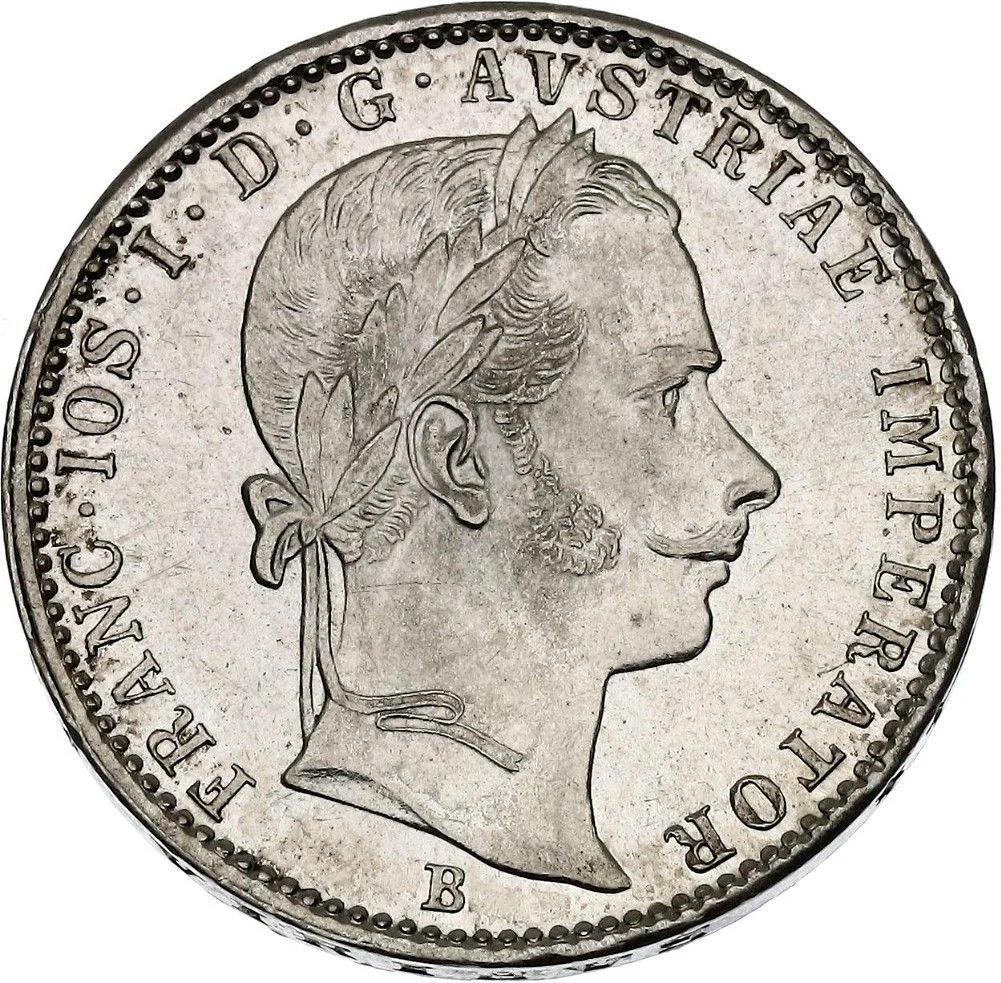
Obverse
Description:
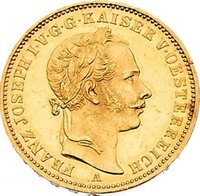
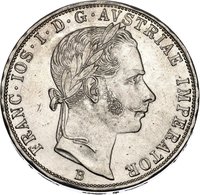
King Franz Joseph I, right-facing bust.
Inscription:
FRANC·IOS·I·D·G·AVSTRIAE IMPERATOR
B
B
Translation:
Francis I, by the Grace of God, Emperor of Austria
Script: Latin
Language: Latin
Engraver: Josef Daniel Böhm
Reverse
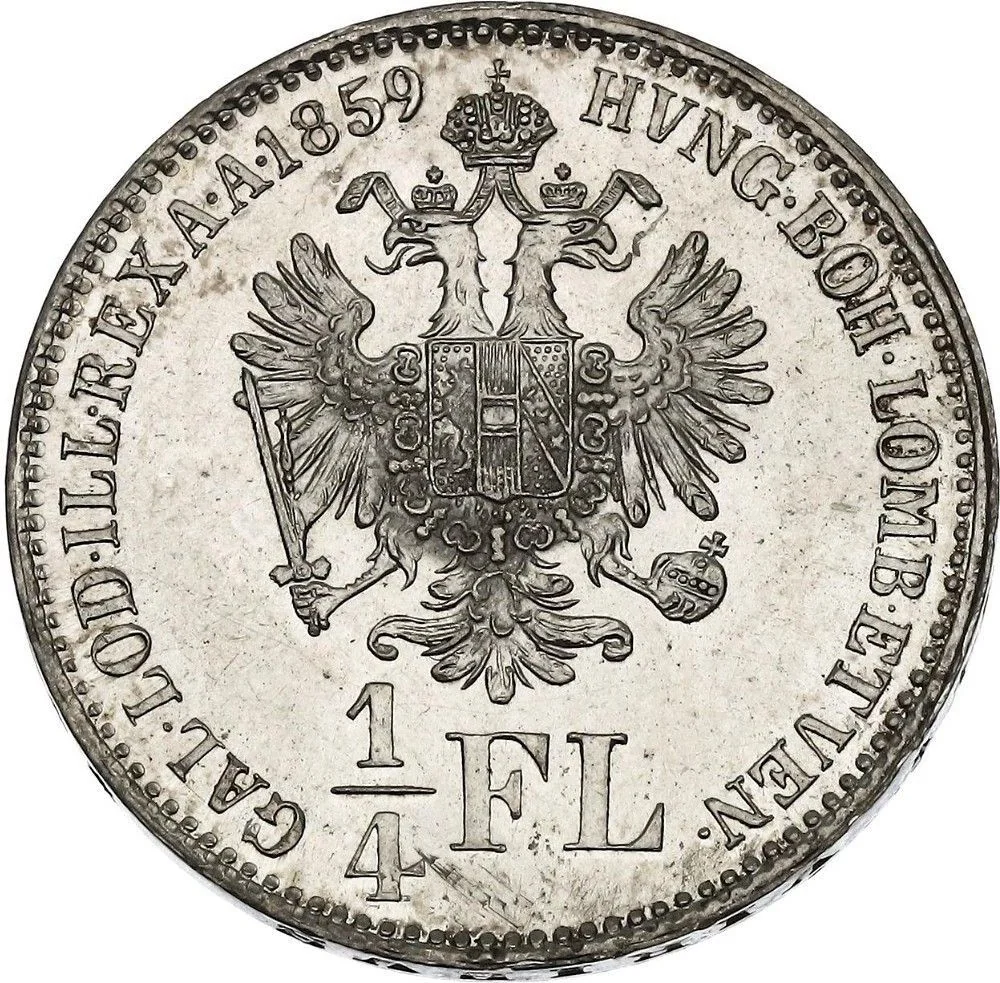
Description:
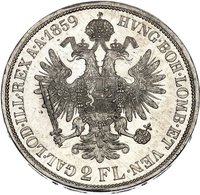
Austria-Hungary coat of arms above value.
Inscription:
HVNG· BOH· LOMB· ET VEN· 1/4 FL GAL· LOD· ILL· REX A· A· date
Translation:
Hungary, Bohemia, Lombardy and Venice; 1/4 Florin; Galicia, Lodomeria, Illyria, King A. A.
Script: Latin
Engraver: Franz Gaul
Edge
Inscripted text
Mints
| Name | Mark |
|---|---|
| Münze Österreich | A |
| Kremnica | B |
| Alba Iulia | E |
| Milan | M |
| Venice | V |
Mintings
| Year | Mint Mark | Mintage | Quality | Collection |
|---|---|---|---|---|
| 1859 | A | 27,415,267 | ||
| 1859 | E | 6,160,509 | ||
| 1859 | V | 8,895,460 | ||
| 1859 | B | 13,108,535 | ||
| 1859 | M | 2,271,626 | ||
| 1860 | A | 2,409,264 | ||
| 1860 | B | 21,247,424 | ||
| 1860 | E | 3,515,674 | ||
| 1860 | V | 7,135,020 | ||
| 1861 | V | 1,441,684 | ||
| 1861 | A | 5,296,904 | ||
| 1861 | B | 1,655,543 | ||
| 1861 | E | — | ||
| 1862 | A | 14,399,248 | ||
| 1862 | B | 2,796,437 | ||
| 1862 | E | 2,629,553 | ||
| 1862 | V | 3,456,492 | ||
| 1863 | A | 800,048 | ||
| 1863 | V | 2,485,108 | ||
| 1864 | A | 4,843,836 | ||
| 1864 | V | 164,584 | ||
| 1865 | A | 80,000 |
Historical background
In 1859, the Austrian Empire's currency system was a complex and fragile structure, still grappling with the aftermath of the 1848 Revolutions and the costly Crimean War neutrality. The official currency was the Conventionsthaler and the Gulden (or Florin), which was divided into 60 Kreuzer. However, the empire did not operate on a pure metallic standard. Since 1857, it had been part of the Vienna Monetary Treaty with most German states, which aimed to create a common silver-based currency area. This treaty established the Vereinsthaler as a common coin, but Austria's adherence was more theoretical than practical, as it struggled to maintain sufficient silver reserves.
The reality was a state of chronic fiscal distress and paper money inflation. To finance its military campaigns, particularly the ongoing Second Italian War of Independence against France and Piedmont-Sardinia in 1859, the Habsburg state heavily relied on printing paper money. The central bank, the Privilegierte Österreichische Nationalbank, was not independent and was compelled to provide large advances to the government. This led to a significant expansion of paper banknotes (Bankozettel) not fully backed by specie, causing their value to depreciate against silver and gold. A wide and fluctuating gap emerged between the face value of paper Gulden and their much lower value in metallic coinage.
Consequently, the empire suffered from a dual currency system and a severe loss of confidence. While obligations were nominally in silver Gulden, daily transactions were increasingly conducted in depreciated paper money, creating economic uncertainty and hampering trade. The costly war of 1859 exacerbated this crisis, draining the treasury and leading to a further increase in debt and money printing. This precarious financial situation set the stage for the impending state bankruptcy and sweeping monetary reforms that would follow Austria's military defeat later that year, culminating in the 1867 compromise and the eventual adoption of the gold standard.
The reality was a state of chronic fiscal distress and paper money inflation. To finance its military campaigns, particularly the ongoing Second Italian War of Independence against France and Piedmont-Sardinia in 1859, the Habsburg state heavily relied on printing paper money. The central bank, the Privilegierte Österreichische Nationalbank, was not independent and was compelled to provide large advances to the government. This led to a significant expansion of paper banknotes (Bankozettel) not fully backed by specie, causing their value to depreciate against silver and gold. A wide and fluctuating gap emerged between the face value of paper Gulden and their much lower value in metallic coinage.
Consequently, the empire suffered from a dual currency system and a severe loss of confidence. While obligations were nominally in silver Gulden, daily transactions were increasingly conducted in depreciated paper money, creating economic uncertainty and hampering trade. The costly war of 1859 exacerbated this crisis, draining the treasury and leading to a further increase in debt and money printing. This precarious financial situation set the stage for the impending state bankruptcy and sweeping monetary reforms that would follow Austria's military defeat later that year, culminating in the 1867 compromise and the eventual adoption of the gold standard.
🌱 Common